EN 1335 is the European norm for office chair ergonomics built for 8+ hour workdays. Class A/B/C requirements, durability tests and B2B ROI explained.
EN 1335 is the European technical standard that defines ergonomic, durability and safety requirements for office chairs designed for 8+ hours of daily use. It specifies minimum adjustment ranges for seat height, depth, lumbar support and backrest angle, plus fatigue and load tests the chair must pass. In practice: a chair without EN 1335 certification should not be deployed in offices where staff sits full-time.
What EN 1335 actually covers
EN 1335 is a three-part European norm issued by CEN. Part 1 defines dimensions, part 2 safety requirements, part 3 testing methods. It is not legally mandatory for every chair sold in the EU, but it has become the de facto standard for public tenders and corporate procurement. Labour inspectors investigating occupational injury claims will check whether workstations meet EN 1335 parameters anyway, regardless of formal status.
Three chair classes: A, B and C
Type A — chairs with full adjustment range, intended for 8+ hours daily use. Type B — reduced adjustment, suitable for 4-8 hours. Type C — basic adjustment for up to 4 hours or meeting rooms. Most offices need type A at primary desks and type C in conference areas. Buying type A „for everyone” inflates the budget by 30-40%; buying type C „for everyone” generates orthopaedic sick leave within 12-18 months.
Mandatory adjustments under EN 1335
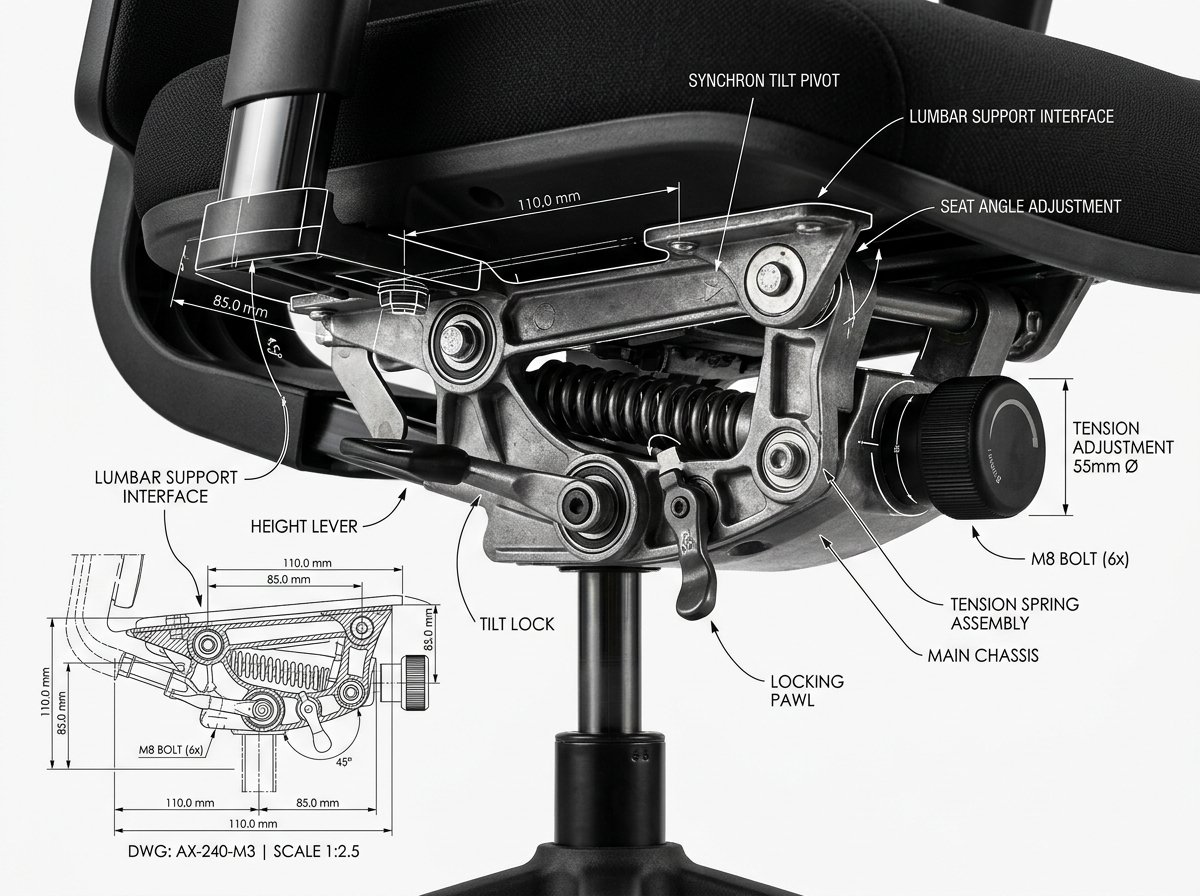
Seat height: minimum 120 mm range, usually 400-520 mm from the floor. Seat depth: minimum 50 mm adjustment to support the thigh without pressure behind the knee. Backrest angle: 90° to at least 110° with lockable positions or a synchronous mechanism. Lumbar support: better type A models add 3D adjustment (height, depth, pressure) — critical for protecting L1-L5 vertebrae during full-day sitting.
Durability requirements — fatigue and load tests
EN 1335-3 defines mechanical tests the chair must pass. Seat load: 1 600 N applied across 100 000 cycles. Backrest load: 560 N across 200 000 cycles. Stability: the chair cannot tip under 600 N lateral load. Height mechanism: 100 000 full cycles of the gas cylinder. A certified type A chair should run 8-10 years of daily use without failure. Uncertified marketplace alternatives typically last 18-30 months before the mechanism or gas cylinder fails.
EN 1335 chair vs uncertified „ergo” alternative
| Parameter | EN 1335 Type A | Marketplace „ergo” (no cert) |
|---|---|---|
| Height adjustment range | min. 120 mm | often 80-100 mm |
| Seat depth adjustment | mandatory (min. 50 mm) | usually missing |
| 3D lumbar adjustment | in better type A models | absent or cosmetic |
| Mechanism test cycles | 100 000+ documented | not declared |
| Average lifespan | 8-10 years | 18-30 months |
| Gas cylinder class | min. class 4 (DIN 4550) | often class 2-3 |
| 5-year total cost | flat one-off | flat + replacements + lost work |
ROI in numbers for the CFO
According to office-market research, lower back and neck pain account for an average 4.2 sick days per office worker per year. At a typical Warsaw corporate salary that translates to roughly 1 600 PLN of lost productivity per person annually — before counting the sick-leave payout itself. Companies that move to full EN 1335 compliance on primary workstations report a 50-67% drop in back-related absenteeism over 24 months. For a 50-person office that is 40-55k PLN saved per year against a one-off 100-150k PLN investment — ROI in 2-3 years.
Case study: fintech R&D office in Mokotów
A Warsaw fintech with 32 R&D engineers contacted us in spring 2025. Their previous supplier had delivered chairs marketed as „ergonomic” but without EN 1335 certification. After 14 months six engineers were on orthopaedic sick leave in a single quarter. Audit findings: gas cylinders class 2 (losing pressure within 8 months), no seat depth adjustment, no lumbar adjustment, backrests too low for staff above 180 cm. We replaced 32 primary stations with type A chairs (full 3D adjustment, class 4 cylinder, 4D armrests) plus 12 type C chairs for meeting rooms. Project budget: 168k PLN net, delivery and installation across 18 working days. After 6 months the client reported a 71% drop in declared back pain and orthopaedic sick days more than halved. The engagement closed with a service contract covering a 5-year warranty on custom furniture and 3-year warranty on chairs.
Frequently asked questions
Is EN 1335 legally mandatory in Poland? No, but it is the de facto standard for public tenders and corporate procurement, and labour inspectors check it during occupational health disputes. Any serious office procurement specification today references EN 1335.
How do I verify a real EN 1335 certificate? The manufacturer must provide a declaration of conformity referencing PN-EN 1335-2 and a lab test report. If the seller only uses the word „ergonomic” without a norm reference, the certificate likely does not exist. Also check the gas cylinder class — DIN 4550 class 4 is the standard for EN 1335 type A.
Do you supply custom-made office chairs? Grandis Trade builds custom furniture — desks, storage, reception counters, acoustic walls. Office chairs come from certified European producers, selected and specified to match team anthropometry and office aesthetic — see our commercial portfolio.
What warranty do you offer on B2B office chairs? Up to 5 years on a service contract. The gas cylinder is the part most frequently replaced — we always specify class 4 from the top tier to keep the failure rate down.
Article last updated: May 20, 2026