Social selling, case studies and PDF carousels — how to build a LinkedIn presence that reaches architects, buyers and developers and wins B2B furniture contracts.
In Poland LinkedIn has become the core social-selling tool in B2B furniture. According to market research, around 81% of purchasing managers check a supplier's profile and content before the first contact, so a well-run company profile is the shortest path to architecture studios, developers and the procurement departments of large firms. The keys are technical case studies, expert voices and a content format suited to 2026.
LinkedIn as a network for high-value contracts
In B2B procurement, decisions rest on trust and competence rather than spontaneous impulse. LinkedIn is where that trust is built before the first conversation happens. Market research shows that the vast majority of purchasing managers verify a supplier online, analysing their profile and published content.
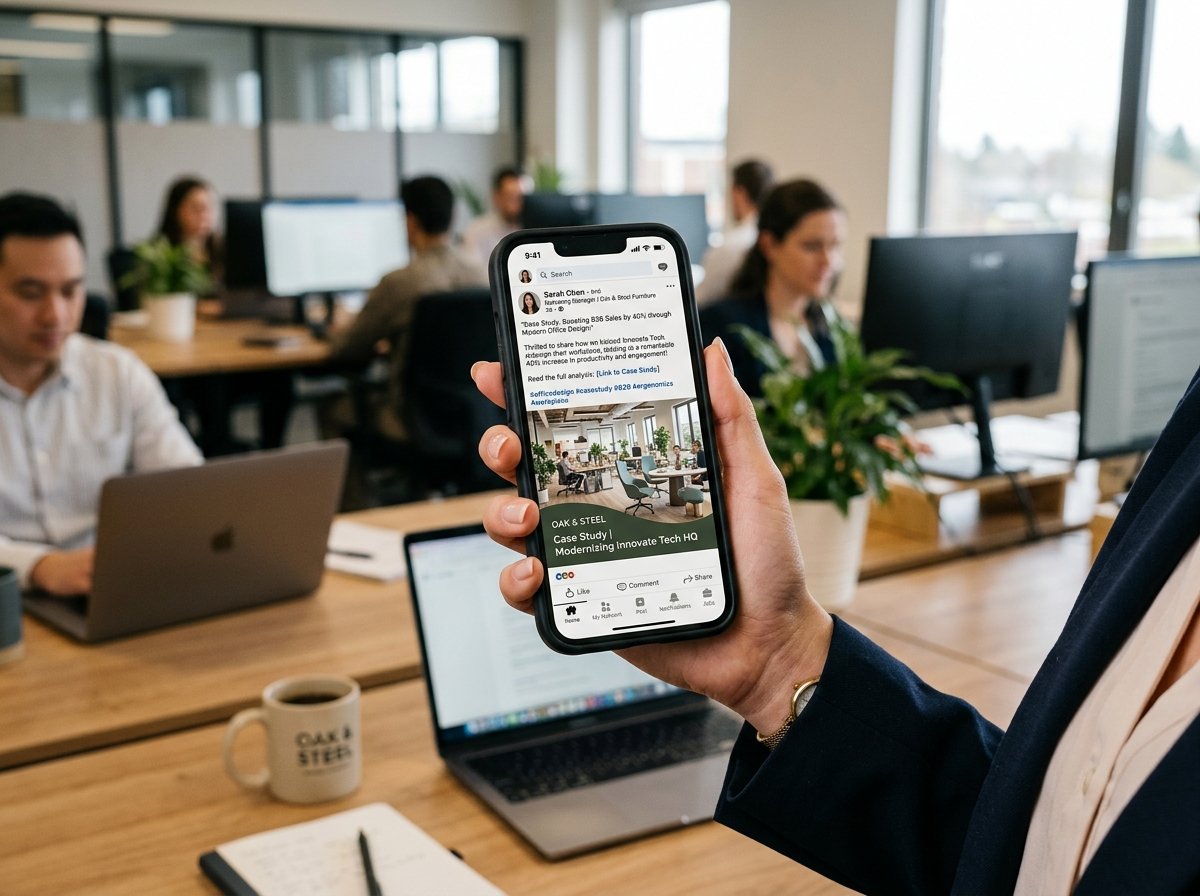
For a contract furniture manufacturer this means the LinkedIn profile acts as a business card and portfolio at once. It is often the first point of contact with an architect designing an office, a developer fitting out an investment or a director responsible for procurement. Absence or a neglected profile means lost contracts before an enquiry even appears.
LinkedIn's strength in furniture lies in precise reach to decision-makers. Instead of broad, untargeted marketing, the company communicates directly with the people who actually award large contracts: architects, interior designers, buyers and facility managers.
What to publish on a company profile
Content decides whether a profile builds trust or remains an empty card. Instead of advertising slogans, it is better to publish material that shows competence and real projects. The list below shows the formats that work best in furniture B2B.
- Technical case studies: instead of slogans, concrete breakdowns, such as how an acoustic problem was solved in a 200-desk office.
- Expert voice (Employee Advocacy): a technologist's comments on the raw-material market. Employees' personal brand can increase trust in the company several times over.
- Production capacity: video of a large shipment or CNC calibration that proves the ability to deliver big orders.
Such content answers decision-makers' real questions: does this supplier understand my problem, do they have the competence, and can they handle the scale. See our commercial projects for what a well-documented case study looks like.
Technical case studies that persuade
The most effective B2B content is concrete stories of solved problems. A case study describing the challenge, the solution applied and the result works far more strongly than general claims of quality. It shows how the company thinks and its ability to handle real project requirements.
A good furniture case study includes the object's context, the constraints faced and a measurable outcome. It does not require disclosing confidential client data — the project can be described anonymously while keeping its substantive value. It is precisely this kind of content that holds the attention of an architect or buyer browsing the profile.
Employee Advocacy: people build trust
Employees' personal brand is one of the strongest trust-building tools on LinkedIn. Comments from a technologist, designer or production manager are perceived as more credible than official company messages. Market observation suggests that employee involvement in communication can multiply trust in the company.
Employee Advocacy is not about artificial promotion but about sharing real knowledge and experience. When a company expert comments on the raw-material market or explains technological nuances, they build an expert position both for themselves and for their employer. This is an authenticity that advertising cannot fake.
Content format 2026: PDF carousels
Format matters no less than content. According to LinkedIn benchmark data, PDF carousels with useful checklists deliver around 15% higher reach and deeper reading than ordinary single-image posts. It is a format that favours conveying concrete, practical knowledge.
A carousel lets you break a topic into successive slides, guiding the reader step by step. In furniture it works well for presenting processes, material comparisons or buyer guides. A well-designed carousel combines substantive value with a readable form, which translates into greater audience engagement.
Comparing LinkedIn content formats
The table compares popular content formats by their effectiveness in furniture B2B.
| Format | Reach | Best use |
|---|---|---|
| Single-image post | baseline | quick updates |
| PDF carousel | about 15% higher | guides, checklists |
| Production video | high | proof of capacity |
| Text case study | high when valuable | building competence |
How to reach architects and developers
Reaching decision-makers requires not only good content but also deliberate network-building. It is worth following and engaging in the discussions of architects, interior designers and developers, offering substantive value rather than pushy sales. The relationship precedes the contract.
- Publish substantive content regularly, not just advertising.
- Build a network among architects, buyers and developers.
- Involve expert employees in communication.
- Document projects as anonymous case studies.
- Use PDF carousels for guides and comparisons.
- Reply to comments and hold a dialogue, not a monologue.
If you are looking for a production partner for a commercial project, fill in the B2B brief — we will show how we deliver similar work.
Common mistakes in B2B communication
The most common mistake is treating LinkedIn like an advertising board. Profiles flooded only with offers and sales slogans build no trust, because they do not answer decision-makers' real questions. A lack of substantive value means the content is ignored.
The second mistake is irregularity and no strategy. Occasional posts without a coherent message do not build an expert position. The third is overlooking employees as brand ambassadors, even though it is people, not logos, who build trust in B2B relations. Avoiding these mistakes is what separates a profile that generates contracts from an empty card.
Case study: a Warsaw contract manufacturer
A Warsaw contract furniture manufacturer wanted to reach architecture studios and developers without relying solely on referrals. Its earlier LinkedIn presence was limited to occasional advertising posts that built neither engagement nor trust.
After shifting strategy to publishing technical case studies, involving a technologist as an expert and using PDF carousels with guides, the profile began to attract the attention of the design community. The company observed a rise in valuable contacts and enquiries from decision-makers. The key was moving from advertising to substantive communication that builds an expert position.
B2B LinkedIn trends 2026
In 2026, B2B communication on LinkedIn is dominated by several directions. The first is the growing role of authenticity and employees' personal brand at the expense of impersonal company messages. The second is the advantage of substantive, educational content over purely promotional posts.
The third is the dominance of engaging formats such as carousels and video that favour conveying concrete knowledge. For furniture this means the firms that win are those that share competence and document real projects, not those that advertise most loudly. Social selling is becoming a standard rather than an experiment.
Frequently asked questions
Why does LinkedIn matter in furniture B2B?
According to market research, around 81% of purchasing managers check a supplier's profile before the first contact. A well-run profile is the shortest path to architects, developers and procurement departments.
What content is best to publish?
Technical case studies, company experts' voices and material showing production capacity. Substantive content builds trust more effectively than advertising slogans.
What is Employee Advocacy?
It is the involvement of expert employees in company communication. Comments from a technologist or designer are seen as more credible and, by market observation, can multiply trust in the company.
Do PDF carousels really get more reach?
According to LinkedIn benchmark data, carousels with useful checklists deliver around 15% higher reach and deeper reading than single-image posts.
How do you reach architects and developers?
Through regular substantive content, deliberate network-building in the design community, and engaging in discussions with value rather than pushy sales.
What is the most common B2B mistake on LinkedIn?
Treating the profile like an advertising board. Content flooded only with offers builds no trust, because it does not answer decision-makers' real questions.
Article last updated: 20 May 2026.