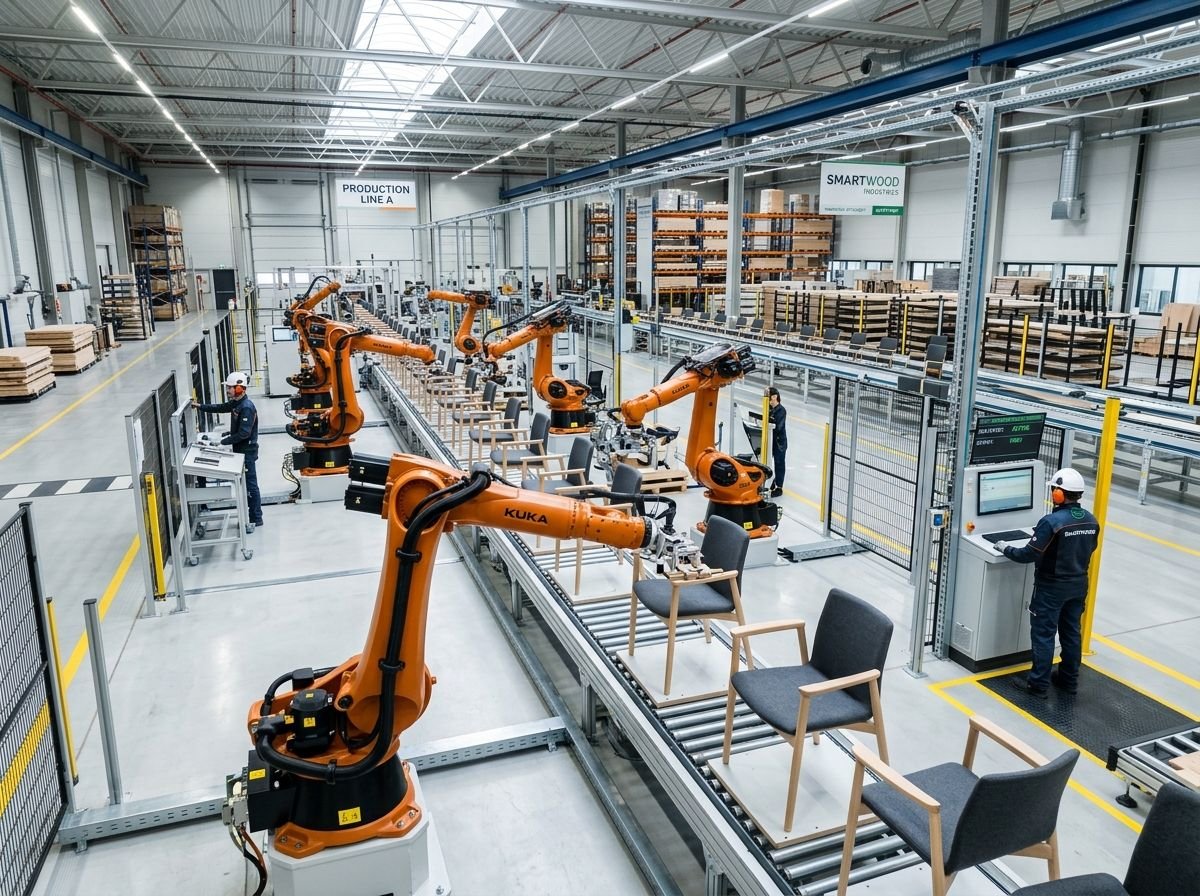
Labour shortages and rising costs are reshaping furniture production economics. How to calculate the return on workshop automation and what it means for quality and lead times.
The ROI of furniture production automation is a calculation with the cost of machines and implementation on one side, and labour savings, fewer errors and greater schedule predictability on the other. Amid rising labour costs and a shortage of skilled staff in Poland, automation is becoming a tool of survival and competitiveness rather than a luxury. The key is to calculate the return in concrete numbers, not to decide by intuition.
Labour shortage as the starting point
The Polish furniture industry faces a persistent shortage of skilled workers. Experienced joiners and operators retire faster than new ones arrive, and labour cost keeps rising. In this context automation stops being a technology fashion and becomes an answer to a real limit on production capacity. Robots and CNC machines do not replace craft; they take over repetitive, demanding operations.
What makes up automation ROI
Return on automation is not only wage savings. A full calculation covers several components that must be valued together for the assessment to be honest. On the cost side: machine purchase, implementation, operator training and maintenance. On the benefit side: lower labour cost per unit, fewer errors and material waste, more repeatable quality, and shorter, more predictable lead times.
Fewer errors, less waste
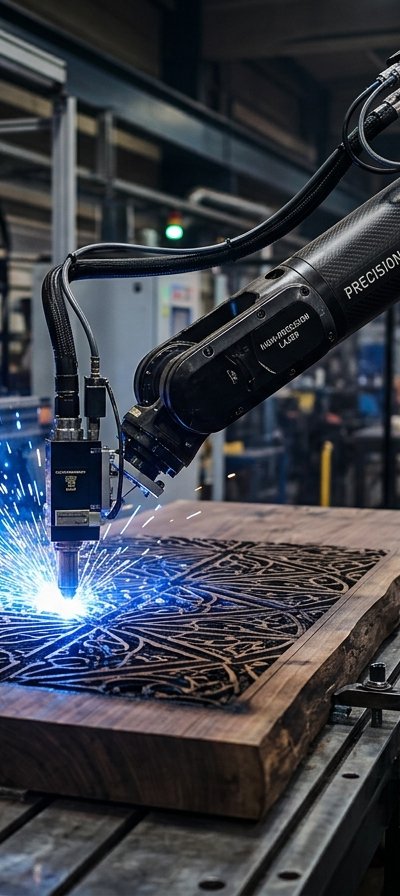
One of the most underestimated parts of ROI is the reduction of errors and material waste. CNC machines cut and drill with an accuracy hard to match by hand, reducing rework, complaints and wasted boards. In custom furniture, where every element differs, this precision translates into real savings, while less waste is both an environmental and a cost argument.
Schedule predictability
Automation increases production predictability, which means on-time delivery for the client and stable planning for the workshop. Machines work to a repeatable rhythm regardless of whether a particular worker is available on a given day, reducing the risk of delays from staffing bottlenecks. For a custom manufacturer, on-time delivery is part of reputation and competitive advantage.
Manual vs automated production
The table compares key parameters of mainly manual production with automation-supported production.
| Parameter | Manual production | Automated production |
|---|---|---|
| Dependence on staff availability | high | limited |
| Quality repeatability | variable | high |
| Material waste | higher | lower |
| Lead-time predictability | variable | high |
What automation cannot replace
An honest discussion requires limits. Machines excel at repeatable precision but do not replace experience in design, judging material quality or solving unusual problems. The best results come from combining automation with craft: machines take repetitive operations, and people focus on design, quality control and finishing. This strengthens craft rather than eliminating it.
Case study: a Wola workshop
A custom furniture maker in Wola faced rising labour costs and difficulty filling operational roles, limiting the number of orders it could accept. After deploying machines for repetitive cutting and drilling, it moved skilled staff to design and finishing tasks. The owner observed reduced material waste and rework and more predictable lead times; over time these effects covered the investment cost and increased order capacity.
How to calculate the return step by step
A reliable ROI assessment needs a structured approach. The list below shows the elements worth including so the result reflects the workshop's reality, not just the price of a machine.
- Full investment cost: machine, implementation, training, maintenance.
- Labour cost saving per unit of product.
- Reduction of material waste and rework cost.
- The value of shorter, more reliable lead times.
- Increased capacity to accept orders.
- The period in which the sum of benefits covers the investment.
Automation and custom-furniture quality
A common fear is that automation means standardisation and the loss of the individual character of custom furniture. In practice the opposite is true: precise machines enable more complex, individual projects with repeatable accuracy hard to achieve by hand alone. Every element can differ yet be made with the same precision, so custom production gains from automation rather than losing. The client gets a project tailored to their needs, made exactly to documentation, on a predictable schedule.
Integrating design with production
Automation delivers the greatest benefits when design and production are integrated. Digital documentation prepared at the design stage can go straight to the machines, eliminating manual re-keying errors and speeding the path from concept to finished element. This shortens the whole order cycle and leaves fewer places where an error can arise. In custom furniture, where every element is individual, this data coherence is especially valuable and directly affects final quality.
Automation and a stable price for the client
Production predictability also translates into cost predictability, which enables stable quotes for the client. When the process is repeatable and waste and rework are limited, a manufacturer can offer prices fixed in the contract without the risk of unexpected surcharges from errors or wasted material. For a B2B client this means a budget they can rely on, and for the manufacturer, credibility and less risk of disputes. A stable, fixed price is possible precisely because of the control over the process that automation provides.
Furniture production trends 2026
In 2026 furniture production shows several clear directions. The first is further automation of repetitive operations in response to staff shortages and rising labour costs. The second is the integration of design with production, where digital documentation goes directly to machines, reducing re-keying errors. The third is thinking in terms of sustainable production: better material use, less waste and longer product life. Automation supports all these directions, making production more efficient, accurate and responsible at once.
Frequently asked questions
Does automation mean layoffs?
Not necessarily. Amid staff shortages, automation often takes over roles that are hard to fill anyway, letting skilled workers move to design and finishing where experience matters.
How long until automation pays off?
It depends on production scale, machine cost and savings. The payback period is the investment cost divided by the annual sum of benefits: labour savings, waste reduction and the value of more reliable deadlines.
Does automation lower custom-furniture quality?
On the contrary. Precise machines enable complex, individual projects with repeatable accuracy hard to achieve by hand, while keeping design flexibility.
Will automation replace craft?
No. The best results combine machines with craft: technology handles repetition while people design, control quality and finish.
Article last updated: 20 May 2026.