How to design a hybrid office in 2026: zones, sit-to-stand ergonomics, costs and pitfalls — based on 300+ commercial fit-outs by Grandis Trade in Warsaw.
Hybrid work has become a permanent feature of the Polish office market — not a temporary pandemic response, but a new operating model that requires a different kind of office. To do its job in 2026, the workplace needs modular, ergonomic furniture with home-like aesthetics. Below we show how to design an office for the 2–3 days-a-week model, which zones matter, what budget to expect and which mistakes to avoid — drawing on Grandis Trade's experience of 300+ commercial fit-outs in Warsaw.
Hybrid work in Poland 2026 — what the data shows
According to the JLL Polish office market report from 2024, more than 70% of Polish professional-services firms have adopted hybrid as their permanent model. The standard is 2–3 days in the office per week, most often Tuesday, Wednesday and Thursday. Average desk density has fallen from 8 m² to 6 m² per worker, while the number of meeting rooms, acoustic pods and focus seats has risen sharply.
The home office furniture segment in Poland grows roughly 5.75% per year, approaching 2 billion PLN in annual turnover according to industry estimates. Companies increasingly fund employees' home setups, treating it as a benefit and a health-and-safety measure. Office redesigns for hybrid models cost, in our experience, 15–25% less than a classic open-space densification.
Hybrid office vs classic open-space
A classic open-space assumed every employee owned a desk. A hybrid office inverts this logic: employees come in for an experience the home cannot provide — workshops, client meetings, creative sessions or simply human contact. Furniture must support these scenarios, not single fixed seats.
In practice this means fewer desks, more types of seating. Zones emerge: focus (single booths and shielded desks), collaboration (modular tables, movable flipcharts), formal meetings (rooms with reservation systems) and lounge (sofas, boucle armchairs, low tables). Each requires different furniture and different acoustics. A rigid set of 50 identical desks in 2026 means a building empty for more than 60% of the week.
Focus zone — single-person work
The hardest zone to design is the focus area. An employee arriving once every three days expects concentration conditions at least as good as at home. Acoustic pods and single booths have become a non-negotiable element. Sound-absorbing materials — felt panels, boucle upholstery — are key. Desks here should be full-size (140 × 80 cm minimum), height-adjustable and with side or front shields. In our projects we use sit-to-stand desks compliant with EN 527-2, laminated boards class U2/E1 from European premium board manufacturers, and cables routed inside the legs.
Collaboration zone — modular tables and hot-desking
The collaboration zone is the heart of a hybrid office. This is where workshops, distributed-team meetings and brainstorming happen. Furniture must be light, mobile and easy to reconfigure. Modular tables 120 × 60 cm work best — they combine into any layout, from a 12-person long table to six pair stations. Chairs here follow a different logic than in the focus zone: they need not be 8-hour ergonomic, but must accept varied postures and roll easily. See examples in our B2B portfolio.
Lounge zone and sit-to-stand ergonomics
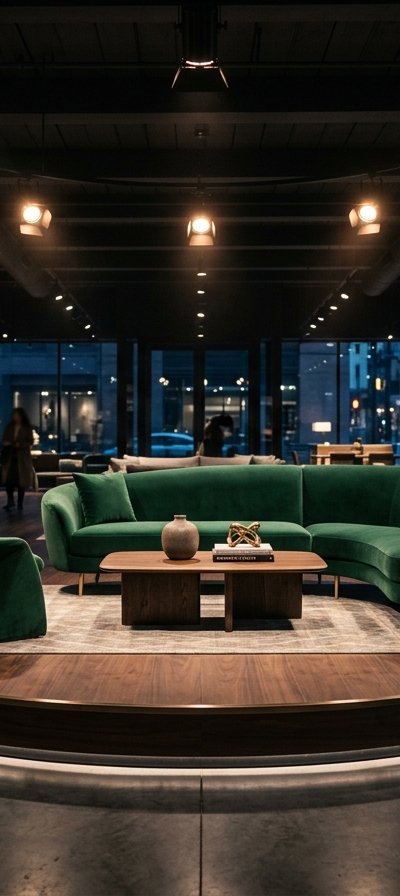
The most visible change in recent years is the move away from corporate aesthetics toward interiors that feel like a good apartment: modular sofas in soft fabrics, boucle armchairs, natural oak and ash, warm greys and earth tones. An employee who comes in once every three days expects the office to be better than home — or at least no worse.
Electric height-adjustable desks are no longer a premium perk. According to industry estimates their unit cost has dropped about 35% in Poland over the past five years. In our B2B projects sit-to-stand has been the default for all desks since 2024, alongside soft-close mechanisms, CARB Phase 2 boards and USB-C ports built into the surface.
Classic vs hybrid office — comparison
The table below compares typical 200 m² projects for a 30-person company in classic and hybrid models:
| Parameter | Classic office 2019 | Hybrid office 2026 |
|---|---|---|
| Desks | 30 fixed | 18 hot + 4 sit-to-stand |
| Meeting rooms | 2 rooms for 8 | 5 pods + 2 rooms + 1 focus room |
| Lounge area | ~8 m² (kitchen) | ~40 m² (sofas, library) |
| Acoustics | none | panels, rugs, pods |
| Aesthetics | white desks, plastic | wood, boucle, linen |
| Furniture cost (200 m²) | 180–220k PLN | 240–320k PLN |
| Space utilisation | 40–60% | 75–90% |
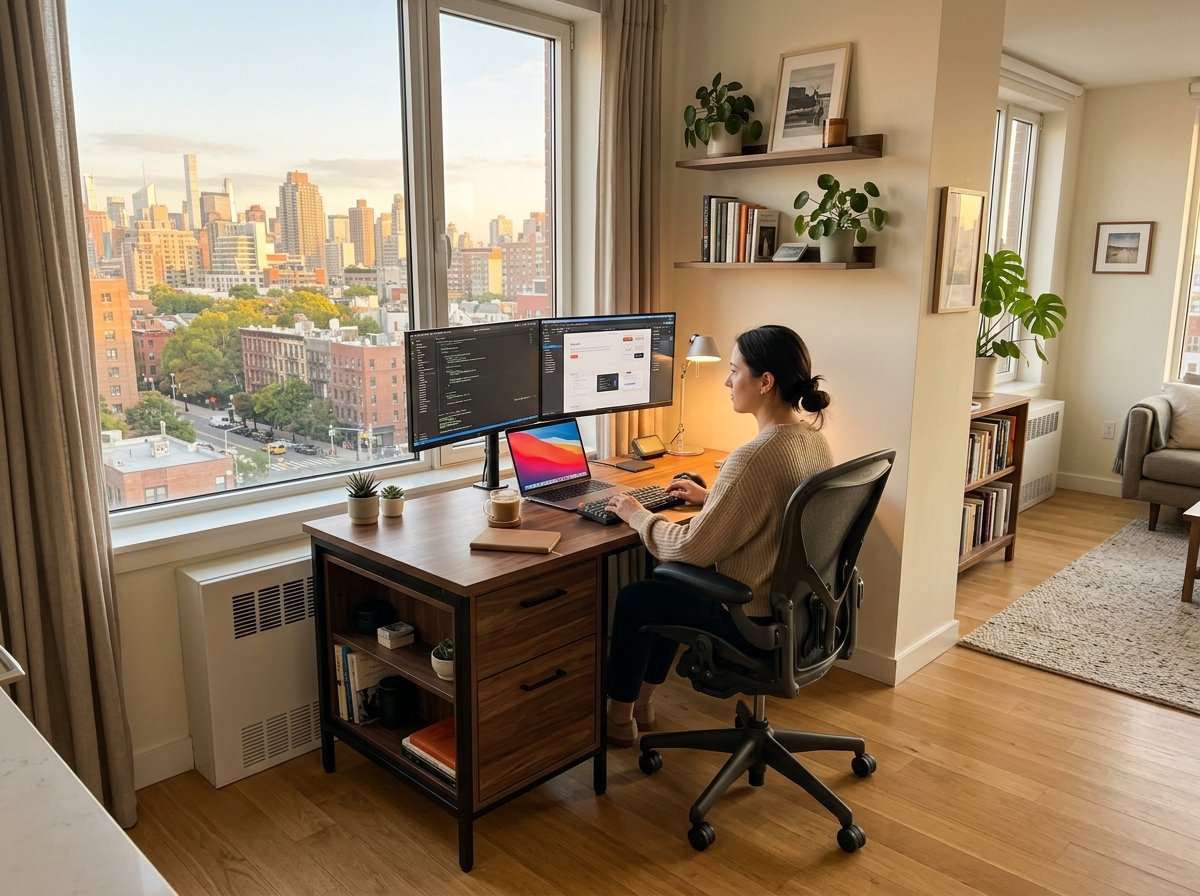
The key takeaway: hybrid offices are more expensive per m² but cheaper per employee, since 30–40% more people use the same floor in rotation. Home-office packages for employees (sit-to-stand desk, ergonomic chair, lighting) typically run 4 500–7 500 PLN net per worker and, in our B2B experience with IT, finance and consulting clients, lift remote-team productivity by 15–20%. Explore our B2B offering or fill in the project brief.
Case study: IT office on Mokotów, 240 m²
In late 2024 we delivered a project for an R&D team on Mokotów. The brief: convert a classic 30-desk open-space into a hybrid layout with 2 days in the office, budget under 280k PLN net, six-week timeline. The client wanted apartment-style aesthetics, not corporate. The solution included 18 hot desks (six sit-to-stand), four single acoustic pods, two modular meeting rooms, a 38 m² lounge with boucle sofas and a library, plus a kitchen with an oak ten-seat table. After nine months: office utilisation rose from 42% to 78%, cross-team conversations grew 60%, employee turnover dropped 23%. Total cost 264k PLN net, installed in three weeks, five-year warranty, fixed price written into the contract.
FAQ
How much does a 200 m² hybrid office cost?
In our practice, a complete furniture fit-out for a 200 m² hybrid office serving 30 employees runs 240–320k PLN net. The figure covers sit-to-stand desks, acoustic pods, meeting rooms, lounge and kitchen. Per-employee cost typically falls compared with a classic open-space thanks to rotation.
How long does the project take?
A typical 200–300 m² project at Grandis Trade runs six to eight weeks: one week of 3D design, three weeks of production in our 3 000 m² Warsaw workshop, one to two weeks of installation. Free on-site measurement happens within 48 hours of your enquiry.
Are sit-to-stand desks mandatory under Polish OHS law?
Formally no, but the 2023 Ministry of Labour regulation on screen work strongly recommends „the option to change posture”. Labour inspectors increasingly flag fixed-height desks as a shortcoming. For offices designed for 5+ years, sit-to-stand is a future-proofing choice rather than a luxury.
Can employers fund home-office setups as a benefit?
Yes — Polish companies increasingly offer a 4 500–7 500 PLN package per employee covering desk, chair, lighting and accessories. Grandis Trade delivers such packages at company scale with a single aesthetic standard and central logistics. See our B2B services.
Next steps
If you are planning a hybrid office in Warsaw — Mokotów, Wola, Wilanów, Ursynów, Praga, Białołęka, Bemowo or Żoliborz — start with free measurement and a 3D design. Submit your project brief and our specialist will get back to you promptly to schedule the measurement. All commercial projects come with a fixed price written into the contract — no annexes, no hidden costs.
Article last updated: 20 May 2026