Adjustable desks, modular beds and safe E1-class finishes — how furniture that grows with the child lets you invest in an interior once a decade.
Growth furniture is a category of solutions that adapt to a child's development, so one set serves for many years instead of being replaced every few seasons. Adjustable desks support correct posture, modular beds extend the sleeping space, and safe E1-class finishes with rounded edges protect the youngest. This approach lets you invest in an interior roughly once a decade.
Why growth furniture is a 2026 trend
Children grow fast, and traditional children's furniture quickly stops fitting their height and needs. Growth furniture answers this with adjustability and modularity that let one set accompany a child for years. It is at once an economical solution and one in keeping with sustainable consumption.
In 2026 parents increasingly think about a child's room as a long-term investment rather than a one-off purchase. Instead of replacing furniture every few years, they choose solutions that evolve with the child, adapting to successive stages of development.
From a custom-furniture perspective this means designing for change. A preschooler's room and a teenager's room differ in function, but a well-designed base can serve both stages with minimal modification, genuinely lowering cost over a decade.
Adjustable desks and correct posture
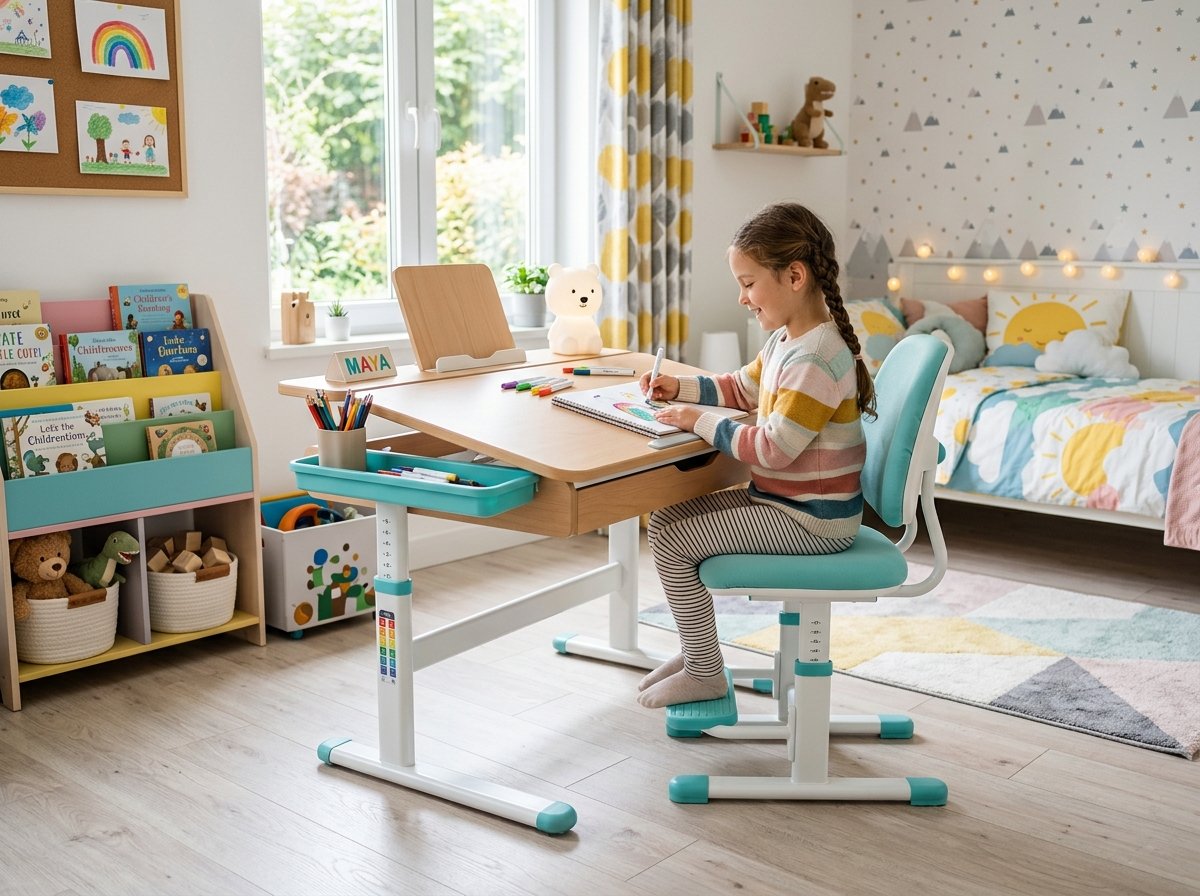
Adjustable desks are the foundation of growth furniture. Being able to match the worktop height to the child's height supports correct posture during study and reduces strain on the spine. This matters especially at school age, when the child spends more and more time at the desk.
A desk that grows with the child removes the need to replace furniture at every growth spurt. Adjustment keeps an ergonomic position from the first school years into the teenage period. Together with a matching chair it forms a workstation that supports healthy posture throughout education.
Modular beds that expand
Modular beds let the sleeping space expand as the child grows. A small child's bed can later be enlarged or transformed into a full-size bed for a teenager, without buying an entirely new piece.
This modularity is not only a saving but also continuity — the child keeps a familiar environment that simply adapts to their needs. In custom furniture we design these solutions so that expansion is simple and aesthetically coherent, rather than looking like an improvised alteration.
Safety: edges and E1-class lacquer
Safety is a priority in children's furniture. Rounded edges reduce the risk of injury during play, and E1-class lacquer and boards mean low formaldehyde emission, which matters for the health of a child spending many hours in the room each day.
We use E1-class boards and finishes safe for the youngest, choosing materials for both durability and health. Stable construction, anti-tip protection and the absence of sharp corners are elements that should be standard, not an option, in a child's room.
Growth furniture vs traditional
The table compares furniture that grows with the child against traditional solutions replaced every few years.
| Feature | Traditional furniture | Growth furniture |
|---|---|---|
| Replacement cycle | every few years | once per ~10 years |
| Adaptation to height | none | adjustment and modules |
| Posture support | limited | ergonomic |
| Cost over a decade | higher | lower |
What to look for when choosing
Choosing growth furniture requires looking ahead — not only at the child's current needs but also at those that will appear in a few years. The list below shows elements worth checking before deciding.
- Adjustment range of desk and chair for successive growth stages.
- Ability to expand the bed without replacing the whole structure.
- E1-class boards and lacquer and the absence of sharp edges.
- Stability and anti-tip protection.
- Durability of fittings under intense, child-level use.
- Flexibility of function: from preschool to teenage room.
If you are planning a child's room, see our home projects and fill in a short form — we will design furniture that grows with your child.
Economics: investing once a decade
Growth furniture is an investment that pays off over time. A higher initial price spreads across years of use, whereas traditional children's furniture has to be replaced at successive development stages. Over a decade, one well-chosen set usually proves cheaper than several successive purchases.
It also means less organisational hassle: no need to plan room renovations every few years and buy new furniture. The parent invests once and the solution adapts to the child. This approach fits the logic of conscious, sustainable consumption that reduces the volume of discarded furniture.
Case study: a child's room in Bemowo
Parents in Bemowo were planning a room for a child starting school. They wanted a solution that would serve for many years, supporting development and posture while staying safe and durable despite intense use.
We designed an adjustable desk, a modular bed with expansion capability and cabinetry from E1-class boards with rounded edges. According to the parents, the room works well with the child's changing needs, and the desk adjustment keeps an ergonomic study station without replacing the piece. The coherent design combines safety with interior aesthetics.
Children's furniture trends 2026
In 2026 children's furniture is moving towards long-lasting, safe solutions. Parents value modularity and adjustability that extend a piece's life cycle, and E1-class materials that protect the child's health. Aesthetics coherent with the rest of the home also play a growing role.
A second clear trend is designing a room that evolves with the child rather than being refitted from scratch every few years. Growth furniture combines these expectations, offering an economical, healthy and sustainable solution that accompanies the child from the first school years into the teenage period.
Frequently asked questions
What is growth furniture?
It is a category of solutions that adapt to a child's development through adjustment and modularity. One set serves for many years instead of being replaced every few seasons, making it an investment roughly once a decade.
Does an adjustable desk really support posture?
Yes. Matching the worktop height to the child's height keeps an ergonomic position during study and reduces strain on the spine, which is especially important at school age.
What does E1 class mean?
E1 class means low formaldehyde emission from boards and finishes, which matters for the health of a child spending many hours in the room each day. It is a basic safety standard for children's furniture.
Is growth furniture more expensive?
The initial price can be higher, but over a decade one set is usually cheaper than several successive purchases of traditional furniture replaced at each development stage.
How long will such furniture last?
Well-chosen growth furniture can accompany a child from the first school years into the teenage period — roughly about 10 years — thanks to adjustment and modular expansion.
Can it match the interior style?
Yes. In custom furniture we design solutions coherent with the rest of the home, combining safety and functionality with aesthetics matched to the interior and the family's preferences.
Article last updated: 20 May 2026.