Eclectic style is the deliberate mixing of eras, materials and colours around one guiding idea. See how to build a coherent space with bespoke custom furniture.
Eclectic style is the deliberate combination of eras, materials and forms around one guiding idea, thanks to which variety turns into a coherent, personal whole.
What is eclectic style
Eclecticism is often confused with a random collection of objects, but in reality it is one of the most demanding approaches to interior design. Its essence is not the absence of rules, but their conscious crossing. An eclectic designer knows the rules of the styles being combined, and precisely for that reason can arrange them so that the whole looks planned rather than accidental. This is a style for people who do not want to lock themselves into a single era or a single palette, yet at the same time value order and the logic of space.
Historically, eclecticism always appeared where different cultures and periods met. In nineteenth century architecture it meant deliberately drawing on Gothic, Renaissance and Baroque within a single building. In a contemporary interior the principle is similar: we take elements that on their own belong to different worlds and arrange them according to one overarching idea. That idea can be a recurring colour, a single dominant material, or a consistently maintained scale and proportion of the furniture.
In practice, eclectic style has several variants. Elegant eclecticism combines classical forms with modern detail and deep, saturated colours. Vintage eclecticism relies on reclaimed furniture and objects with a history, set against a contemporary base. Artistic eclecticism favours strong contrasts of texture and colour, treating the interior like a gallery. All these variants share one principle: coherence despite variety.
The most important thing to understand at the outset is that eclecticism is not a lack of decisions, but an abundance of them held within a frame. Every element must have a reason for being where it is. Only then does the mixture of old and new, matte and glossy, warm and cool begin to work in favour of the whole.
Key features of eclectic style
We recognise eclecticism not by a single distinguishing mark, but by the way different elements have been brought together. Below are the most important features that decide whether an interior is a successful mixture or a chaotic collection.
- Deliberate mixing of eras. A modern kitchen body can sit beside a vintage armchair, and classic mouldings beside a minimalist countertop. The key is intent, not accident.
- Mix of materials. Wood, lacquer in a deep colour, brass and patterned tiles meet in one room, but in considered proportions.
- One guiding idea. A recurring colour or material binds the whole together and explains why seemingly different elements belong together.
- Personalisation. The interior tells a story about its owner: their travels, collections, preferences. It is a strongly individual style, hard to copy.
- Controlled contrast. Eclecticism lives on contrast, but contrast in measured doses, where at least one parameter - scale, colour or texture - remains shared.
- Layering. Space is built in layers: base, accents, details and lighting, so the eye always has something to hold onto.
A well designed eclectic interior gives the impression that it took shape over years, with objects arriving gradually. In reality it is the result of a plan in which it was decided in advance what is background and what is accent. Without this hierarchy, even the most beautiful individual elements begin to fight one another.
The second important feature is restraint in the number of dominants. It works to keep one strong focal point in a single room - for example a patterned tile wall or lacquered cabinetry in an intense colour - and to keep the rest calmer. Eclecticism is not about everything shouting, but about strong elements having room to breathe.
Materials and colours
Materials are the heart of eclecticism. It is precisely their pairing that creates the characteristic tension between what is warm and natural and what is cool and finished. The base is most often wood - veneer with a pronounced grain or solid wood in freestanding furniture. Wood brings warmth and naturalness that balance the more decorative additions. Beside it appear lacquered panels in deep colours: bottle green, navy, dark plum or graphite grey. Lacquer gives a smooth, slightly ceremonial surface that contrasts with the matte structure of wood.
The second layer is formed by metals, above all brass and gold in a brushed tone. Brass handles, frames, trims and lighting elements bring a warm sheen and a touch of classic luxury to the interior. Combined with dark lacquer and natural wood they create a triad recognisable for eclecticism. Increasingly, instead of a single type of metal a deliberate mix is used, for example brass alongside matte black, but always with a clear dominant in order to avoid the impression of randomness.
Stone and patterned tiles are responsible for detail and character. Marble or composite on countertops and fronts brings nobility, while patterned tiles - geometric, Moroccan or with a floral motif - become a strong accent on a wall, floor or in a wet zone. This is usually the most expressive element of the whole composition, which is why it is used selectively. Textures here are deliberately varied: smooth lacquer, raw wood, cold stone and decorative ceramics meet side by side, and their contrast is part of the intended effect.
In terms of palette, eclecticism likes saturated, deep colours, but tied together by a calm base. The background is often whites, beiges, warm greys and shades of natural wood, against which the accents ring out more strongly: green, navy, terracotta, burgundy. It is crucial to repeat the dominant colour at least several times in the room - in furniture, accessories and details - because it is precisely this device that binds the varied elements into one whole. As for durability, the choice of solid panels, hard-wearing lacquers and proper hardware decides whether the mixture of textures stays fresh for years or quickly begins to look tired.
Who eclectic style is for
Eclecticism is a style for people who already have a defined taste and do not want to give up their favourite objects just because they come from different eras. It is a choice for someone who has gathered a collection of furniture, books and travel souvenirs and is looking for a way to combine them into a coherent interior rather than hide them away in storage. If you are planning a space for the home in which every element has a personal history, eclecticism will let you build it without having to submit to a single rigid convention.
This style also finds its place well in commercial spaces with a distinctive character. Restaurants, cafes, boutique hotels, consulting rooms and offices that want to stand out with an individual atmosphere reach for eclecticism, because it lets them tell the brand's story through the interior. Bespoke furniture for business in this style helps create a memorable place in which detail and material build the guest's experience.
Eclecticism, however, requires a readiness to make decisions and a touch of courage. It is not a style for people who want a ready-made, predictable set and feel uncertain when choosing colours or textures. Here it is worth working with a designer who will help establish the guiding idea and the frame within which freedom does not turn into mess. Well planned eclecticism gives in return an interior that cannot be repeated in any other home.
How to introduce eclectic style in bespoke furniture
Bespoke furniture is a natural tool for eclecticism, because it allows precise control of materials, colours and proportions - and these are precisely what decide the coherence of the mix. We begin by establishing the guiding idea: one colour or one material that will recur throughout the home. It is this that allows the rest to be combined more boldly. Examples of projects in which different styles harmonise thanks to a shared dominant can be seen in our portfolio.
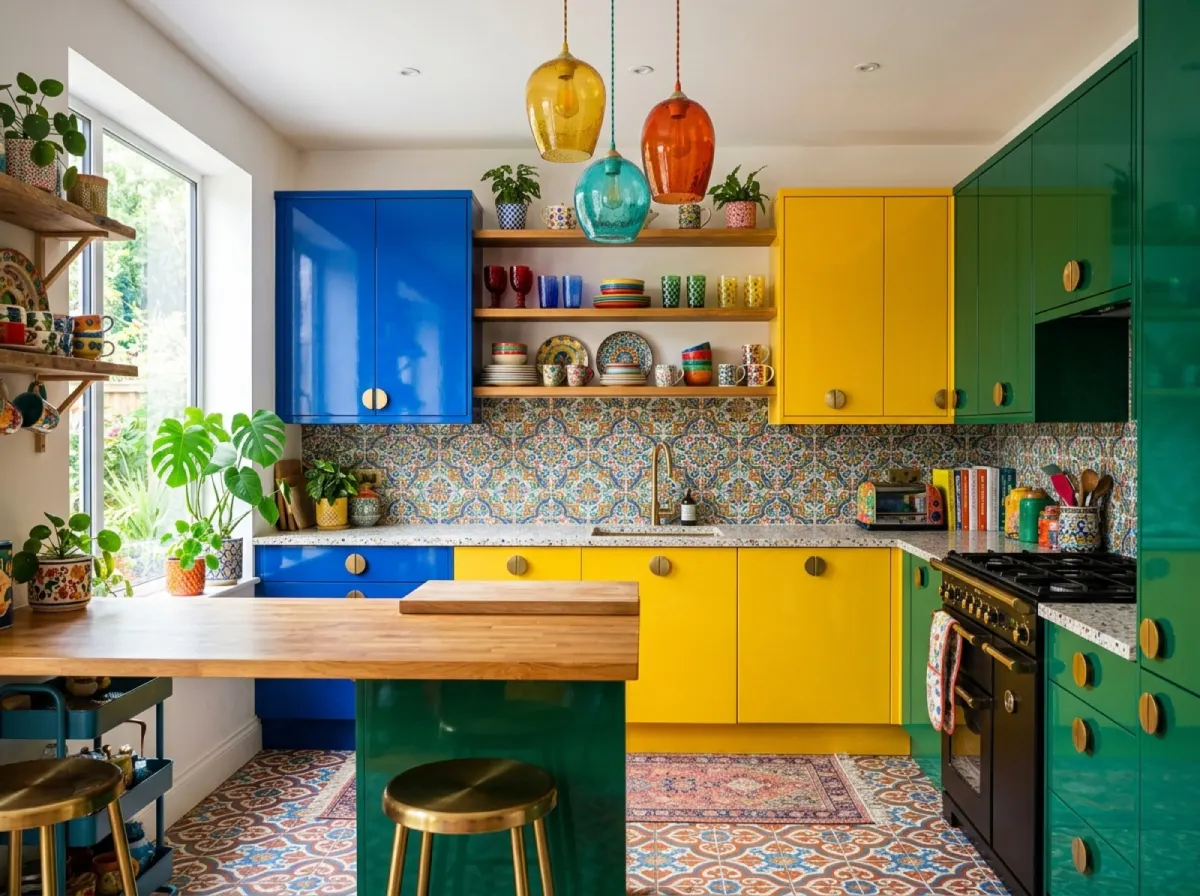
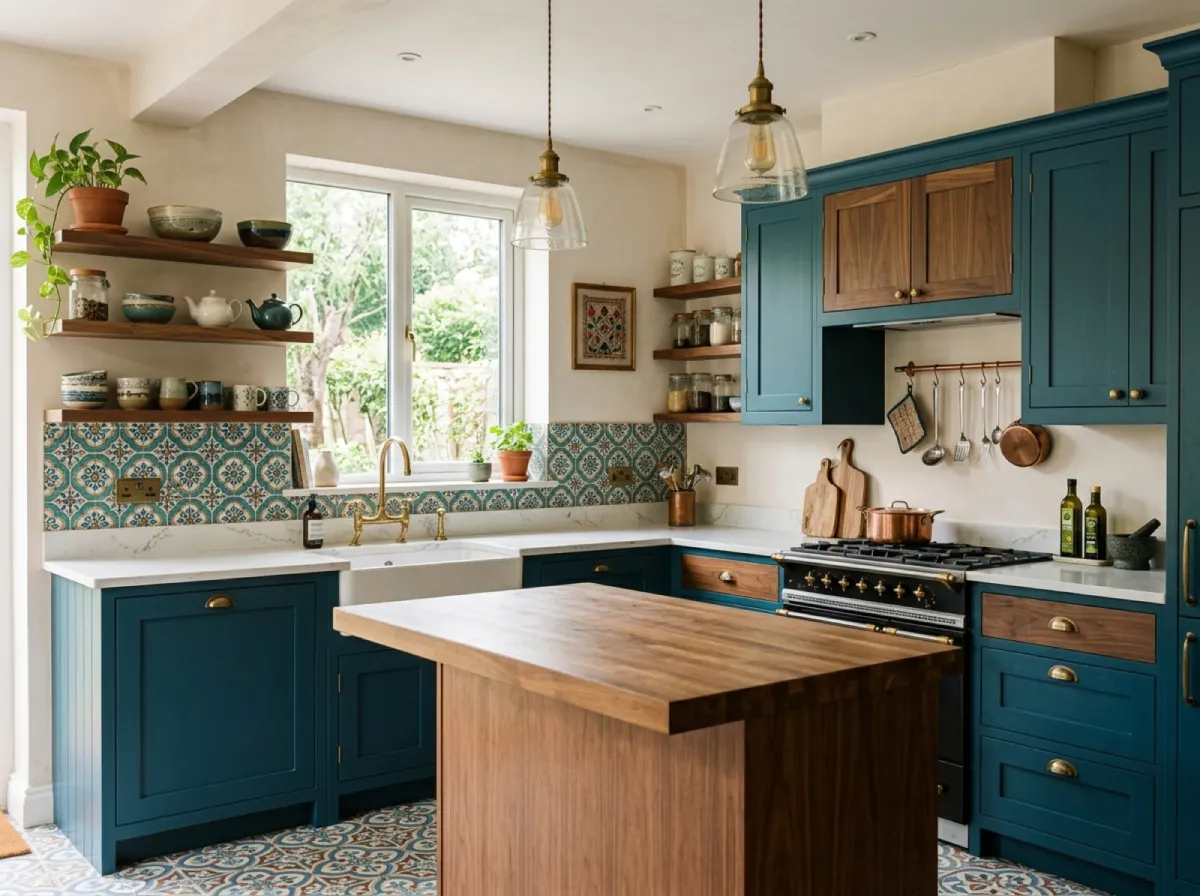
In the kitchen, eclecticism is most easily introduced by pairing cabinetry in a deep lacquered colour with natural wood on the island or shelves and with brass handles. Patterned tiles above the countertop become an accent that gives the whole its character, while the rest remains calm. Thanks to bespoke furniture we can conceal appliances behind uniform fronts, preserving modern functionality under a decorative, individual surface.
Walk-in wardrobes and fitted closets, in turn, are the place where eclecticism works on detail. Lacquered fronts in a saturated colour, a wooden interior, brass railings and handles and glazing with a decorative profile create cabinetry that is practical and at the same time an ornament of the room. In the living room and bedroom we rely on built-ins that combine function with character: bookcases, chests of drawers and wall panels that integrate different materials into one considered form.
A separate chapter is built-in lighting. In eclecticism, light should emphasise the layers: spotlight a patterned wall, accent brass details, illuminate shelves and niches. Integrated strips and fittings mounted in bespoke furniture allow the mood to be directed and the eye guided toward what matters most in a given interior, rather than flooding the space evenly with light.
Eclectic style in different rooms
Eclecticism works throughout the home, but in each zone it distributes accents differently. Below is a short overview of how to lead this style room by room while keeping the shared guiding idea.
Kitchen
An eclectic kitchen combines modern function with decorative detail. Lacquered cabinetry in a deep colour, a wooden countertop or island, patterned tiles and brass handles create the characteristic mix here. It is important that one element is the dominant and the others support it, because a kitchen with several equal accents quickly becomes overwhelming.
Living room
The living room is where eclecticism unfolds most fully. Here furniture from different eras meets: a modern sofa, a vintage armchair, a classic chest of drawers and contemporary lighting. Bespoke built-ins - a bookcase, a display cabinet, a television panel - play the role of background that orders the whole. A repeated colour or material binds these elements, so that the variety does not tire.
Bedroom and wardrobe
In the bedroom, eclecticism quietens down but does not disappear. Lacquered wardrobe fronts, wood, fabrics of varied texture and brass details create a cosy yet expressive space. A bespoke wardrobe lets daily order be hidden behind decorative fronts, while inside it provides a fully functional layout tailored to needs.
Bathroom and entrance zone
The bathroom is a natural field for patterned tiles and the contrast of stone with wood. Brass fittings and mirrors in decorative frames complete the picture. The entrance zone, in turn, is the interior's calling card: built-in storage for shoes and coats, a mirror and an expressive colour accent announce the character of the whole home from the threshold.
A well designed eclecticism withstands the passage of time well, because it is not based on a single passing trend but on durable materials and a personal history. The interior can be completed gradually, adding objects that fit thanks to the shared dominant. It is also a style that openly allows an individual accent: one strong, personal element - a collection, a painting, an inherited piece of furniture - often becomes the heart of the whole composition.
The value of such an interior grows as it becomes more ours. Eclecticism rewards patience and consistency: the longer we stick to the adopted guiding idea, the more coherent and mature the space becomes, even though it is formally made up of many different elements.
The most common mistakes
The most common mistake in eclecticism is chaos without a rule. It is easy to confuse freedom with a lack of plan and to throw too many strong elements into one room, each fighting for attention. The remedy is to set a guiding idea and a hierarchy: one dominant accent, the rest subordinate. If every piece of furniture is a star, the interior loses its focal point.
The second trap is too many colours and textures at once. Eclecticism lives on contrast, but contrast needs a background. When five intense colours, four patterns and three kinds of metal meet in one room without any repetition, the eye has nothing on which to rest. It is worth following the rule of repetition: every important colour and material should appear at least two or three times.
The third mistake is ignoring scale and proportion. Mixing eras does not mean mixing random sizes. A massive, heavy piece of furniture next to a delicate, fine detail without a conscious intent gives the impression of chaos. In successful eclecticism, at least one parameter - scale, colour or material - links the paired objects, even if they come from different worlds.
The fourth trap is treating eclecticism as an excuse for a lack of decisions. It is a style that requires more planning than monochromatic interiors, not less. Without a preliminary design and an established frame it is easy to end up with a space that looks unfinished. That is why eclecticism is best designed holistically, planning in advance what is the base and what is the accent.
How we do it at Grandis
We have been designing and producing bespoke furniture for over 15 years, in our own facility covering 3 000 m². We have completed over 300 projects, which in the case of a style as demanding as eclecticism really matters: we know how to pair materials, colours and textures so that the mix stays coherent rather than accidental. We begin work with a laser measurement and a 3D design, which is included in the price - thanks to the visualisation it is visible how the guiding idea binds the whole interior before anything goes into production.
We use European-class materials and certified hardware, which in eclectic combinations of lacquer, wood and metal decides the durability of the result. Installation is carried out by our in-house team, not subcontractors, so decorative details and the precise joints of different materials are made exactly as designed. A standard project takes 2-4 weeks, and the price is fixed, without addenda - from the start you know what the whole project will cost.
Eclecticism succeeds when one consistent decision stands behind the variety. Our role is to help make that decision and translate it into furniture that for years will look considered rather than accidental.
Frequently asked questions
How does eclecticism differ from simply mixing styles?
The difference lies in the guiding idea. Random mixing is a collection of objects with no common denominator. Eclecticism is a deliberate arrangement in which a recurring colour, material or scale binds the varied elements into a coherent whole.
Will eclectic style date quickly?
No, if it rests on durable materials and a personal history rather than a passing trend. Eclecticism can be completed gradually, adding objects that fit thanks to the shared dominant, which makes it resistant to changing fashion.
Will eclecticism work in a small apartment?
Yes, provided the number of dominants is limited. In a small space one strong accent is enough - for example a patterned wall or lacquered cabinetry - while it is worth keeping the rest calm so that the interior does not feel overloaded.
Where to start an eclectic interior project?
With the choice of a guiding idea: one colour or material that will recur throughout the room. Only then are elements from different eras selected. A prior 3D design also helps, showing whether the mix holds together.
Is bespoke furniture necessary in this style?
It is not a condition, but it makes the task much easier. It allows precise selection of the lacquer colour, the type of wood, the kind of hardware and the proportions, so that the shared dominant is consistently maintained throughout the interior.