Summer party and barbecue in the garden: how to plan the dining zone, lounge, kitchen, lighting and shade so guests feel at ease. A practical hosting guide.
Summer gatherings outdoors are one of the main reasons we want a garden or terrace in the first place. A well-planned space lets the host relax with the guests instead of shuttling between the kitchen and the table. This guide shows how to prepare a terrace or garden for a party and barbecue — zone by zone, with specifics rather than generalities.
Gatherings as the heart of the garden
For many people, a garden is above all a place to gather. The barbecue, long dinners and evenings with friends are the scenarios we set up an outdoor space for. Increasingly, younger generations point to shared grilling as the single biggest advantage of having their own plot or terrace. The conclusion is simple: an outdoor space is worth planning not only for everyday rest, but above all for hosting, because that is when flaws in the layout surface fastest.
A garden party has its own rules. The number of people grows, movement intensifies, and activities overlap: someone is grilling, someone is setting the table, someone is talking in an armchair. A terrace arranged at random, with a set bought in a hurry, quickly gets congested. A good spatial plan lets all of this happen at once — without crowding and without the host being cut off from the company.
The starting point is the real number of guests and the way you most often gather. You will plan the space differently for intimate dinners of four than for regular barbecues for a dozen or more. Before choosing furniture, answer how many people should sit at the table, how many guests appear on bigger occasions, and which zones will be the most heavily used.
The dining zone — where everyone sits down
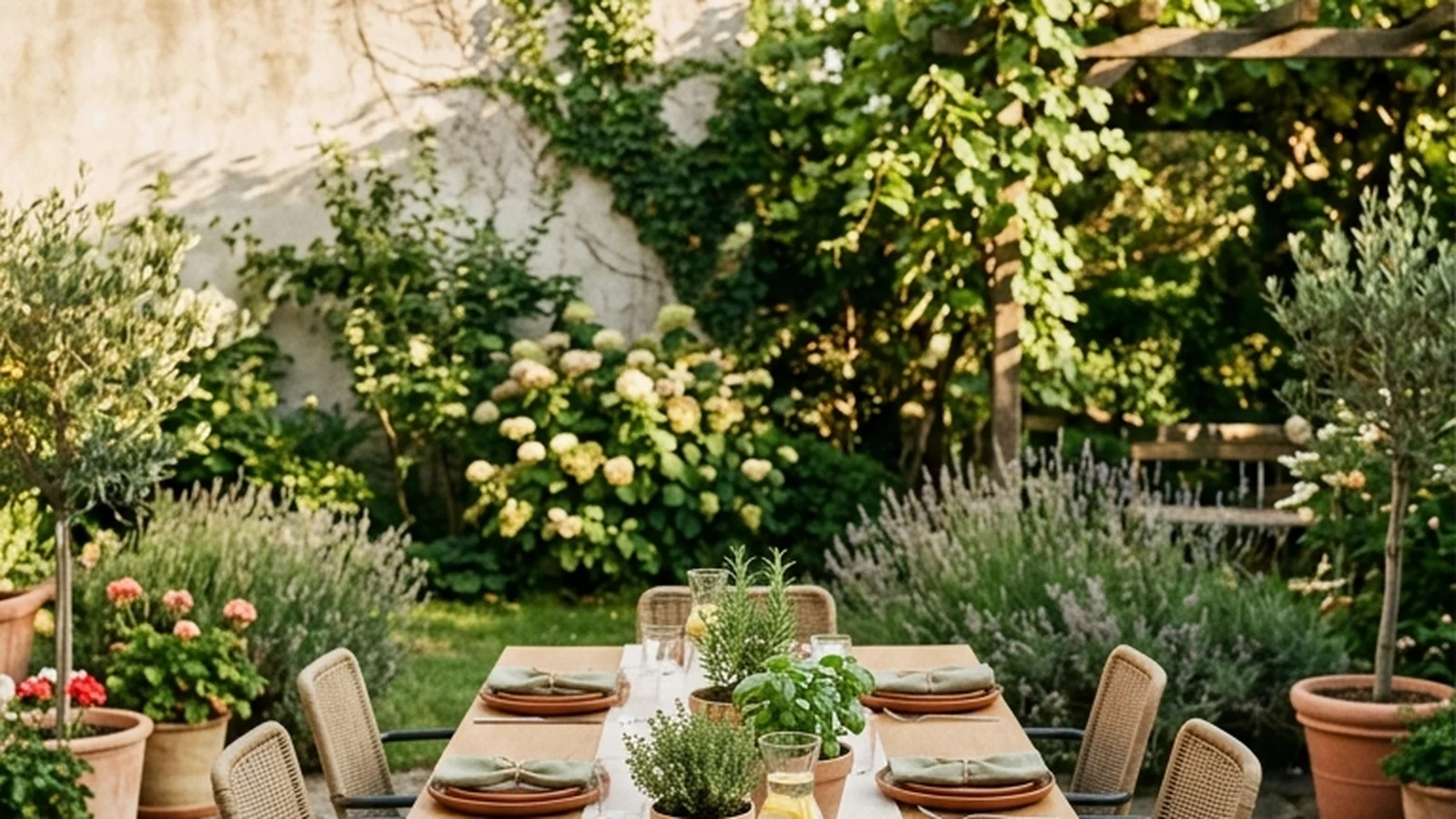
The heart of any party is the table. When planning the dining zone, start from the real number of guests and allow a reserve of seats, because summer gatherings tend to grow — someone brings a friend, someone stays longer than expected. It is better to have two chairs too many than too few. The table should be wide enough to fit platters, tableware, drinks and decorations, so guests sitting opposite each other are not fighting for every centimetre of the top.
The space around the table matters just as much. You need room to pull out chairs and pass behind seated people — roughly a metre of clearance behind a chair lets people stand up without squeezing past. If the passage clashes with a railing, planters or a wall, some seats become practically unusable. That is why the table position is worth considering in the context of the whole terrace.
Materials here have a purely practical meaning. A top resistant to moisture and sunlight is easy to clean after a meal and does not warp from spilled drinks or hot dishes. High-pressure laminates and quartz sinters work well — surfaces that withstand daily use without marks. Chairs with a comfortable seat encourage guests to linger at the table, which is the whole point of a summer party. If your terrace often becomes the venue for gatherings, a table matched precisely to the floor area and the number of guests makes a bigger difference than it seems — and this is where terrace furniture designed for a specific space proves its worth.
The lounge zone — where conversation lasts longer
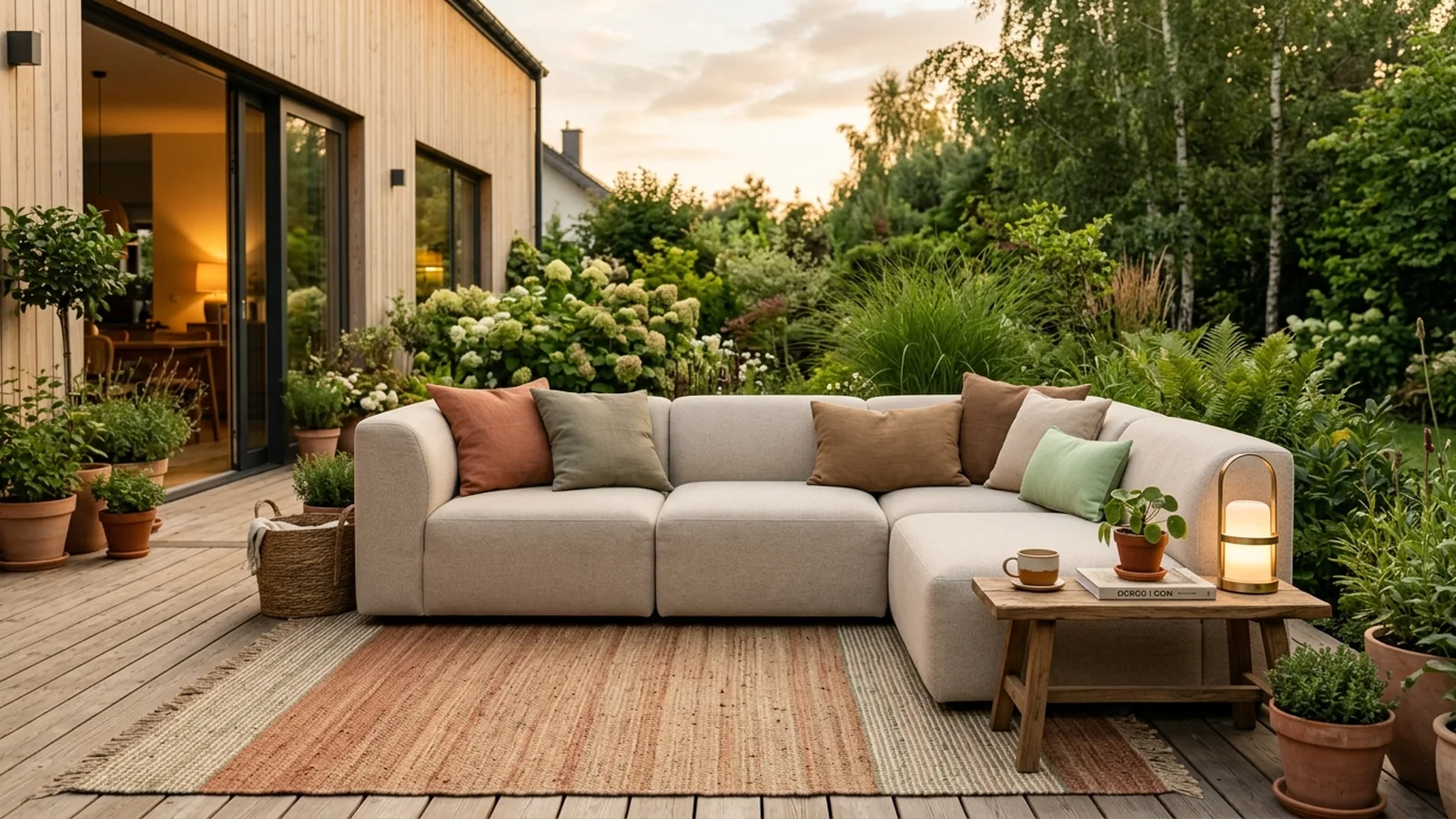
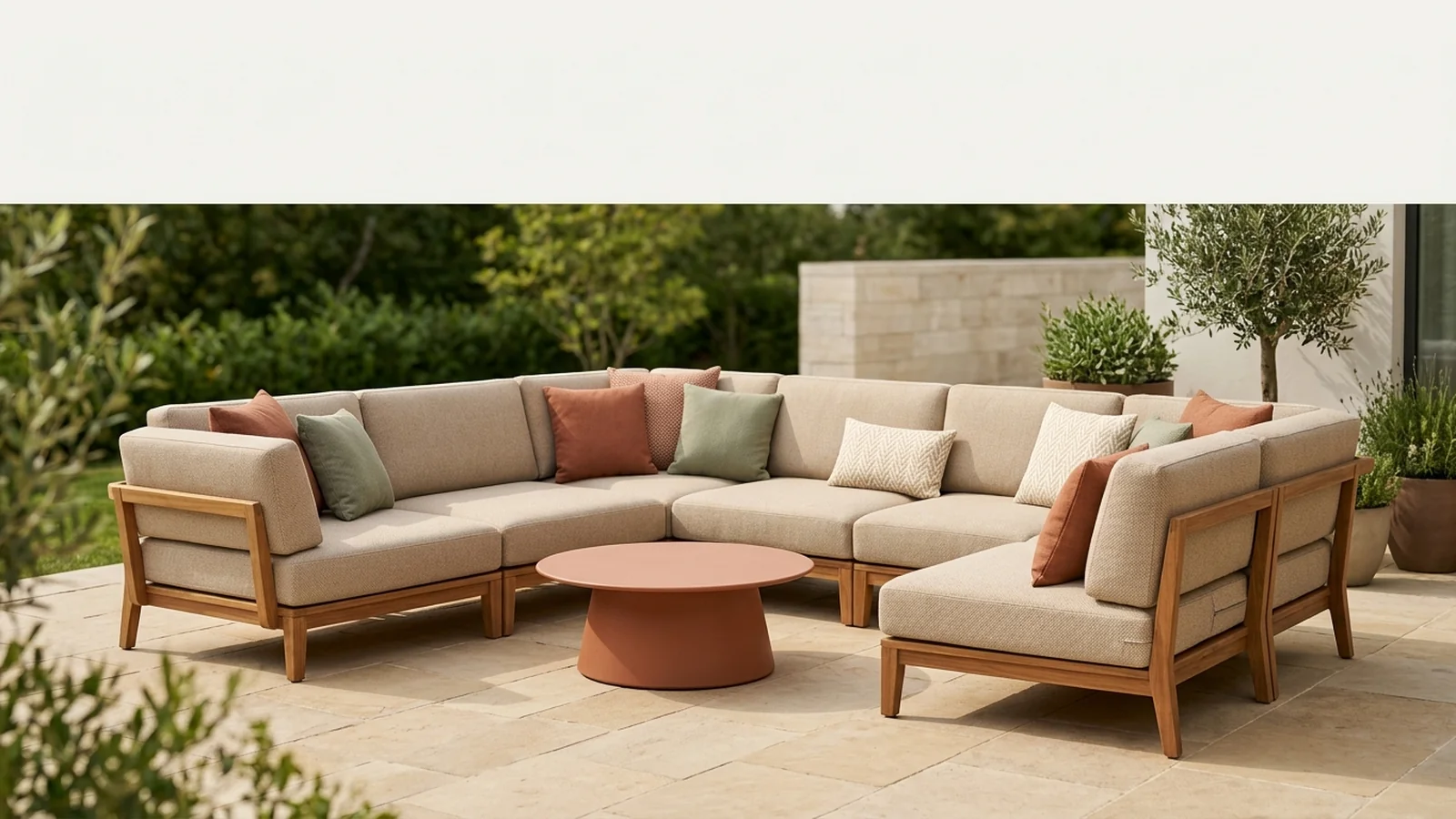
After the meal, the gathering naturally drifts toward more comfortable seating. The lounge zone — an outdoor sofa, armchairs and a low coffee table — is the place for conversation, a drink and a lazy evening. Set it apart from the table so guests have somewhere to move to, and the space gains a natural rhythm: first at the table, then on the low seats.
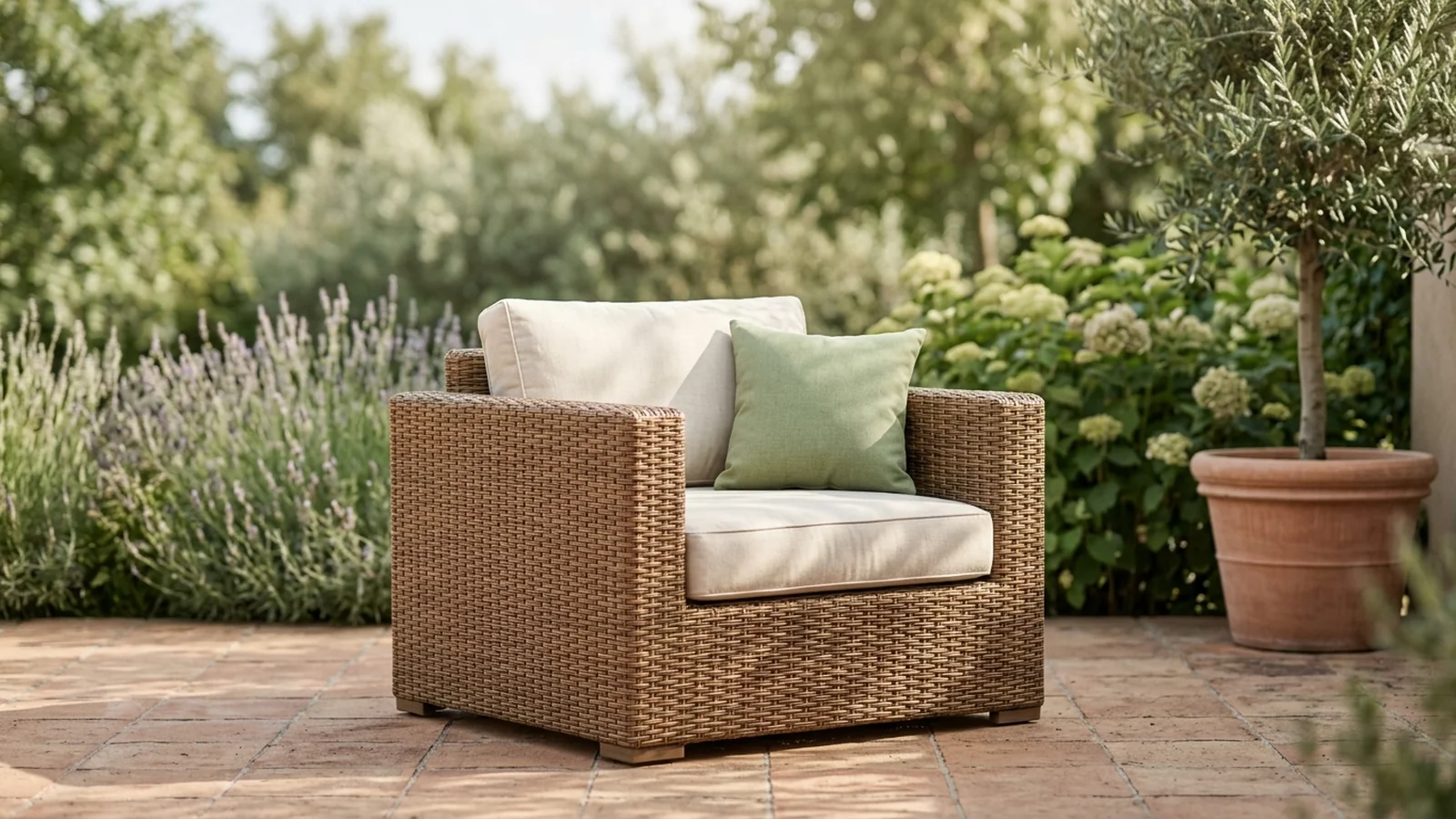
Deep seats and soft cushions in UV-resistant fabrics simply make you want to stay in the lounge. Comfort here depends on seat depth, the backrest angle and the quality of the fillings — elements not worth skimping on, because they decide whether someone sits for five minutes or two hours. Good European-class outdoor fabrics keep their colour through the season and dry faster after rain.
The seating arrangement matters too. A semicircle or an L-shaped layout favours conversation, because everyone can see one another. Rows facing each other work worse, splitting the company into two groups. Even on a smaller terrace you can carve out such a corner — a compact sofa and two armchairs around a low table are enough, as long as they fit the available space rather than being forced into it.
The grill and the outdoor kitchen zone
Place the grill so that the host is not cut off from the rest of the company, while smoke and heat do not bother those seated at the table. Setting it to the side of the dining zone, on the downwind side but within sight and conversation range, works well. A host who stands with their back to the guests for an hour loses all the pleasure of the gathering.
A reserve of working surface near the grill is essential. A few centimetres of countertop for spices, a board and platters means grilling stops being a juggling act between the grate and the table. A permanent or semi-permanent kitchen zone with a worktop organises the whole process and relieves the dining table — raw meat, finished dishes and tableware do not mix in one spot.
If you plan this zone permanently, built-in furniture matched to the terrace lets you combine the worktop, storage and room for a cooler or sink in one coherent body. Such an outdoor kitchen need not be large — what counts is a layout in which everything you need at the grill is within arm's reach. Fronts and tops of European-class materials, resistant to moisture and temperature, survive the season without traces of daily use.
Lighting and shade — comfort from noon to night
Two elements most often decide whether guests stay longer: shade by day and light in the evening. During peak sun a parasol, an awning or a shaded corner is essential, without which the dining zone can be unbearable in the heat. Plan shade exactly where people actually sit — over the table and the lounge — not over an empty stretch of terrace that no one uses.
After dusk, light takes over. String lights, floor lamps and discreet points along the paths build the mood and extend the gathering into late hours. A warm light colour feels friendlier than harsh, cold lighting and does not tire the eyes. Spread the light across several points instead of lighting the whole terrace with one strong lamp — diffused light creates a cosier atmosphere.
The combination of shade by day and soft light in the evening makes the space welcoming all day, from the afternoon barbecue to the late-night talk — and genuinely extends the time spent together.
Guest flow and the logic of movement
The comfort of a party is decided not only by the furniture, but by how people move between zones. Guests circulate around the terrace: from the table to the grill, from the lounge to the drinks bar, from the door to where their friends sit. If these routes cross and run through bottlenecks, it gets crowded and tense, even with a modest number of people.
Plan the zones so that movement flows. A table with drinks and snacks is best placed where it is easy to reach from every zone, without squeezing past seated guests. Main passages should be wide enough for two people to pass — usually about a metre of clear space. The entrance from the house should not land exactly where someone sits with their back turned at the table.
The more guests you expect, the more these minor decisions matter. A well-considered flow makes the space feel larger than it is, and the host need not keep asking people to move aside. This is easiest to achieve by designing the zone layout in advance, not arranging furniture on the day of the party.
Weather and storage — a season without surprises
Summer weather can surprise you, so when planning a hosting space, think about a sudden change in conditions. An awning or parasol with a solid base protects not only from the sun but also from a brief shower that need not end the gathering. European-class fabrics and cushions, resistant to moisture, dry quickly and do not soak water into the filling, so after a passing downpour the lounge is back in use within a quarter of an hour.
Between gatherings and after the season, a place to store cushions and accessories comes in handy. A bench with storage, a garden chest or built-in furniture with a closing section keeps textiles at hand while protecting them from moisture and dust. This is especially convenient on smaller terraces with no utility room or garage — storage built into the furniture saves space.
Small habits matter too: stowing cushions before a forecast storm, wiping the top after a meal, or moving lighter furniture into shade on the hottest days. None of this takes effort, yet it extends the period during which the furniture looks like new and stays ready for the next party.
A coherent space that makes hosting easier
The best parties happen where the zones — dining, lounge and kitchen — form a logical whole rather than a collection of random furniture. Coherence of dimensions, materials and colours makes the space legible, and guests intuitively know where to sit and where to serve food. This is hard to achieve by combining ready-made sets from different sources, with different proportions and shades.
That is why more and more people plan a hosting space from scratch, with furniture matched to the floor area and the way it will be used. A made-to-measure design gives full control over table dimensions, seat depth, zone layout and the grill-side build — everything adapted to the real terrace, its shape, sun exposure and movement direction.
At Grandis Trade we design and manufacture outdoor furniture to measure in our own studio in Warsaw — from the dining and lounge zones to the kitchen build by the grill. We have over 15 years of experience, 3 000 m² of production space and more than 300 completed projects. Every project begins with a laser measurement and a 3D visualisation included in the price; we work with European-class materials and close each project within 2–4 weeks at a fixed price. Installation is handled by our in-house team. See our work in the portfolio section, check the home offer on the forhome page and business solutions under forbusiness. To prepare your terrace or garden for summer gatherings, fill in a short quiz and we will prepare a design and a quote.
Frequently asked questions
How much space at the table should I plan per guest?
Allow roughly 60 cm of table width per seat, so guests sitting side by side have room to move. Add a reserve for platters in the centre, plus about a metre of free space behind a chair so people can stand up comfortably. For frequent gatherings, plan a table with two or three seats beyond the fixed number of household members.
Where is the best place to set the grill relative to the dining zone?
Place the grill to the side of the dining zone, on the downwind side, so the smoke does not drift toward those seated, while the host stays within sight and conversation range. A working surface right next to the grill helps, as does a safe distance from upholstered furniture and plants.
What materials work for an outdoor table top?
High-pressure laminates and quartz sinters handle outdoor conditions best — resistant to moisture, sunlight, scratches and stains, and easy to clean. Aluminium with a suitable coating also works. Whatever the material, choose European-class components that neither warp nor fade through the season.
How do I arrange a guest zone on a small terrace?
On a limited floor area, opt for furniture matched to the dimensions: a compact sofa with two armchairs in an L-shaped layout, a folding or narrow table, and a bench with storage for cushions. The zones need not be expansive — just clearly defined and not blocking the passage. A made-to-measure design helps especially here.
Does made-to-measure furniture make sense for hosting parties?
Yes, especially when the terrace often becomes a venue for gatherings or has an unusual shape. A made-to-measure design matches the table length, zone layout, grill-side kitchen build and traffic flow to the real space and number of guests. The zones form a coherent whole rather than a collection of random sets, which makes hosting easier.
How do I protect a guest zone against a sudden change in weather?
The basics are shade and rain cover: an awning or a parasol with a solid base, ideally over the places where guests actually sit. European-class cushions and fabrics, resistant to moisture, dry quickly after a passing shower. It is also worth having storage — a bench or chest — so you can quickly stow textiles in a storm.