How to protect your lounge zone from sun and heat: umbrellas, pergolas, terrace awnings and UV-protective fabrics. A practical guide to garden shade.
On summer afternoons, the difference between a pleasant rest outdoors and a retreat into the cool interior usually comes down to one thing — shade. Well-planned sun protection extends the time you actually spend in the garden, lowers the perceived temperature and protects furniture from fading. It is not a last-minute add-on but a design element that decides whether a terrace is used all day or only in the morning and evening.
Why shade is the foundation of comfort, not decoration
A lounge zone without considered shade works for only part of the day. During peak sun, between noon and early afternoon, an unprotected terrace can heat up to a point where sitting becomes tiring. The result is simple: the furniture stands empty during the warmest part of the day, and the space you invested in works only partially.
Shade also has a practical dimension that becomes clear after a season. Direct radiation speeds up the fading of fabrics and the drying of wood, while temperature swings stress the structures. A well-designed cover extends the life of furniture because it limits exposure to the factors that wear it down fastest. For this reason, shade is worth planning alongside the furniture rather than buying after the fact, once it turns out the terrace is unbearable.
Garden umbrella — flexibility first
An umbrella is the simplest and most flexible way to create shade. It can be moved, folded and stored out of season, and the entry cost is lower than with permanent structures. It is a good choice where needs change during the day or where you do not want to interfere with the garden's permanent architecture.
It is worth distinguishing two types. A centre-pole umbrella is stable and cheaper, but the leg in the middle limits the arrangement of the table and chairs. A cantilever umbrella, with the arm extended to the side, leaves the space underneath free and lets you rotate the canopy to follow the sun, which matters over a long afternoon.
Three parameters count when choosing. The first is canopy diameter relative to the zone you want to cover — the shade should reach not only the tabletop but also the people seated at it. The second is base weight: too light a base will not hold the umbrella in a gust, so it is worth following the loading weight recommended by the manufacturer. The third is canopy fabric — materials with UV protection limit radiation and lose colour more slowly.
Pergola — a permanent structure and a sense of space
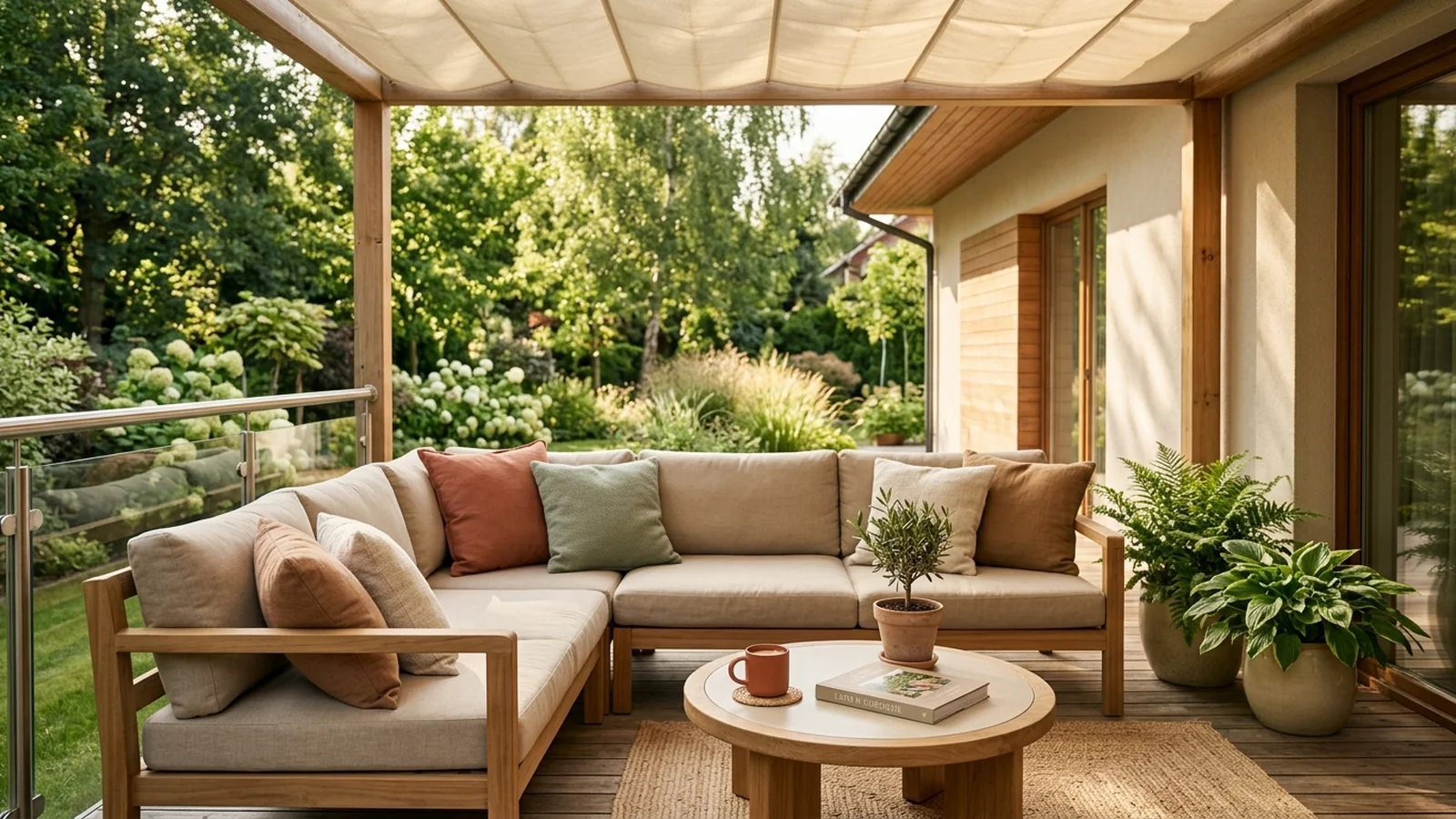
Where you want a solution for years, a pergola works well. It is a structure that not only provides shade but also organises the garden and clearly marks out the lounge or dining zone. Unlike an umbrella, a pergola becomes part of the architecture rather than a movable accessory.
Bioclimatic pergolas with adjustable louvres deserve particular attention. They let you control the light: at a hot noon the louvres can be closed for deep shade, and in the evening opened to let in more sky. This solution combines the permanence of a structure with a flexibility that an umbrella does not offer.
A pergola requires considered foundations and usually involves more outlay than an umbrella, but in return it offers durability and independence from constant repositioning. Well designed, it harmonises with the form of the house and the materials of the furniture, so the whole space looks coherent rather than like a collection of separate elements.
Terrace awning — shade by the wall of the house
A terrace awning is mounted to the wall of the building and extends over the terrace, providing shade without taking up floor space. It is a convenient solution for zones adjacent to the house, where a freestanding structure makes no sense. The awning can be extended to the desired depth and, after use, retracted into a cassette that protects the fabric from dust and moisture.
Newer solutions equip awnings with sun, wind and rain sensors, so they extend and retract on their own. In a stronger wind the awning rolls up to avoid damaging the mechanism, and on a hot afternoon it extends when the sun falls directly on the seating zone. Such automation means less manual operation and a longer service life for the cover, because the mechanism does not work in unfavourable conditions.
An awning complements other solutions well. Where a terrace partly adjoins the house and partly opens into the garden, it can make sense to combine an awning by the wall with an umbrella or pergola in the further part of the space.
UV-protective fabrics — an invisible but important element
Whatever structure you choose, the quality of the shade is decided by the fabric. Materials with UV protection limit the penetration of solar radiation, which translates into a lower temperature under the cover and a reduced risk of sunburn. Equally important is resistance to fading — a fabric exposed to the sun all season loses colour saturation more slowly if it has the right coating.
For shading fabrics, weight and breathability also matter. A denser fabric gives deeper shade but tends to be less breathable, so the choice depends on whether you care more about fully blocking the sun or maintaining air circulation. Waterproof coatings let you wait out a short shower, although they do not replace a full roof.
Colour also has a practical meaning. Lighter shades heat up less and reflect more light, so a more pleasant temperature prevails beneath them. Darker fabrics give deeper, more contrasting shade but accumulate more heat. It is worth choosing colour deliberately, combining aesthetic value with how the cover will behave in full sun.
Heat is not only the sun — airflow and surface
Summer comfort depends on several factors at once, and shade is only one of them. If the air stands still, even a covered zone can feel stuffy. When planning a lounge zone, it is worth leaving a path for airflow and avoiding closing it off tightly on all sides — a little air movement genuinely lowers the perceived temperature.
The surface matters too. Dark, solid materials heat up strongly and give off heat long after sunset, while lighter, breathable boards stay cooler. It is a detail easy to forget, yet one that affects comfort throughout the evening.
Plants also work for comfort. Climbers trained over a pergola or taller greenery on the side of the afternoon sun lower the perceived temperature and soften the light, giving a gentler shade than a solid cover. Combining a technical solution with greenery usually gives a better result than either one used alone.
Shade planned for a specific garden
We increasingly think of the garden as an additional room, where shade and comfort are part of the design rather than an improvisation in July. The starting point should be how you actually use the space: where and at what hour the sun falls, where you sit most often, how movement runs between zones. Only on this basis is it worth choosing a specific solution — an umbrella, a pergola, an awning or a combination of them.
This process eliminates the typical mistake in which the cover ends up where there happened to be room rather than where you actually sit. Shade that covers an empty part of the terrace instead of the heads of those gathered fulfils its role only partly. That is why sun protection is worth treating as part of the functional layout of the whole zone, not a separate purchase.
In this approach, furniture and cover work best when they are created as a coherent whole, matched to the direction of the sun, the shape of the terrace and the way it is used. At Grandis Trade we design home spaces from measurement and sun analysis onward, and we select bespoke outdoor furniture in materials and colours that harmonise with the shade structure. We also deliver solutions for commercial spaces — from outdoor dining areas to relaxation zones in hotels. The results of earlier projects can be seen in our portfolio.
Frequently asked questions
Umbrella, pergola or awning — what to choose first?
If you value flexibility and a lower entry cost, start with an umbrella, ideally a cantilever one that does not block the furniture layout. A pergola makes sense when you want a solution for years and at the same time to mark out a permanent zone. An awning works well by the wall of the house, where a freestanding structure would be redundant. Often the best effect comes from combining two solutions in different parts of the terrace.
How do I match umbrella diameter to the lounge zone?
The shade should cover not only the tabletop but also the people seated at it, with a margin for the changing position of the sun. In practice this means a canopy clearly larger than the table itself. The longer you use the zone during the day, the larger the margin worth allowing, because the sun moves and the shade travels with it.
Do UV-protective fabrics really make a difference?
Yes, in two ways. First, they limit the penetration of radiation, so under the cover there is a lower temperature and a reduced risk of sunburn. Second, they fade more slowly, so the cover keeps its colour and appearance longer. It is an element you do not notice at first glance, but one that decides comfort and durability.
What besides shade affects comfort on hot days?
Airflow and surface. A zone closed off tightly on all sides can feel stuffy despite the shade, so it is worth leaving a path for air movement. A lighter, breathable surface heats up less than dark, solid materials. Plants also help, softening the light and lowering the perceived temperature.
Are automatic awnings worth the extra cost?
If you spend many hours in the garden and care about durability, usually yes. Wind and rain sensors retract the awning in unfavourable conditions, which protects the mechanism and fabric from damage. Less manual operation also means the cover is actually used rather than left rolled up out of convenience.
Can shade be planned together with bespoke furniture?
Yes, and that is the best approach. When the cover and furniture are created as a coherent whole, the shade falls exactly where you sit, and the materials and colours harmonise with the structure. We start with measurement and sun analysis, so the solution is matched to the specific space. Take a short quiz and we will propose a lounge-zone layout with well-resolved shade.