Modularity, solar charging, smart awnings and recycled materials. A grounded review of 2026 garden furniture innovations that truly change the terrace.
Garden furniture is no longer just a table and chairs stowed in the garage for winter. The 2026 season shows that outdoor space has matured: technology, automation and environmental responsibility are settling in for good, not as a seasonal novelty. In this guide we break down the key innovations — what actually works, what mainly looks good in brochures, and how to apply these directions in a space tailored to your terrace.
Modularity as an answer to changing needs
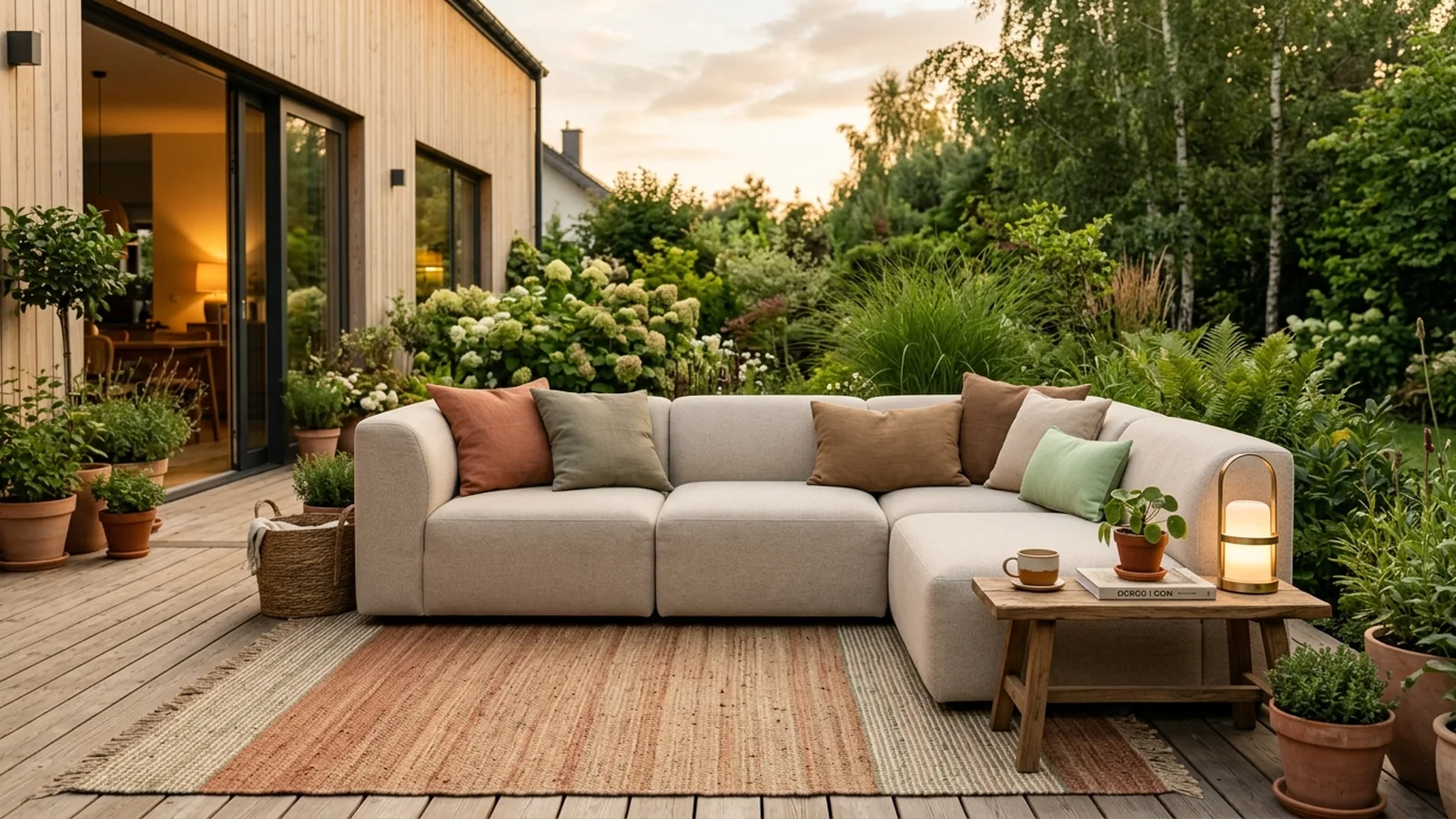
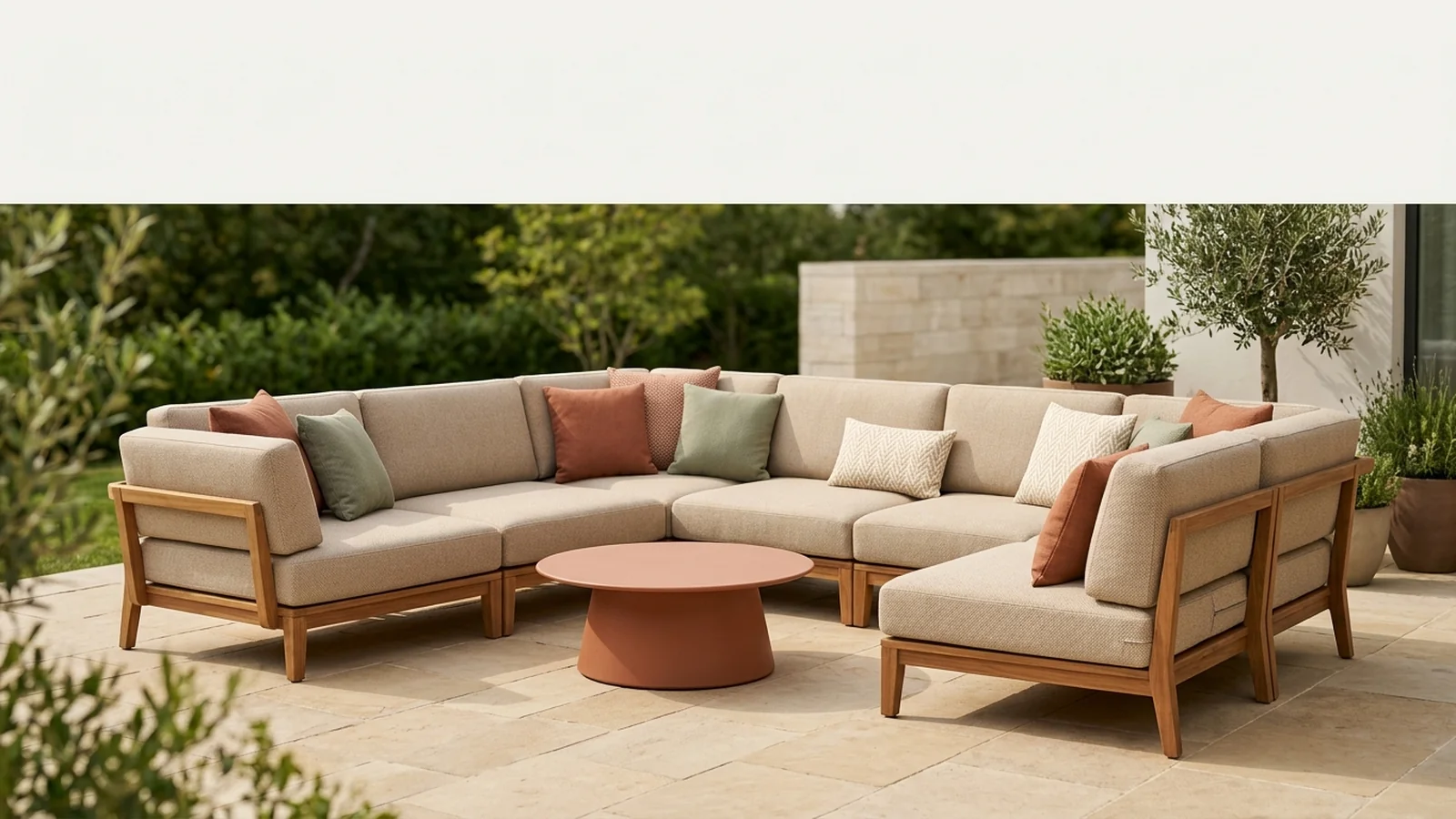
The first clear trend of the season is modularity. Instead of a rigid set of one table and four chairs, more and more people are choosing individual segments that can be arranged in many ways. The same set covers several scenarios: a full corner sofa for a Saturday-evening crowd, two armchairs for weekday morning coffee, an extra pouf when one more person turns up. The layout shifts with the time of day and the season, and the furniture no longer dictates a single, predetermined way of using the space.
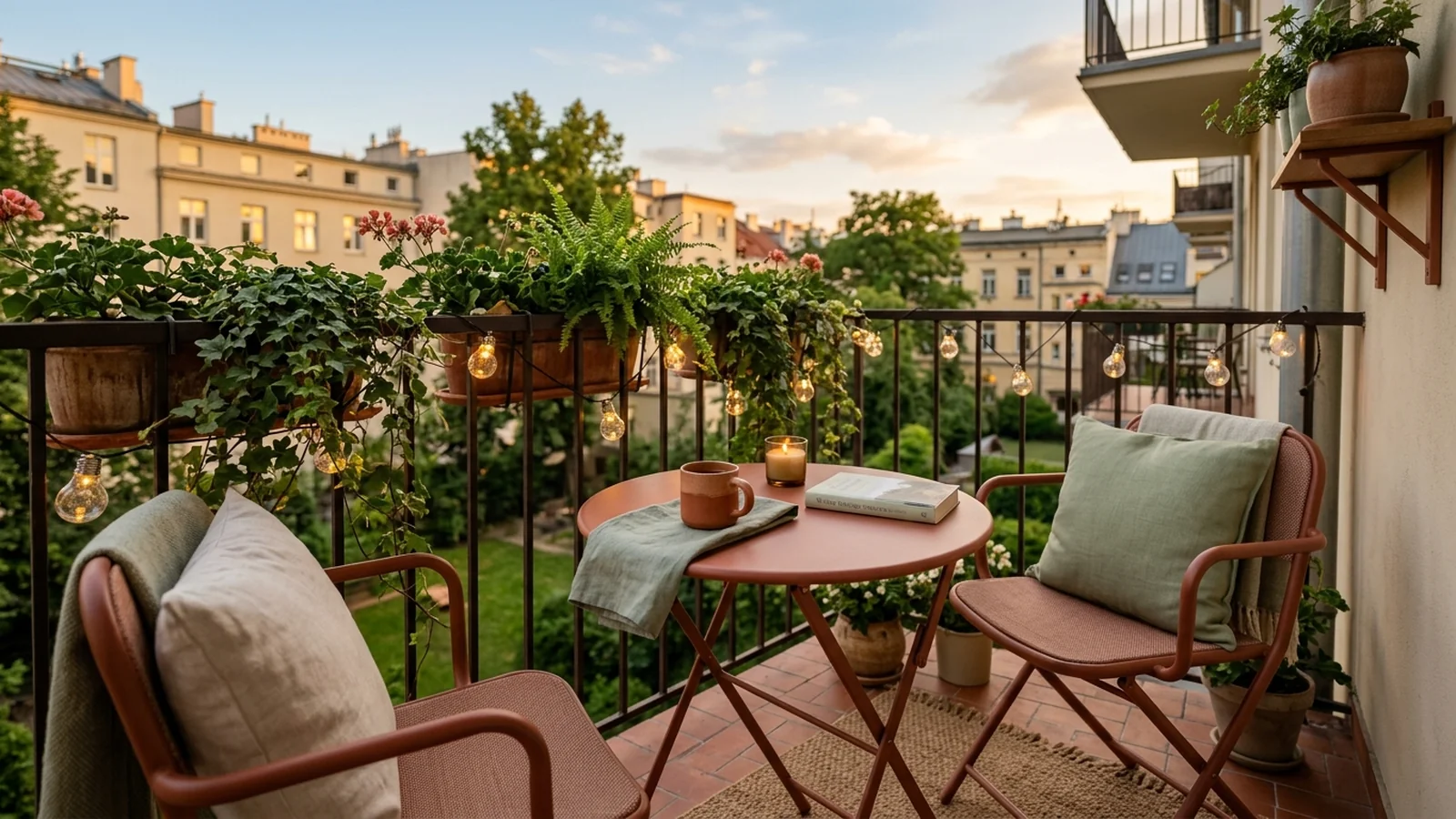
Modularity also has a concrete practical side on smaller footprints. On a balcony two metres wide, every centimetre matters, and being able to separate segments lets you fit the shapes to an irregular layout — a narrow passage, a bay window or a corner. It is also convenient for storage: single elements are easier to move and put away off-season than one heavy, fused set.
It is worth distinguishing real modularity from the illusion of it, though. In cheaper sets the so-called modules are often loosely placed blocks that drift apart at the slightest movement. A good modular solution holds together thanks to thoughtful connectors and repeatable segment dimensions — only then is rearranging quick and the overall proportions stay intact.
Power in the armrest — solar and USB solutions
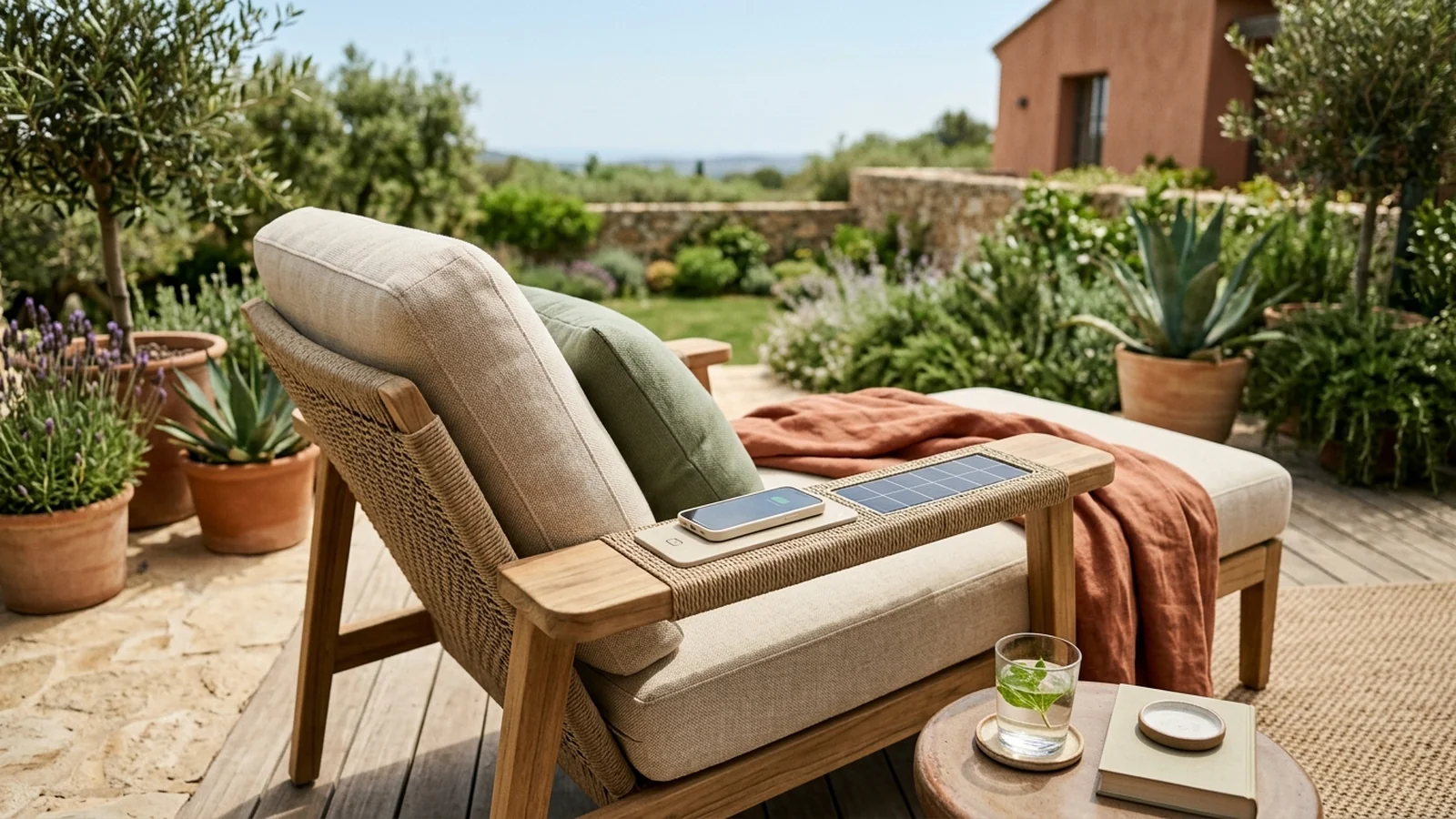
The second group of innovations concerns power supply. Induction chargers and USB ports are appearing in the armrests of armchairs and sofas, fed by mini solar panels built into the furniture itself or a nearby screen. A phone charges without running a cable from indoors, and the panel gathers energy during the day, when the lounge area is sunlit anyway. From a daily-use standpoint this is a genuine convenience — no tangle of cords and one less reason to head back inside.
This solution looks striking in manufacturer materials, but it is worth a sober view. The output of mini panels is limited and works well for small electronics — a phone, headphones, an e-reader — not for powering larger devices. A cloudy day further reduces the yield. It is most sensible to treat this element as a supplementary convenience rather than a full power source for the whole terrace.
If this function matters to you, its placement is key. A port or charger in an armrest only makes sense where you actually sit with a phone — by a lounge chair or at the end of a corner sofa, not in a random segment. This is one of the decisions best made at the design stage, when the way the piece will be used is already known.
Smart awnings that respond to the weather
The third direction is the automation of sun protection. Smart awnings fitted with sunlight, wind and rain sensors extend and retract on their own, without the user lifting a finger. In a stronger gust the awning rolls in to avoid damage, and on a hot afternoon it extends precisely when the sun falls directly on the seating area. For people who spend many hours in the garden, this means less manual handling and greater durability of the awning itself.
Automation also protects the mechanism. An awning left extended during a sudden squall is a classic cause of damage — the wind sensor eliminates that scenario by retracting it before overload occurs. In practice this translates into a longer service life for the structure and a lower risk of a costly repair in the middle of the season.
Shade, after all, is one of the most important and often underrated elements of an outdoor space. Without it a dining or lounge zone can be unbearable at midday. A smart awning solves this automatically, but its effectiveness depends on whether it was planned over the spot where people actually sit — and not over an empty stretch of terrace.
Self-cleaning fabrics and nano-coatings
The fourth topic is upholstery materials. Fabrics with a nano-coating limit how far dirt and water penetrate the fibre structure. A coffee or juice stain more often stays on the surface, where it is easier to remove, instead of soaking deep into the fabric. Combined with UV resistance, which limits colour fading, such materials keep an appearance close to the original for longer — and it is the look after the season that separates a well-kept piece from a neglected one.
It is not, however, an eternal coating. Over time its effect weakens, especially in areas exposed to heavy friction. In outdoor conditions, where furniture meets dust, pollen and moisture, the difference in daily care is nonetheless clearly noticeable — less scrubbing and less time needed to bring the cushions back into shape.
When choosing fabric it pays to look at the full set of parameters, not just the word self-cleaning. Weight, abrasion resistance, colour retention in full sun and whether the cover can be removed and washed all matter. Good European-class outdoor fabrics combine these traits, which is why in durable outdoor furniture they decide comfort for years to come.
Eco materials — recycling and certificates
The fifth area is raw materials. In 2026 garden furniture, recycled aluminium plays a growing role, combining lightness with corrosion resistance while lowering the environmental footprint compared with primary aluminium. Alongside it comes wood with certification confirming responsible sourcing, and composites made from recovered plastics, including those retrieved from the oceans. Recycled material is no longer a quality compromise — in many applications it matches primary raw materials.
Add to that worktops made of moisture-resistant materials that need no painting, and aluminium finished to imitate the grain of wood, which keeps the parameters of metal while looking warm and natural. Such solutions blend aesthetics with practicality: they deliver the look of wood without the annual maintenance that real natural material requires.
Furniture made of recovered and certified raw materials is no longer a niche today but a distinct market segment. For many people this is not only a matter of values but also of practical accounting — responsibly sourced materials are often more durable and withstand years of outdoor use better. Eco and durability increasingly go hand in hand rather than excluding each other.
Why it matters — the market context
The directions described do not arise in a vacuum. According to a 2024 industry report, the garden-goods market in Poland grew from 1,33 billion PLN in 2019 to 1,6 billion PLN in 2023, an increase of roughly 20 percent. Garden furniture is cited as the segment with the greatest growth potential in Europe, with a forecast of around 21 percent by 2030, and in spring 2024 its sales nearly doubled year over year.
Behind these figures lies a shift in mindset: we increasingly treat the terrace and balcony as a full part of the home, where we spend time from morning to evening. This is a maturing market, and with it grow expectations of function, durability and materials. Smart and eco are no longer an add-on for enthusiasts — they are becoming a standard that customers start to expect.
Smart and eco in made-to-measure furniture
Most of the solutions described work best when planned for a specific space rather than picked from a ready-made catalogue. Arranging modules to suit the shape of the terrace, hiding power ports in a chosen armrest, selecting UV-resistant fabrics for the side the sun comes from — these are decisions best made at the design stage, not patched up after purchase. A ready set rarely hits all these needs at once.
This is exactly where the advantage of made-to-measure production shows. At Grandis Trade we design furniture for the home and private spaces, starting from a laser measurement and a 3D project included in the price, and ending with shapes fitted to your balcony, terrace or garden to the centimetre. We work with European-class boards and fronts, reputable hardware and UV-resistant fabrics, and the fixed price is set upfront, with no surprises at the end. For commercial projects — restaurants, hotels, shared spaces — we run realisations for business in parallel.
Our studio has operated for over 15 years, has 3 000 m² of production space and more than 300 completed projects to its name, while an in-house assembly team is responsible for the final result on site. The standard lead time is 2–4 weeks. Examples of finished interiors and outdoor spaces are gathered in our portfolio, where you can see how smart and eco solutions look in real projects.
Frequently asked questions
Does solar charging in garden furniture make sense?
Yes, but within a defined range. Built-in mini panels and induction chargers work well for small electronics — a phone, headphones, an e-reader. They will not power larger devices and lose output on cloudy days. It is a handy supplementary convenience, not a full power source for the terrace.
Is furniture made of recycled materials durable?
In many applications it matches primary raw materials. Recycled aluminium keeps its lightness and corrosion resistance, and composites from recovered plastics handle moisture and sun well. Recycled material is no longer a quality compromise — increasingly, eco and durability go hand in hand.
What does a nano-coating on upholstery fabric do?
It limits how far water and dirt penetrate the fibre, so stains are easier to remove from the surface. Combined with UV resistance, the fabric keeps its colour longer. The coating is not eternal and weakens over time, but in outdoor conditions it genuinely shortens daily care.
Does a smart awning really protect against damage?
Yes. The wind sensor retracts the awning in a stronger gust, before the mechanism is overloaded, and the rain sensor responds to precipitation. This eliminates the most common cause of damage — leaving the awning extended during a sudden squall — which translates into a longer service life.
Can smart functions be added to made-to-measure furniture?
Yes, and that is their natural environment. Power ports, modules and screens are best planned for a specific terrace layout and way of use. At the design stage we decide where to place a charger, how to arrange the segments and which fabrics to choose for sun exposure. Fill in our short quiz and we will prepare a proposal tailored to your space.