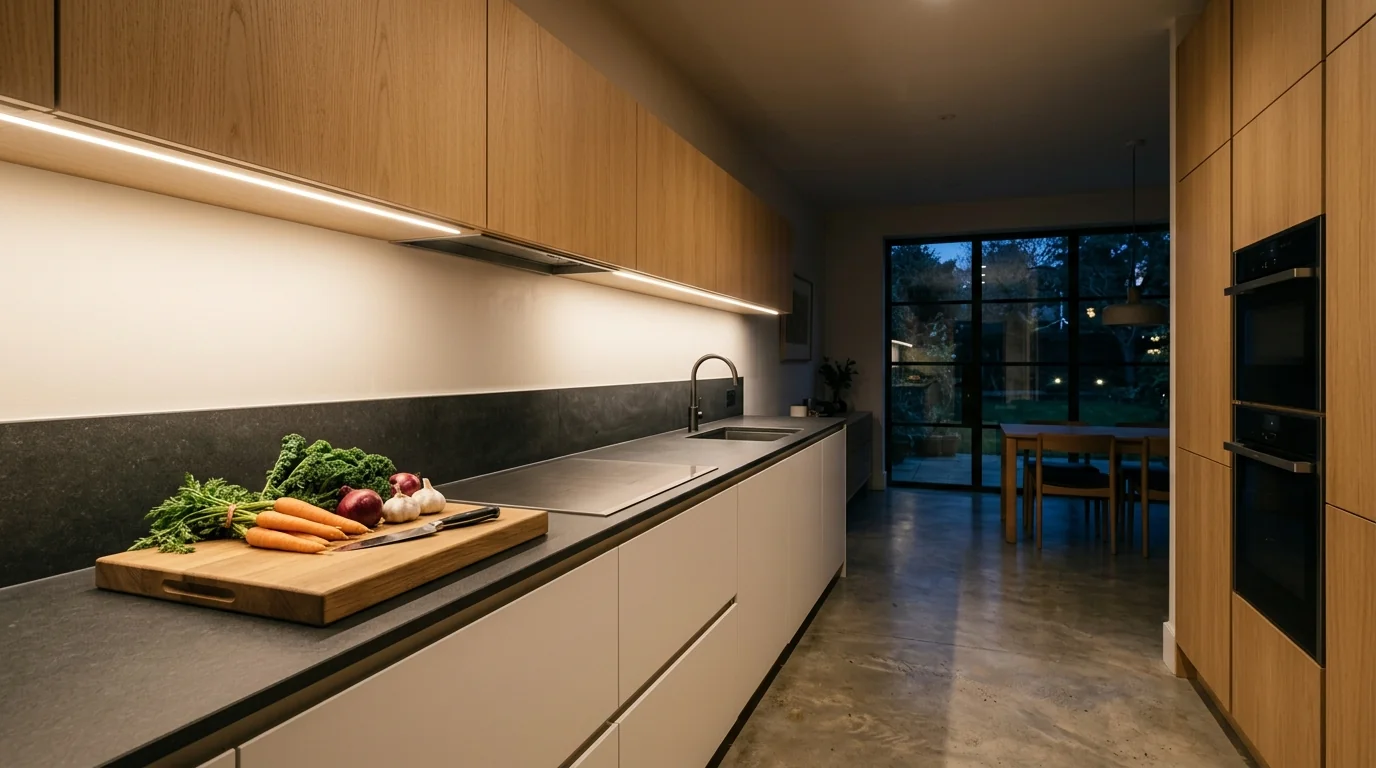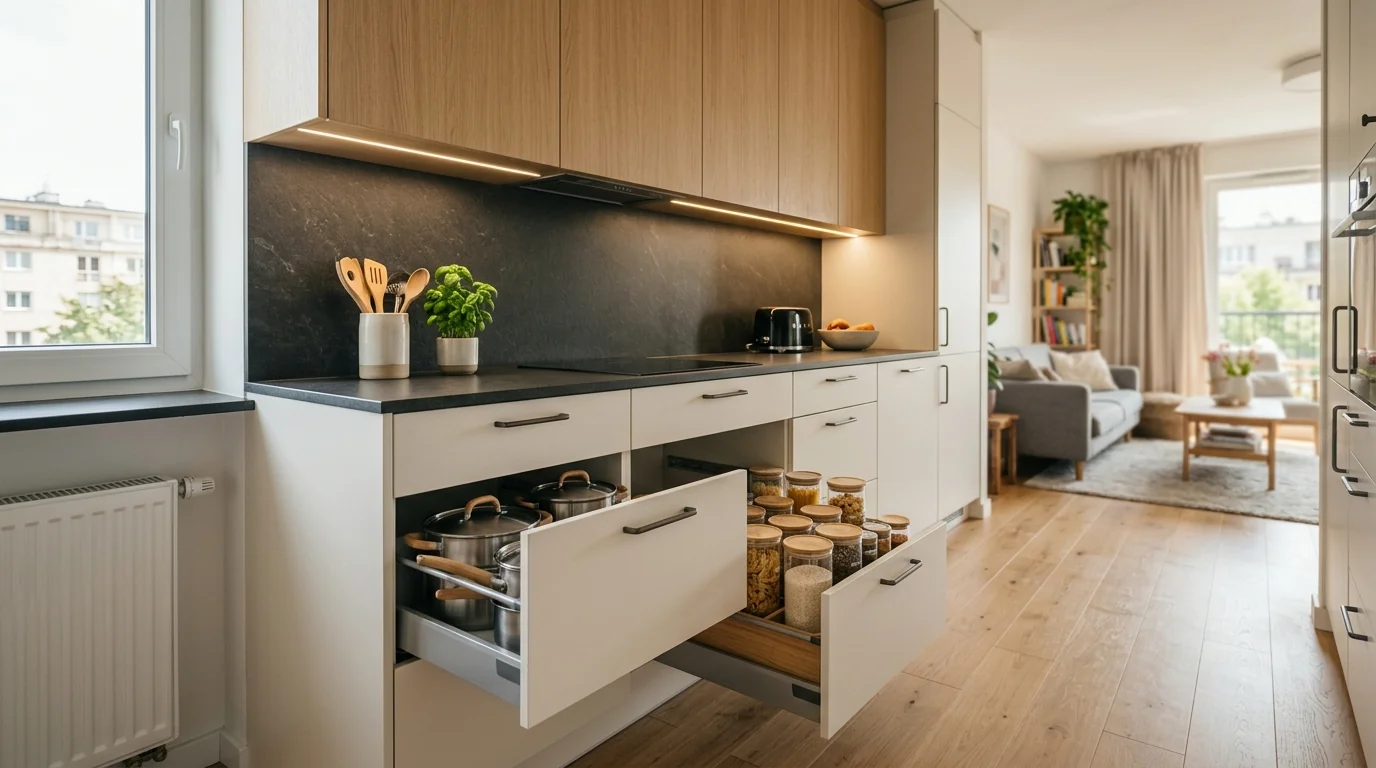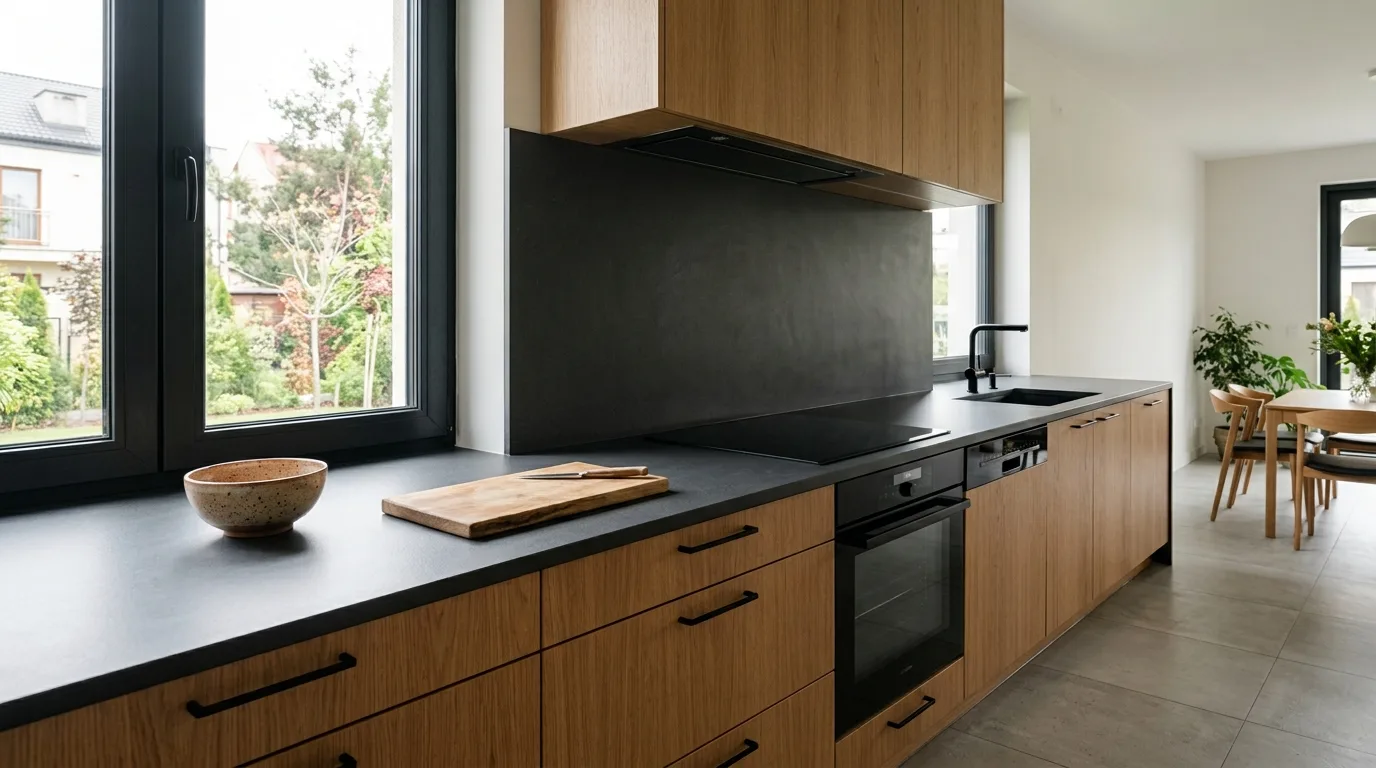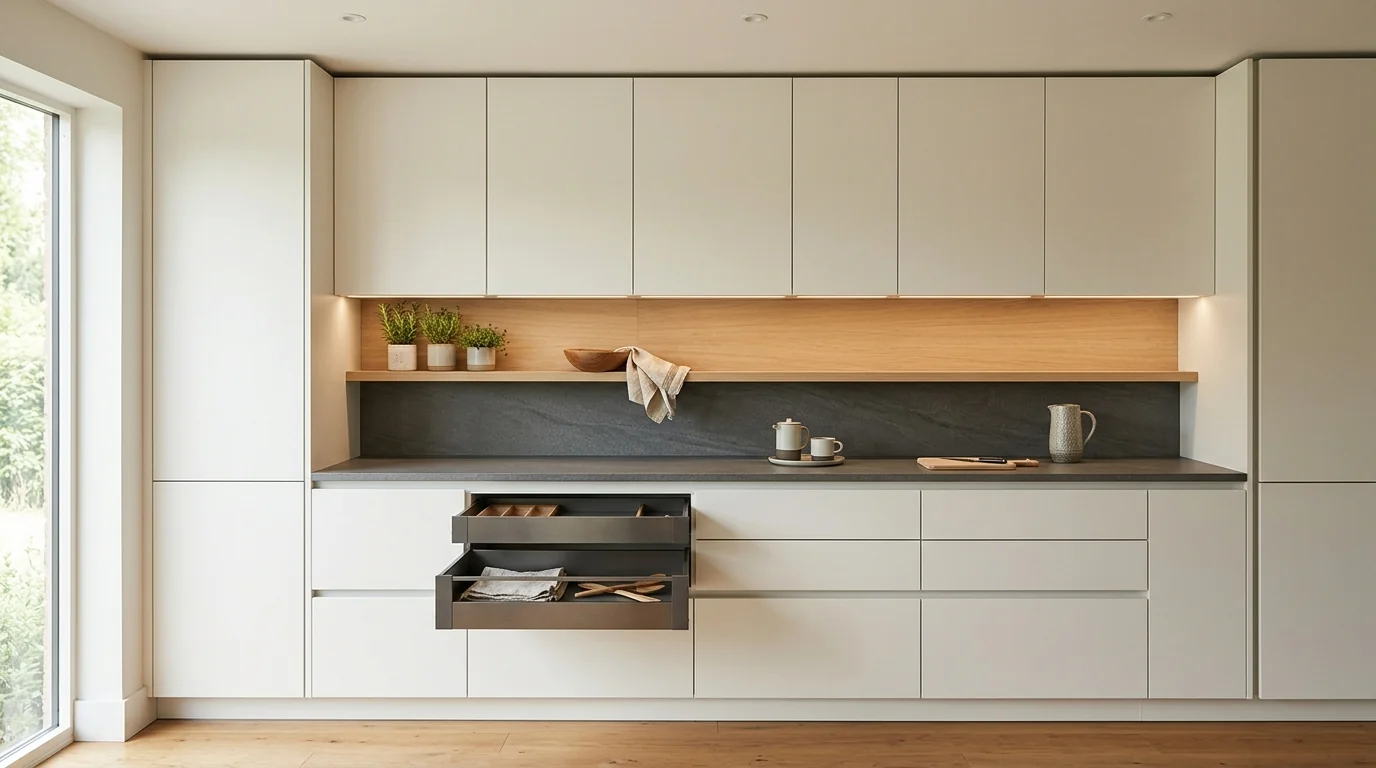
Hardware never shows up in photographs, yet you touch it dozens of times a day. What belongs where: runners, soft close, push-to-open, lift systems and cycles.
Hardware and opening systems are the only part of a kitchen that never appears in photographs and that you touch several dozen times a day. Fronts and worktops decide how a kitchen looks on handover day; runners, hinges and lift systems decide how it works five years later. Below is a guide to what belongs in which cabinet, plus a checklist worth taking to the meeting with your designer.
Why hardware decides how a kitchen works years later
In a bespoke kitchen quote, hardware usually accounts for ten to fifteen per cent of the total and is the first place people economise — precisely because it cannot be seen. Yet it is the only element that works mechanically: the carcass stands still, the front hangs, and the runner travels tens of thousands of times over the life of the kitchen.
The first reason to take it seriously is that it cannot be replaced without dismantling. A handle unscrews in a minute, a front can be repainted, a worktop swapped in a day. Replacing runners in a fitted kitchen means removing the drawers, often taking the carcass apart, and — if the hole pattern differs — drilling fresh holes in the sides.
The second reason is that hardware defines how the furniture is used. It decides whether a drawer travels all the way out or stops twenty centimetres short; whether a front opens with one finger or has to be steadied with the other hand. Neither material nor design compensates for that.
The third reason is quiet. A kitchen open to the living room is now standard, which means every slammed front is heard at the table and from the sofa. Soft close has stopped being a premium extra and become a condition of comfort in a flat where the kitchen is not a separate room.
The fourth reason is dependencies. The choice of opening system affects where a cable to the internal cabinet lighting can run, how deep a drawer can be and how much actually fits inside. Hardware is therefore selected together with the zone layout, not at the very end when everything else is fixed.
Opening systems and hardware: what belongs where
There is no single set of hardware that suits a whole kitchen. A pan drawer works under different conditions than a plate cabinet, and the front above the extractor is opened a few times a year rather than a few times a day. The seven points below organise the choice by where each solution genuinely works — and where it creates more problems than it solves.
1. Drawer runners: full extension and load rating
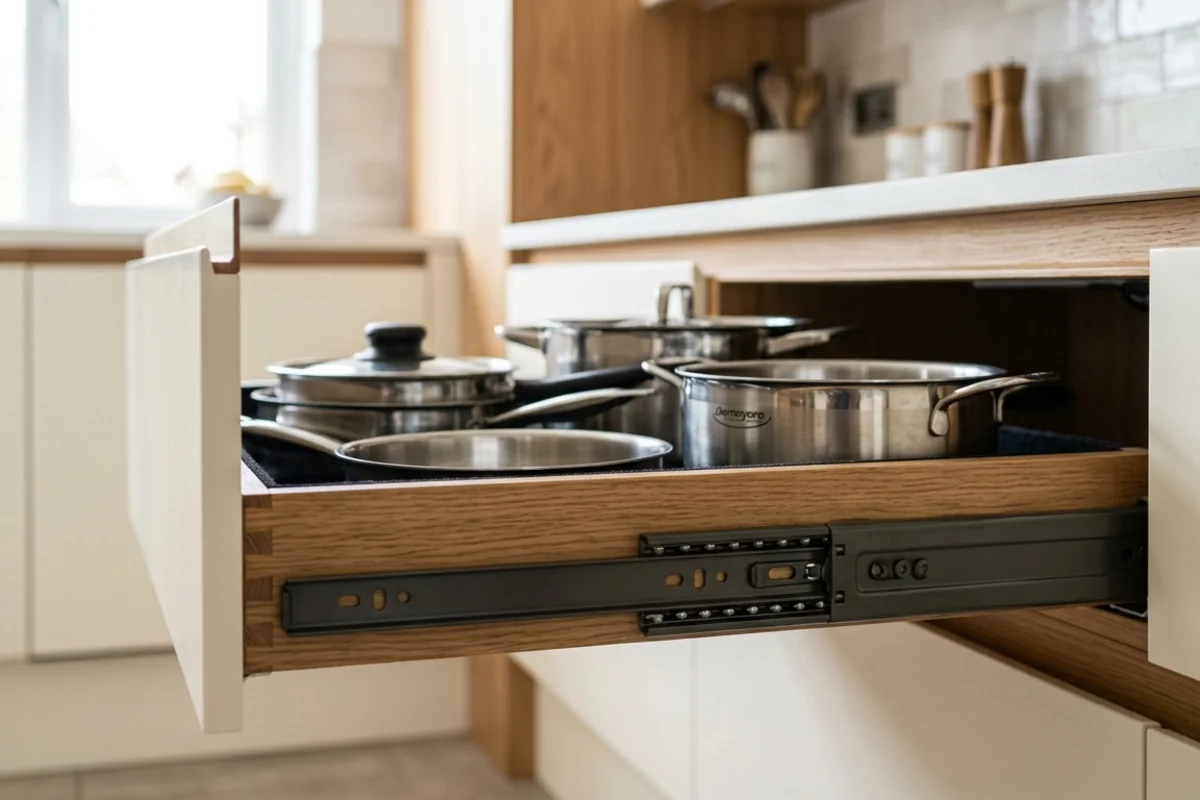
The runner is the single most important piece of hardware in a kitchen, because it decides whether you use the full depth of the unit. A partial-extension version leaves the last fifteen to twenty centimetres inside — exactly where, a year later, the forgotten items live. Full extension brings the entire contents out in front of the carcass, and it is the only version that makes sense in base units.
The second parameter is load rating. A drawer of pans, dry goods or bottles easily weighs tens of kilograms, and a runner specified to the limit begins to sag over time: the front stops holding its line with its neighbours and the soft close works progressively worse. It is worth specifying with headroom, especially in drawers wider than 80 cm.
The third point is the mounting method. Runners concealed under the drawer base look cleaner and do not collect dirt along the sides; roller runners are cheaper but carry less weight and last noticeably less. In a bespoke kitchen the price difference between them spreads across the whole unit and is usually smaller than comparing individual pieces suggests.
2. Soft close: where it helps and where it gets in the way
Soft close is a mechanism that brakes the front over the last few centimetres of travel. In base drawers and in cabinets opened daily it is something you get used to within a week and miss badly afterwards — particularly in a kitchen open to the living area.
There are places where it works less well. Very light fronts may fail to close fully, because the resistance of the mechanism exceeds the momentum available. Conversely, a heavy front in solid timber or with a stone insert needs a stronger version of the damper — a standard one simply will not stop it, and it will close with a bang despite the system being nominally present.
It is also worth remembering that in most systems soft close and push-to-open are mutually exclusive: either the front closes itself or it springs open when pressed. Combining both functions on one front requires a specific hardware set, and that has to be settled at design stage, not during installation.
3. Push-to-open and handleless fronts
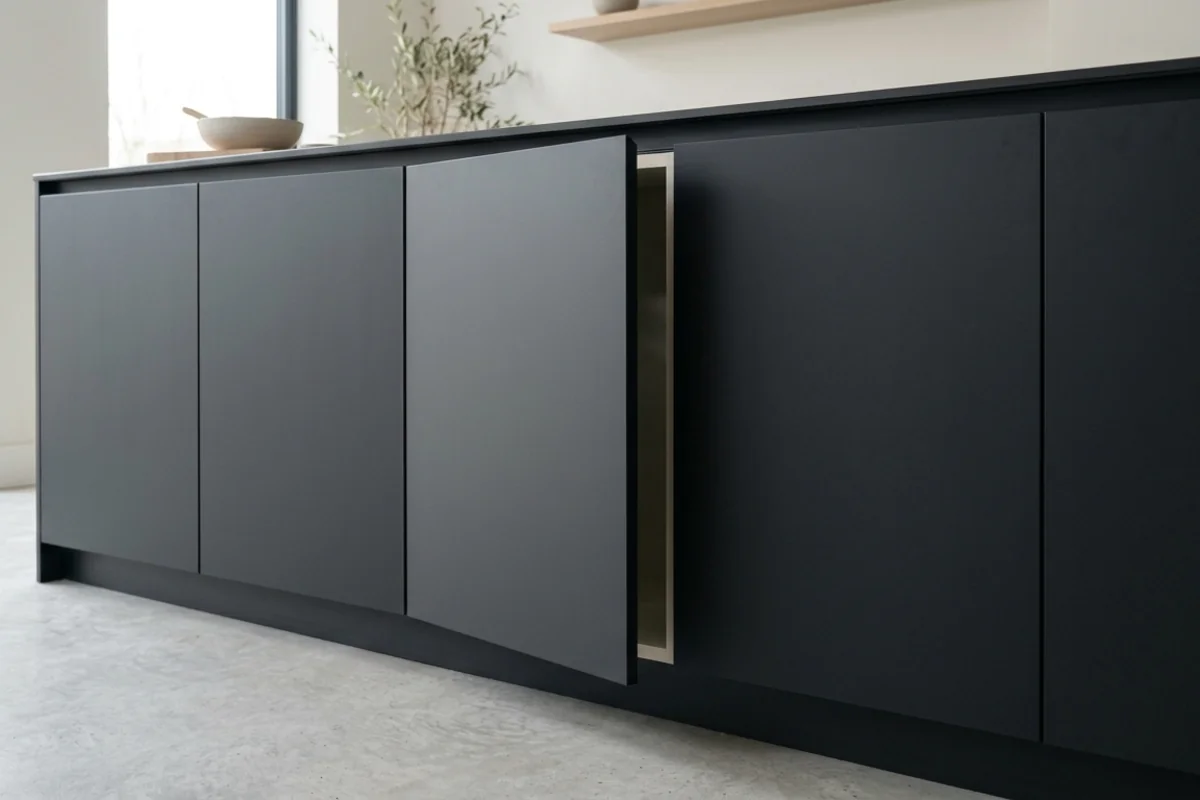
Press-to-open lets you do away with handles and achieve an unbroken wall of fronts — an effect that works especially well in a kitchen visible from the living room. The mechanism is simple: you press the front, a spring pushes it out a few centimetres, and you open it the rest of the way by hand.
It works well in wall units and in cabinets you do not touch with wet hands. It works less well where fronts are dark and matt — after every opening the fingerprints land in exactly the same spot. We strongly advise against it on the sink cabinet and the waste bin: this is the one place in a kitchen where the front is regularly opened with a dirty hand, and sometimes with a knee, which with this mechanism ends in accidental opening.
The alternative to push-to-open is a physical place for your fingers: a chamfered edge milled into the front, or a horizontal handle profile recessed between the modules. The visual result is similar — no protruding handles — but the opening action is mechanical, without a spring that can wear out. In kitchens with small children this is usually the more sensible choice.
4. Handle, milled edge or handle profile
The handle is the most underrated ergonomic element in a kitchen, because it is touched more often than anything else in the home. A classic surface-mounted handle gives the best grip, especially on heavy drawers and with wet hands, and it is the only solution that can be changed without touching the front.
A milled edge — an angled cut into the top of the front — disappears visually and works well on drawers. In wall units it is less comfortable, since you have to reach higher than you would for a handle. A handle profile fitted horizontally between rows simplifies opening whole runs, but it collects dust and grease — near the hob it needs cleaning more often.
The practical rule: the heavier the drawer and the more often it is opened with a wet hand, the more a physical handle pays off. Handleless solutions work best in wall units and in cabinets used less frequently. Mixing systems within one kitchen is fine as long as it follows the logic of the zones rather than chance.
5. Lift systems for wall units
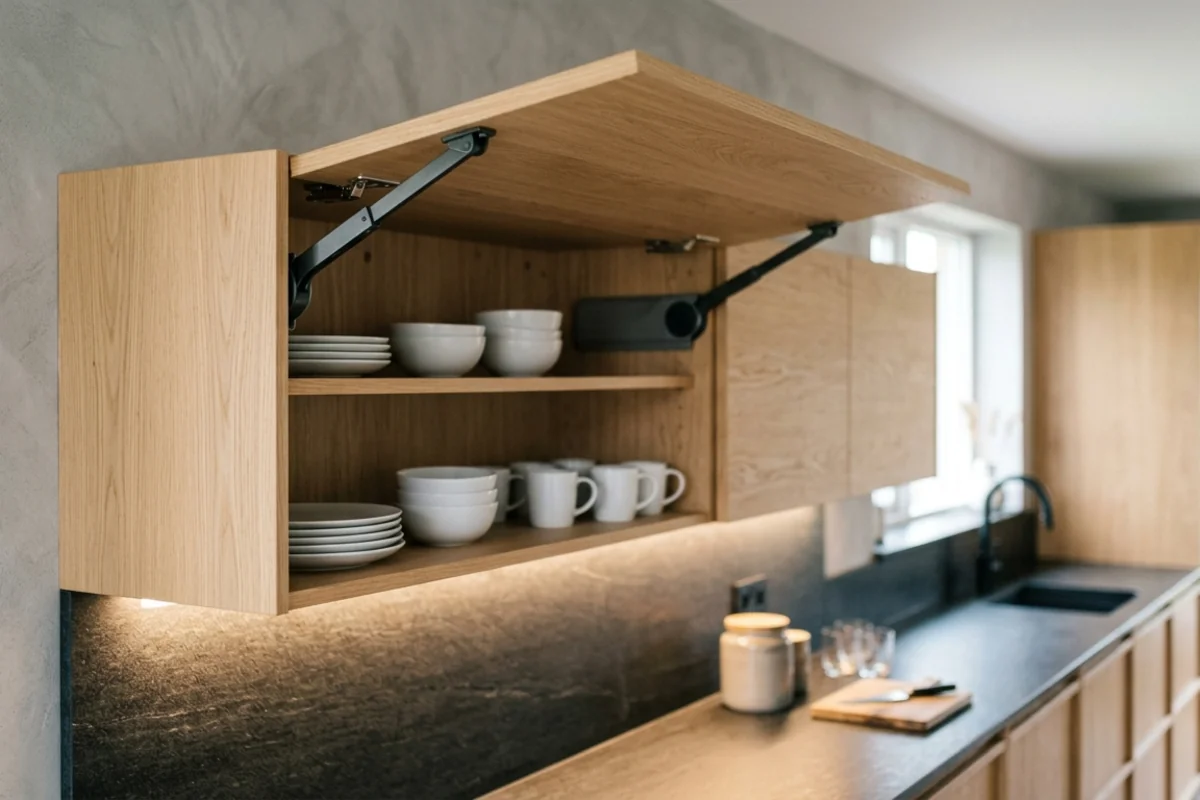
A wall unit with a conventional side-hung door opens sideways and, with cabinets running to the ceiling, can block a walkway or catch the extractor. A lift system raises the front and holds it in any position, which in a narrow kitchen is the difference between comfort and stepping around an open door every day.
The choice depends on two things: the weight of the front and the height of the cabinet. The same mechanism behaves entirely differently with a lacquered front and with glass in an aluminium frame — badly specified, it either drops on its own or needs force to close. The weight of the front is therefore calculated at design stage, together with the hardware, not after it has been fitted.
A bi-fold version is worth considering separately on very tall units: a folding front takes up less space when open and does not require reaching the full height to close it. It costs more, but in a kitchen with cabinets to the ceiling it is usually justified.
6. Hinges and front adjustment
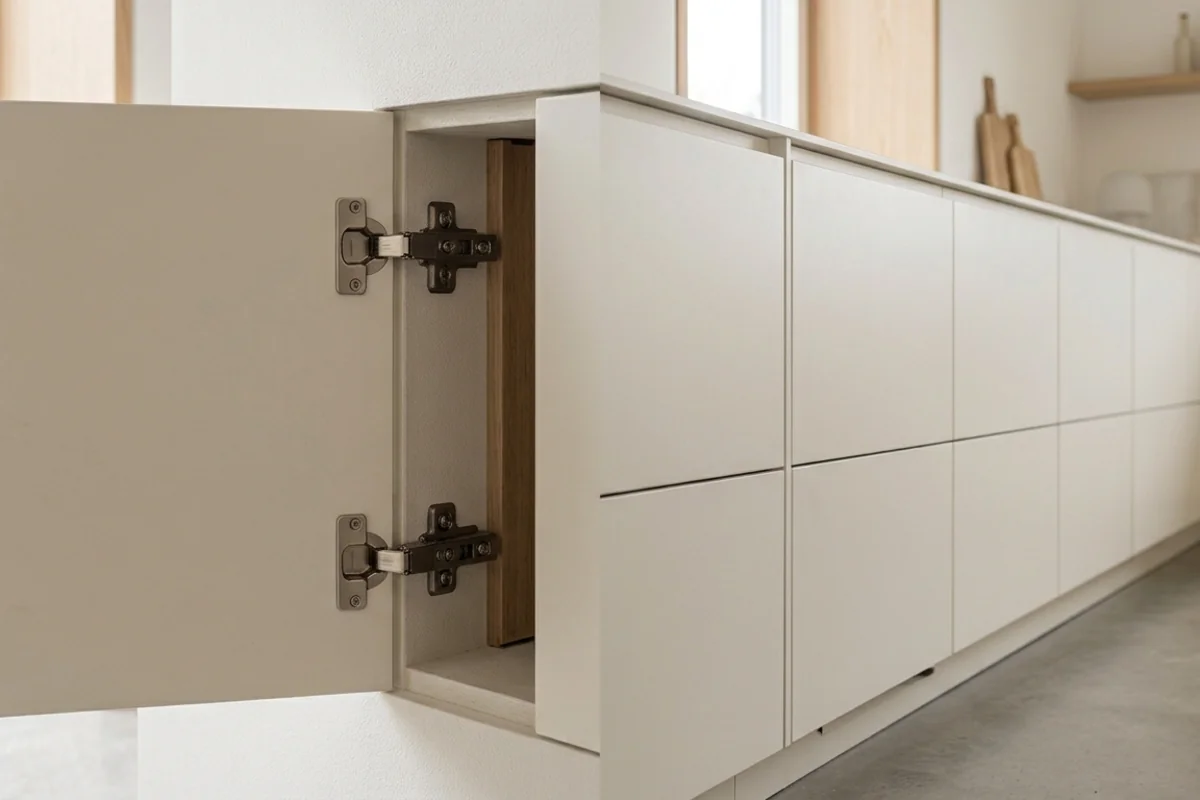
The hinge determines whether the gaps between fronts are even and stay even. Versions with three-way adjustment let you set the front after installation and correct it a season later, when timber or board has moved slightly — without that adjustment the only remedy is re-drilling.
Opening angle is the second parameter worth asking about. The standard 110 degrees is enough for most cabinets, but in a corner, or where a front sits against a wall, a wider range is often needed; otherwise an internal drawer will not pull out with the door open. It is a classic clash that only shows up in a finished kitchen, while on a drawing it takes a minute to check.
Hinges from a reputable hardware manufacturer have one further advantage: they stay on the market for years, so after five or eight years a single unit can be bought instead of replacing the whole set. With the cheapest unbranded hardware it usually means replacing every hinge in that cabinet so the fronts keep one line.
7. Opening cycles: what the stated durability actually means
Hardware manufacturers state durability in opening and closing cycles — most often twenty, sixty or eighty thousand. The number alone says little until it is translated into real use. A cutlery drawer in a family of four is opened more than ten times a day, which is over five thousand cycles a year. The cabinet above the extractor: a dozen times a year.
The practical conclusion is that buying top-class hardware for the entire kitchen makes little sense. What does make sense is not economising where the traffic is heaviest — the washing-up zone, the cutlery drawer and the waste bin, which is opened more often than any other front in the flat.
A second point concerns conditions. Stated cycles are measured at the nominal load; a drawer filled beyond its rating wears out faster regardless of the class of hardware. Front heights and the distribution of contents are therefore decided together with the choice of runners — the same design stage we wrote about in the article on planning storage in a bespoke kitchen.
How to choose hardware for your own kitchen
Before deciding which systems go into the project, answer a few questions. They usually narrow the choice faster than any catalogue.
- Which fronts do you open most often? The waste bin, the cutlery drawer and the cabinet by the sink work many times harder than the rest of the kitchen — that is where hardware is specified with headroom, even if savings are needed elsewhere.
- Is the kitchen open to the living room? If so, soft close stops being an extra and becomes a condition of quiet in the seating area.
- How heavy are the fronts? Solid timber, framed glass and thick boards need stronger hinges and lift systems than standard lacquered fronts.
- Are there small children at home? Push-to-open reacts to accidental pressure, including a knee; in a kitchen with children, handles and a milled edge are often safer.
- How long do you plan to live here? Over ten to fifteen years the difference in hardware class pays for itself within the first decade; for a stay of a couple of years the priorities look different.
There is no single set of hardware that is "the best on the market" — only a set matched to specific joinery and a specific way of using the kitchen.
The most common mistakes when choosing hardware
From conversations with clients who come to us with a kitchen that needs corrections, hardware problems are rarely about quality. Far more often they are about putting the right solution in the wrong place.
- Push-to-open under the sink and on the bin. A front opened with a dirty hand or a knee is the worst possible application of this mechanism; within a month people go back to a handle.
- Runners specified without load headroom. A pan drawer filled to the brim starts to sag, the front loses its line and the soft close stops engaging properly.
- One class of hardware across the whole kitchen. The same mechanism in a drawer opened ten times a day and in the cabinet above the extractor means either overpaying or premature wear, depending on which way the choice went.
- Clashes not checked on the drawing. An open oven door blocking an island drawer, or a front that will not open fully against a wall, are mistakes visible only after installation.
- Hardware with no service availability. The cheapest unbranded systems disappear from the market within a few years and a single part cannot be sourced — the whole set gets replaced.
What it costs and how the project runs
Pricing depends on the number of drawers, the class of runners, the number of lift systems and whether fronts are handled or handleless — a simple single-run kitchen is costed very differently from floor-to-ceiling joinery with an island and press-to-open. That is why every project is quoted individually after a survey rather than from a per-metre price list. In our experience — more than 300 completed interiors and 3,000 m² of our own production — hardware is the line item clients most often say was not worth economising on.
A bespoke kitchen normally takes 2-4 weeks from approved design to installation, depending on the material and current production load. The process runs like this: a survey in the flat, zones and cabinet contents agreed, hardware matched to front weight and opening frequency, clashes checked on the drawing, production, then installation and the adjustment of hinges and the gaps between fronts. That last stage matters more than it seems — it is what decides whether the joinery reads as genuinely made to measure.
The hardware choice is worth weighing against the finish of the fronts: matt surfaces handle fingerprints differently from gloss, which matters especially with handleless solutions — we covered this in the article on matt versus gloss kitchen fronts. Completed work showing both the fronts and the way they open is collected in our portfolio and in the bespoke furniture for the home section.
If you are planning a bespoke kitchen in Warsaw and are not sure where to start, begin with our short style-matching quiz — it will narrow the choice before you sit down with a designer.