Mid-century modern means warm wood, slim tapered legs and the retro optimism of the 1950s. See how to bring this timeless style into bespoke furniture.
Mid-century modern means warm wood, slim proportions and the orderliness of the 1950s and 1960s, where form goes hand in hand with function. It is a style that keeps coming back over the years and never goes out of fashion.
What is the mid-century modern style
Mid-century modern is a movement in interior and furniture design that emerged roughly in the middle of the 20th century, between the 1940s and the 1960s. At its heart was a post-war belief in a better tomorrow and in the idea that good design could be available to many rather than only a few. This is the source of its characteristic retro optimism, lightness and friendly simplicity, which we still read as modern even though more than half a century has passed.
The philosophy is simple: form follows function, and ornament must not get in the way of use. The furniture is honest about its materials, showing the natural grain and not pretending to be anything other than what it is. Instead of heavy masses and rich ornamentation, the designers of those years chose slim silhouettes lifted above the floor on thin legs, which give the interior air and make a room feel larger and brighter.
Although we speak of a single style, it has several variants. The Scandinavian version is lighter, based on pale wood and soft colours. The American version tends to be warmer, with walnut and more decisive colour accents. We also find notes of organic modernism, with flowing, rounded shapes inspired by nature. All share the same core: warm wood, a legible structure and the sense that every element has a reason to be there.
For many people, mid-century modern is today a synonym for timeless retro elegance. It is neither loud nor fashionable in a seasonal sense. Rather, it quietly endures, combines easily with other styles and ages well, both visually and in terms of durability.
Key features of the mid-century modern style
We recognise this style by a few recurring elements that together create its character.
- Warm wood with rich grain. Walnut and teak are classics, their grain pattern is a decoration in itself.
- Slanted, tapered legs. Thin legs set at an angle are the trademark of this era, giving lightness and lifting the body above the floor.
- Flat fronts with a milled handle. Instead of protruding knobs, a recess is milled into the panel, so the front stays smooth.
- Slim proportions. The furniture is lower and visually lighter than in many styles, leaving room for light.
- Functionality without ornament. Every element has a task, and decoration comes from the material and proportions.
- A retro colour palette. Mustard, olive, creams and warm browns build the optimistic mood of this era.
These features do not work in isolation. Slim legs make sense precisely because the body above them is light, and the flat front emphasises the grain of the wood, which is not hidden by a large handle. It is a coherent system in which one thing follows from another.
It is worth remembering that mid-century modern is not a cold or austere style. Despite the simplicity of its forms, it is friendly and warm, mainly thanks to natural wood and soft, muted colours. It is precisely this balance between order and warmth that makes the style work so well in everyday living.
Materials and colours
The foundation of the style is wood with a pronounced grain. It is most associated with walnut and teak, whose warm tone and rich grain give furniture character without any additions. In bespoke furniture we achieve this through natural veneers and European-class boards that faithfully reproduce the grain while staying stable and resistant to everyday use. Where greater durability is needed, for example in kitchen countertops, stone or sintered stone with a calm, uniform texture works well.
The colour palette is one of the most recognisable elements. The base is warm browns and creams, while mustard, olive and muted shades of orange and bottle green play the role of accents. These colours are not garish, they contain a touch of grey, which keeps them pleasant over the years. The accent appears in specific spots rather than on every surface.
Textures here are matte and natural rather than glossy. Wood is usually finished with oil or a matte lacquer that lets you touch the structure rather than merely see it. Metal appears sparingly, in thin legs or details, most often in warm brass or black. This restraint means the wood plays first fiddle and the other materials only accompany it.
Durability matters here not only practically but as a matter of principle. Mid-century modern was from the start conceived as design for years, not for a single season. That is why the choice of solid boards, certified fittings and materials that age with dignity is so important. A well-made piece looks no worse after years, and often more interesting, because the wood gains depth.
Who is the mid-century modern style for
This style suits people who value order and warmth at the same time. It is for those who want neither cold minimalism nor overloaded classicism, but something in between: simple yet cosy. It works in small flats, because slim furniture on thin legs does not overwhelm the space, and in large houses, where it builds a calm, elegant mood. If you are planning interiors for the home, mid-century modern provides a gracious base, easy to complement with personal accents.
It is also favoured by people who appreciate good design. They will value that the furniture refers to recognised mid-20th-century patterns, but in a version adapted to contemporary needs and dimensions. Mid-century modern does not demand austere discipline in keeping order, as extreme minimalism sometimes does, but provides a framework in which everyday life looks good on its own.
This style increasingly appears in commercial spaces too. Warm wood and a calm palette help build the image of a brand that wants to be seen as solid yet modern. In offices or reception areas, it introduces an atmosphere that is professional and friendly at once. If you are arranging a space for business, this style helps you avoid office cliché while not being a risky trend that quickly grows old.
How to bring the mid-century modern style into bespoke furniture
The greatest advantage of bespoke furniture here is the ability to preserve its slim proportions in real, often atypical interiors. Ready-made furniture rarely fits a room perfectly, and mid-century modern lives by its proportions. Designing to measure, we plan the height of cabinets, the spacing of legs and the width of fronts so the whole remains light and balanced rather than accidental.
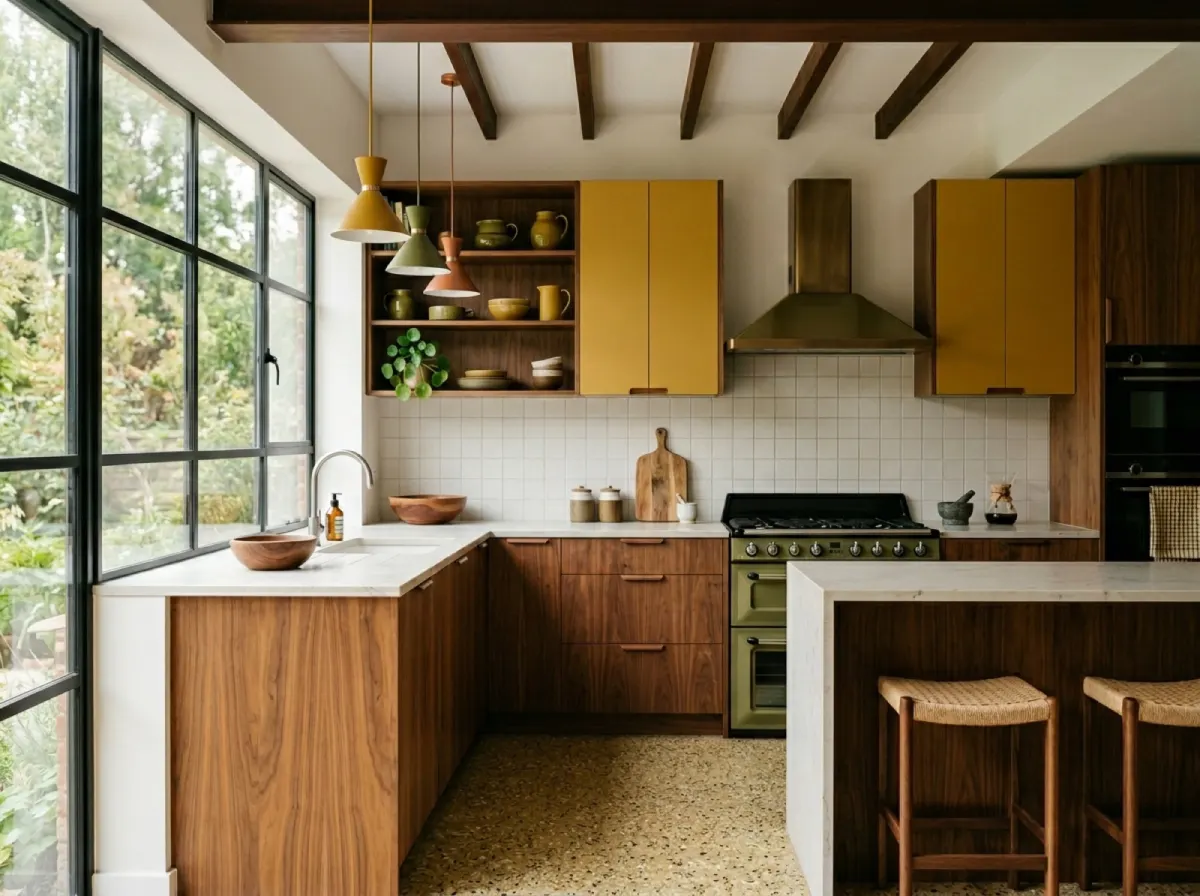
In the kitchen we realise this style through flat fronts with a milled handle, warm wood veneer on selected cabinets and a calm countertop. The lower cabinets can be partly lifted on thin legs or an open zone left to retain the characteristic lightness. It is worth keeping the upper run restrained, so the wood and the accent colour do not compete for attention. Examples can be seen in our portfolio, where you can see how details translate into the overall effect.
In wardrobes and closets, mid-century modern means smooth fronts without protruding handles, warm wood inside and thoughtful organisation. Instead of massive masses, we design units with a calm rhythm of divisions, the proportions of the fronts in tune. The milled handle lets you open doors without spoiling the smooth surface, important for the clean line of the whole wall.
In the living room and bedroom we introduce the style through low sideboards on slanted legs, display cabinets with slim frames and units that do not reach the ceiling, so the interior can breathe. An important element is built-in lighting: gentle illumination of shelves and recesses emphasises the grain and builds a warm evening mood, without harsh glare. Light here should be soft and pointed, a complement rather than the main protagonist.
The mid-century modern style in different rooms
Although the core stays the same, each room follows slightly different rules. Below we show how mid-century modern reads in the individual zones of a home.
Kitchen
In the kitchen the most important things are flat fronts, the milled handle and warm wood combined with a calm countertop. A colour accent, mustard or olive, is best introduced in specific spots, on a selected part of the units or the island. The rest should remain subdued, so the kitchen does not become too loud visually. Thanks to the slim proportions, even a small kitchen gains an impression of lightness.
Living room
The living room is a natural place for low sideboards, display cabinets on thin legs and units around the television in a light, raised form. Here wood with a pronounced grain can appear most generously, because this is a representative space. Open shelves alternating with closed fronts let you display a few objects and hide the rest, maintaining the order characteristic of this style.
Bedroom and wardrobe
In the bedroom, low bedside cabinets on slanted legs and units with a calm rhythm work well. A wardrobe here means smooth fronts, warm wood inside and clear organisation in which everything has its place. Milled handles keep the line of the wall uninterrupted, and muted colours favour rest before sleep.
Bathroom and entrance zone
In the bathroom we introduce mid-century modern carefully, through warm moisture-resistant veneer and a slim vanity cabinet on legs. In the entrance zone a low sideboard or shoe unit with a milled handle gives the interior character right from the threshold. These are places where one well-chosen piece can set the tone of the whole home.
The durability of this style is a matter of value over time, not only appearance. A well-designed mid-century modern piece does not lose relevance, because it is based not on seasonal fashion but on proportions and natural materials. Over the years the wood gains depth and the form stays legible, so the investment pays off in comfort of use.
Importantly, this style allows an individual accent. You can add a single stronger colour, a favourite object from another era or an unusual detail, and the whole still stays coherent. Mid-century modern provides a framework but does not lock you into a rigid scheme, which makes it a gracious starting point for your own ideas.
The most common mistakes
The first and most common trap is overdoing the colour accents. Mustard and olive are beautiful, but on all surfaces at once the interior becomes tiring and loses its nobility. It is better to treat them in specific spots, as a complement to the warm wood and cream base, rather than as a leading colour on every front.
The second mistake is mixing too many species and shades of wood without a plan. Mid-century modern likes coherence, so it is worth choosing one dominant tone, for example walnut, and keeping to it consistently. A random combination of several veneers makes the interior look chaotic, and the slim proportions stop being legible because the eye gets lost in the textures.
The third trap is abandoning slim proportions for massive, heavy masses only because they offer more capacity. A piece that stands heavily on the floor, without being lifted and without air beneath it, loses what matters most. It is better to plan capacity wisely, in depth and internal divisions, than to spoil the external lightness.
The fourth mistake concerns handles. Adding large, protruding knobs to flat fronts cancels out the calm line that is the essence of the style. If a clean surface matters, it is worth keeping to the milled handle or a discreet opening system, rather than reaching for expressive fittings that draw the eye and break up the composition.
How we do it at Grandis
We have been designing and producing bespoke furniture for over 15 years, in a plant of 3 000 m². We have over 300 completed projects behind us, so we know how to translate the slim proportions of mid-century modern into a real interior where everything has to match to the millimetre. We begin with laser measurement, and a visualisation and 3D design are included in the price, so even before production you can see how the details will play together.
We use European-class materials and certified fittings, and the assembly is carried out by our in-house team rather than subcontractors, which means consistent quality of finish. A standard project takes 2-4 weeks, and the price is fixed, with no addenda along the way. So a style meant to last for years is created in a predictable, controlled process.
In mid-century modern, proportions and wood matter most. That is why we measure with a laser, show the 3D design before production and keep a fixed price, so the result is exactly what we agreed.
Frequently asked questions
Does mid-century modern suit a small flat
Yes, and exceptionally well. Slim furniture on thin legs leaves the floor visible and air beneath, so the interior seems larger and brighter than with heavy masses.
Which wood is best for this style
The classics are walnut and teak with a pronounced grain. In bespoke furniture we achieve this through natural veneers and European-class boards that faithfully reproduce the grain and are stable in everyday use.
Can mid-century modern be combined with modern interiors
Yes, it is one of the most flexible styles. It combines well with minimalism, the Scandinavian style and modern accessories, because its simple form and natural materials form a calm base.
How to choose accent colours so as not to overdo it
It is best to choose one accent, mustard or olive, and apply it in specific spots, on a selected part of the units or in accessories. The rest is worth keeping in warm browns and creams.
How long does it take to make furniture in this style
A standard project takes 2-4 weeks. We begin with laser measurement and a 3D design that is included in the price, and the assembly is carried out by our in-house team.