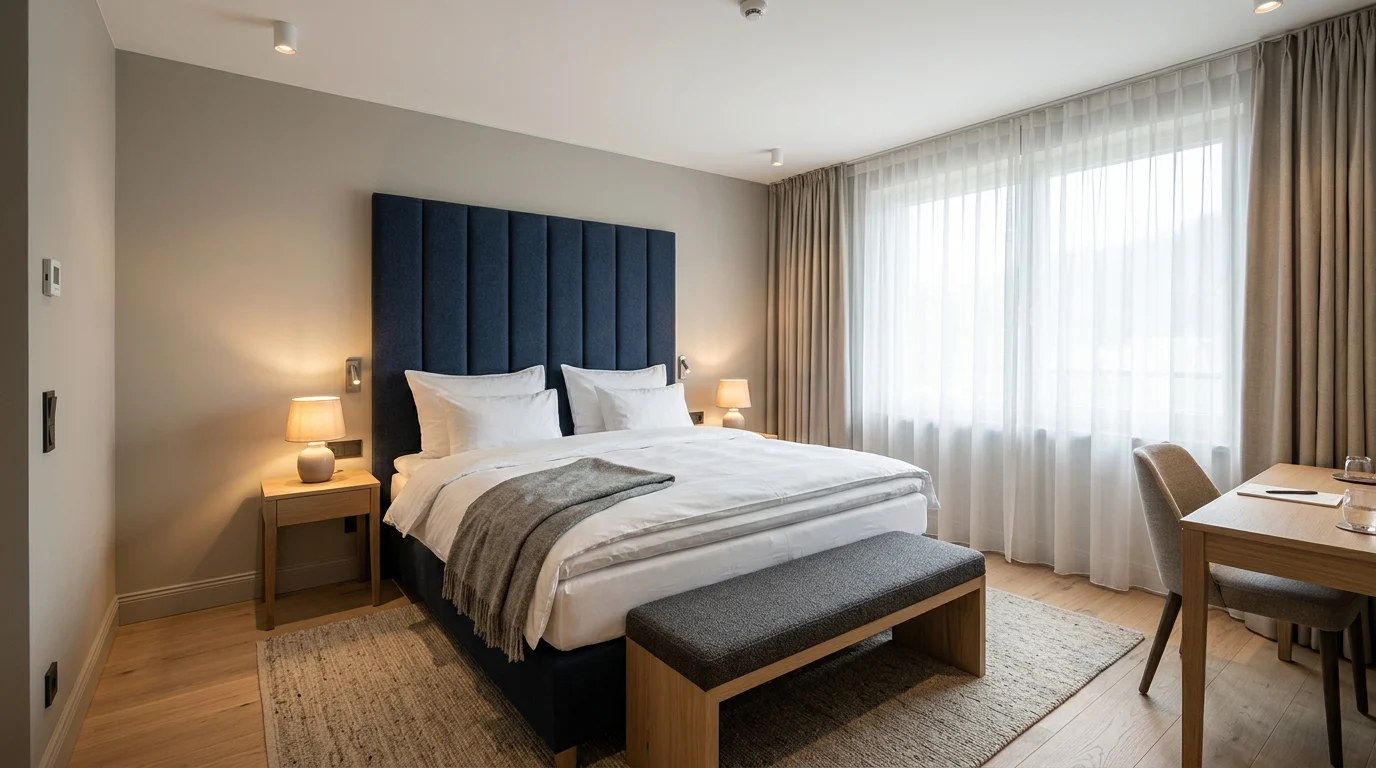
Hotel beds are chosen by room size and layout, not from a catalogue. In Poland, any hotel needs a single bed of at least 90×200 cm and a double of at least 140×200 cm. In practice, two 90×200 cm beds joined into 180×200 cm work best, with a sleeping height of 45 cm or more and a wall-mounted headboard.
In this article
- Hotel bed vs continental bed: what is the difference
- What bed size to choose for a hotel room
- Zip and link hotel beds: twin and double in one room
- Sleeping height: guest comfort and housekeepers' backs
- Headboard on the wall or on the bed
- Servicing and durability of hotel beds
- How to order beds and furniture for a hotel
- Frequently asked questions
This is not legal advice. The text is our review of publicly available sources, prepared with the help of AI. Before deciding, check the current requirements in official sources.
Hotel beds are chosen by room size and layout, not from a catalogue. In Poland, any hotel needs a single bed of at least 90×200 cm and a double of at least 140×200 cm. In practice, two 90×200 cm beds joined into 180×200 cm work best, with a sleeping height of 45 cm or more and a wall-mounted headboard.
A few numbers set the whole choice. According to available materials, a double room in a three-star hotel in Poland usually has at least 14 m², in a four-star 16 m², in a five-star 18 m². Two 90 cm beds set apart with walkways need about 360 cm of room width, and about 300 cm once joined. So whether a room can be sold as a twin one night and as a double the next depends on the floor plan, not on the type of mattress.
Hotel bed vs continental bed: what is the difference
A continental bed, also called a box-spring bed, has three layers. At the bottom is an upholstered sprung base, on top of it the mattress, and above that a thin mattress topper. A classic hotel bed has a frame with a slatted base and one mattress. Both types are used in hotels, and they differ mainly in how they are serviced.
| Feature | Frame with slats and mattress | Continental (box-spring) bed |
|---|---|---|
| Build | frame, slatted base, mattress | sprung base, mattress, topper |
| Sleeping height | depends on the frame, usually lower | higher, because base and mattress add up |
| Frame visible in the room | yes, it has to match the interior | the base is upholstered, no frame needed |
| Joining two beds | harder, frames leave a gap | bases are pushed together and linked, the topper covers the joint |
| Cleaning under the bed | depends on frame height | legs usually up to 20 cm or a base down to the floor |
| Replacing worn parts | mattress separately | topper, mattress and base separately |
A continental bed is not automatically more durable. In an independent consumer test in Germany in 2026, nine continental beds were examined: only one got a good overall rating, and two quickly developed deep dips in the durability test. In some models the mattress is permanently fixed to the base, so it cannot be replaced. When ordering for a hotel, ask not for the name of the system but whether each layer can be replaced separately.
What bed size to choose for a hotel room
A single room needs a 90×200 cm bed, and the minimum for a double room is 140×200 cm. But 140 cm is narrow for two adults, so double rooms more often get 160 or 180 cm. A 180×200 cm bed has an extra advantage: it can be made from two 90 cm beds.
Bed size has to be matched with room area. According to available materials, these are indicative room sizes for hotels by category. The area usually excludes the bathroom, and a smaller figure is sometimes tolerated.
| Hotel category | Single room | Double room |
|---|---|---|
| five stars | 14 m² | 18 m² |
| four stars | 12 m² | 16 m² |
| three stars | 10 m² | 14 m² |
| two stars | 9 m² | 12 m² |
| one star | 8 m² | 10 m² |
In practice you leave at least 60 cm of walkway on each side people get out of bed, and 70 cm is comfortable. The base of a continental bed is usually the size of the mattress. From this it is easy to work out how much room width the sleeping zone alone takes.
| Layout | With 60 cm walkways | With 70 cm walkways |
|---|---|---|
| One 160×200 cm bed | 160 + 2 × 60 = 280 cm | 160 + 2 × 70 = 300 cm |
| Two 90 cm beds joined into 180×200 cm | 180 + 2 × 60 = 300 cm | 180 + 2 × 70 = 320 cm |
| Twin: two 80 cm beds with a walkway between | 80 + 80 + 3 × 60 = 340 cm | 80 + 80 + 3 × 70 = 370 cm |
| Twin: two 90 cm beds with a walkway between | 90 + 90 + 3 × 60 = 360 cm | 90 + 90 + 3 × 70 = 390 cm |
For room length, count 200 cm of mattress, 5–10 cm of headboard and about 70 cm of walkway at the foot. That adds up to about 280 cm. A 3.5 × 4 m room, or 14 m², fits a 180 cm bed comfortably. A twin of two 90 cm beds needs a compromise there, because it is 10 cm short of the minimum walkways.
Zip and link hotel beds: twin and double in one room
Zip and link beds are two single beds that are linked into one double. The hotel can then sell the same room as a twin (two separate beds) for two colleagues or as a double (one shared bed) for a couple. This works best with continental beds, because their bases have no frames to leave a gap.
The link has three parts. The bases are fixed together with a connector so they do not drift apart at night. The mattresses can have a zip along the inner edge that joins them into one surface. A full-width topper goes on top and hides the joint. Two 90×200 cm beds make 180×200 cm this way, and two 80×200 cm beds make 160×200 cm.
Castors or glides under the base decide how easy the bed is to service. Housekeeping separates the beds between stays, so the base has to slide without lifting. Ergonomic practice holds that a hotel bed should weigh no more than 35 kg, so that staff can move it without straining their backs. A heavy base is better ordered with braked castors.
Bedding for two layouts. A hotel with zip and link beds needs bedding sets in two sizes: for 90 cm and for 180 cm. The full-width topper also has to be taken off and stored when the room goes back to the twin layout.
This only makes sense if the room fits both layouts. The table above shows that a twin of 90 cm beds needs at least 360 cm of width. In a narrower room it is better to choose 80 cm beds or sell the room as a double only.
Sleeping height: guest comfort and housekeepers' backs
Sleeping height is measured from the floor to the top of the mattress with the topper. In practice it should be at least 45 cm, because getting up from a lower bed is hard. Continental beds usually clear this minimum easily, because the height of the base and the mattress adds up. Such a bed is easy to sit on and get up from, and housekeeping makes it with less bending.
Higher is not always better. In US hotels, thicker bases and mattresses have raised beds to 64–76 cm (25–30 in). For older and shorter guests and for wheelchair users, such a bed becomes a barrier. A soft topper also sinks under weight, so the height when sitting down differs from the height when getting up.
Under Polish rules, a hotel with more than 50 rooms and suites should have at least one room adapted for a wheelchair user, and above 100, one more for every started 100. In such a room a lower bed on legs works better. It leaves space under the base for the feet of a patient hoist, and the light switches must be reachable from the bed. In US practice, a bed height of 43–58 cm is used for such a room. A base that goes down to the floor does not let a hoist roll in.
Height matters for servicing, too. Bed-making is one of the most physically demanding tasks in housekeeping, although studies differ on how big the risk is. A bed higher than 45 cm, on castors, with a mattress that does not have to be lifted to fit the sheet, makes every linen change easier.
Headboard on the wall or on the bed
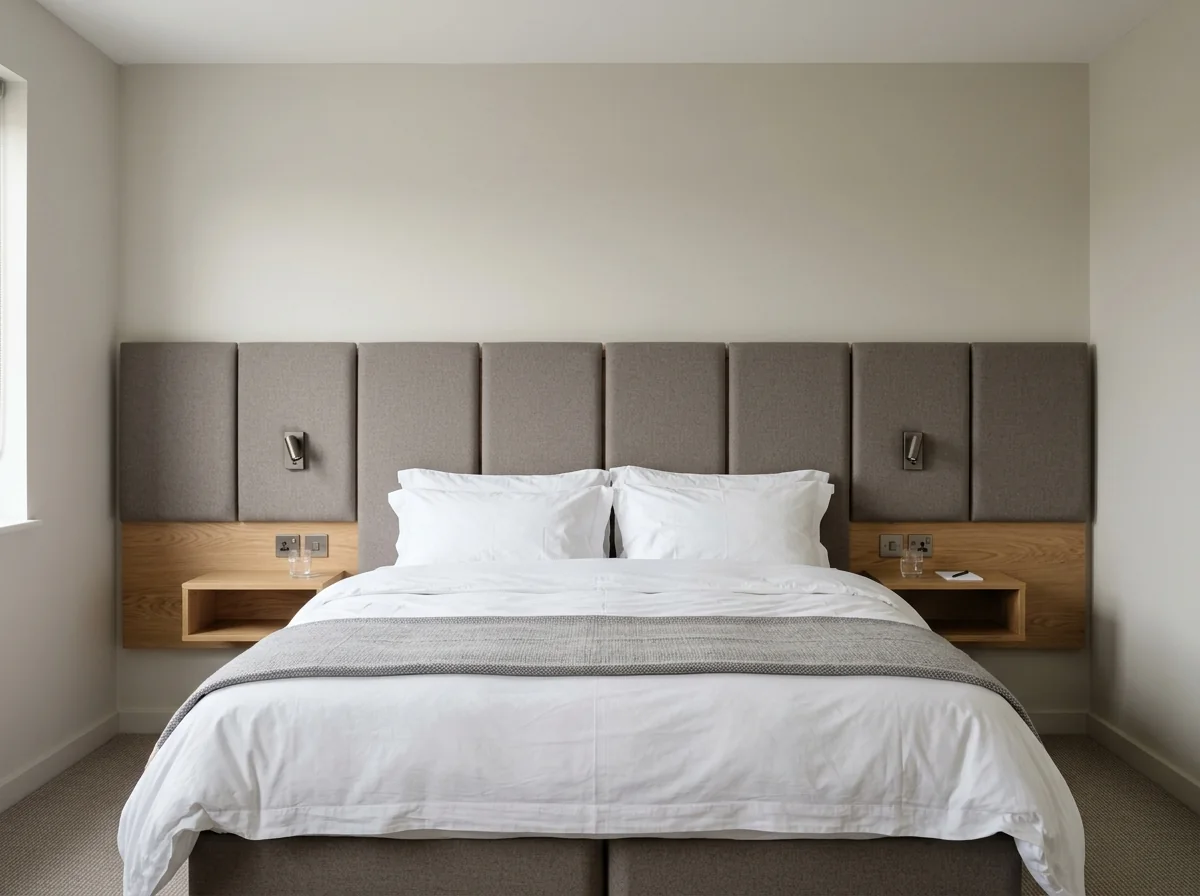
Upholstered headboards in hotels are most often mounted on the wall, not on the bed. A wall panel does not move when the bed is made and does not knock against the wall. Above all, it fits both layouts. A wide panel behind the bed covers either one 180 cm bed or two 90 cm beds with a walkway.
A headboard fixed to each bed separately turns into two separate panels with a visible gap once the beds are joined. So with zip and link beds, a wall headboard is really the only sensible choice. A panel the full width of the wall can be combined with bedside tables, shelves and lamps into one built-in unit. Every sleeping place in a hotel needs a bedside table or shelf and a lamp you can read by lying down.
It is best to plan sockets and chargers on both sides of the bed in the panel from the start. The cables then run behind the upholstery instead of across the wall. We showed a similar combination of headboard and bedside tables in our article on rounded bedroom furniture.
A headboard's upholstery works differently in a hotel than at home. Heads rest against it, and coffee and cosmetics end up on it, so abrasion resistance, easy cleaning and a fire-retardancy certificate matter. How to compare fabrics for these loads is covered in our article on HoReCa furniture. A fabric panel slightly reduces reverberation in the room, but it will not stop noise from behind the wall. More on what soft surfaces do is in our article on acoustic panels.
 AI-generated
Panels that lift off the rail. A headboard made of segments hung on a mounting rail can be taken down for cleaning or replaced one piece at a time. A stain means replacing one segment, not the whole wall.
Servicing and durability of hotel beds
A hotel bed wears out in layers. The topper and mattress go first, the base more slowly, and a wall headboard lasts longest. That is why a setup in which each layer is replaced separately, without throwing away the rest, works best.
A few decisions at the ordering stage make daily work easier:
- Removable, washable covers. A topper with a zipped cover comes off for washing. A mattress protector guards the mattress against stains.
- Base on legs or down to the floor. Legs let you vacuum under the bed. A base down to the floor collects no dust underneath, but is harder to move.
- Rotating the mattress. The mattress is rotated head to foot regularly, and the frequency should be written into the hotel's standard according to occupancy. The mattress then wears more evenly.
- Spare parts. Two or three spare toppers and upholstery segments let you replace a damaged item the same day.
If the hotel has several dozen rooms, it is worth writing one standard for all beds. It covers dimensions, sleeping height, connector type, fabric and how the headboard is mounted. For the next order or a replacement a few years later, there is no need to rebuild the specification from scratch.
How to order beds and furniture for a hotel
The order starts with the room plans, and fabrics come later. First decide which rooms will be twin, which double, and which must work in both layouts. That determines the bed widths, the connector type and the width of the panel behind the bed.
- Floor plan and room list. The dimensions of each room type and the position of windows, doors, radiators and sockets. The walkway calculation shows whether the room fits a twin of 90 cm beds.
- Layout and sizes. Beds of 80, 90 or 160 cm, linked or fixed, on castors or on legs.
- Headboard and bedside zone. Wall panel, bedside tables, lamps, sockets, sleeping height.
- Model room. With a larger number of rooms, it is worth fitting out one room first. It is used to check height, walkways and housekeeping work before the order covers the whole hotel.
- Measurement, design and contract. On-site measurement, then a design with visualisation, a quote and a deadline in the contract.
We also work with upholstered furniture. For each project we make upholstered bed bases and headboards, as well as everything that surrounds the bed in the room: bedside tables, desks, wardrobes and built-in units across the wall behind the bed. We also make custom furniture for business, among others for offices and service premises. We have more than 300 projects and more than 15 years of work behind us. The furniture is made in a 3,000 m² production facility and installed by our own permanent team.
Laser measurement is free. After it we prepare a design with visualisation and a quote. The cost depends on the number of rooms, the panel dimensions, the fabric and what goes into the units, such as lamps, sockets and drawers. We give the exact amount in the quote, and the price and deadline go into the contract. We work across Poland and Europe, and the cost of travel and installation for more distant addresses is agreed in advance. To start, just book a measurement.
This article is for information only and describes design practice as of October 2026. According to available materials, the Polish hotel category requirements changed on 15 September 2026, but the minimum bed and room sizes stayed the same, and 6 months to adapt is stated for hotels that already have a category. Before applying for a category, check the current regulations; we do not replace an adviser on this.
Frequently asked questions
How is a hotel bed different from a home bed?
The sizes are the same; the servicing is different. A hotel bed is made every day and moved between stays, so it has castors or glides, removable covers and fabric that stands up to heavy use. It can often be joined with a second bed into one double.
Does a continental bed need a topper?
It does not have to, but in a hotel a topper pays off. It wears out first and is cheaper to replace than the mattress. With zip and link beds, a full-width topper covers the joint between the two mattresses, so the guest does not feel the gap.
How long does a hotel mattress last?
There is no single number, because lifespan depends on occupancy, mattress quality and rotation. That is why it is better to plan replacement in layers. The topper and mattress are replaced more often, the base and headboard less often. Rotating the mattress regularly evens out wear, and the frequency is best set by occupancy.
Who makes custom hotel beds?
Upholstered bases and headboards for a specific room are made by a custom furniture maker, together with bedside tables and built-in units around the bed. The mattress is chosen to match the size of the base. The scope of work and the materials depend on the budget and are agreed in the design, after the measurement.