FSC certification confirms that the wood in a product comes from forests managed under FSC rules, recycled material or verified sources, and that supply chain companies pass independent audits. Polish law does not make it mandatory in public tenders. A buyer may ask for it but must also accept an equivalent label, such as PEFC.
In this article
- What FSC certification means and who issues it
- Three FSC labels and their PEFC counterpart
- Is FSC mandatory in Polish public tenders?
- Where FSC really opens doors
- Who needs the certificate: the furniture maker or the board supplier
- How to check a contractor's FSC certificate
- What to write in a request for quotation
- Frequently asked questions
This is not legal advice. The text is our review of publicly available sources, prepared with the help of AI. Before deciding, check the current requirements in official sources.
FSC certification confirms that the wood in a product comes from forests managed under FSC rules, recycled material or verified sources, and that supply chain companies pass independent audits. According to available materials, Polish law does not usually make it mandatory in public tenders. A buyer may ask for it but usually also accepts an equivalent label, such as PEFC.
FSC works as a real entry pass elsewhere. It counts in fit-outs for green-certified buildings, with companies that have their own purchasing policy, and in export. In January 2026, 62% of Poland's forests held FSC certification, and 2,235 chain of custody certificates were active in the country. The detail most often missed is the order of links in the chain. A certified board does not turn a piece of furniture into "FSC furniture" if its maker holds no certificate of its own.
What FSC certification means and who issues it
FSC (Forest Stewardship Council) is an international organisation that sets rules for responsible forest management and wood tracking. It does not issue certificates itself. Independent certification bodies do that, checking every year whether a company follows the rules. A certificate is valid for five years.
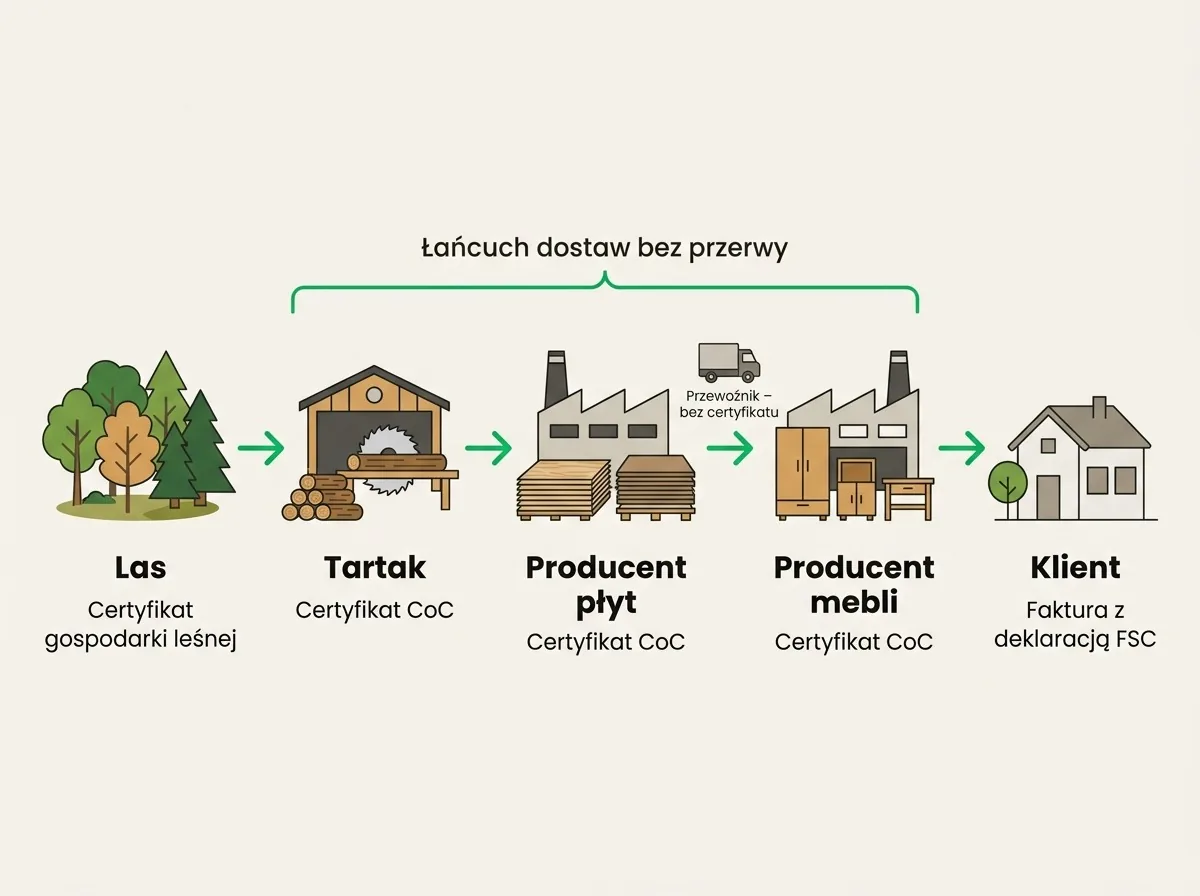
The system has two parts. Forest management certification goes to whoever manages the forest. Chain of custody certification, CoC for short, goes to every company that buys, processes or sells wood with an FSC claim: a sawmill, a board producer, a furniture maker, a wholesaler. It keeps certified wood from being mixed with other wood along the way.
The certificate covers the origin of the wood. It says nothing about the durability of the furniture, emissions from the board or the quality of the work. Those are checked separately.
Three FSC labels and their PEFC counterpart
The tree logo comes in three versions. They differ in where the raw material comes from, and that difference decides whether a product meets the requirement of a given order. Alongside FSC, Poland often sees a second wood certification system, PEFC.
| Label | What the product contains | What to watch |
|---|---|---|
| FSC 100% | only wood from FSC-certified forests | the narrowest requirement, all material from FSC forests |
| FSC Mix | at least 70% FSC-certified or recycled material, the rest controlled wood | enough, among others, for green building certification |
| FSC Recycled | only recycled material | the wood does not come directly from the forest |
| FSC Controlled Wood | wood from outside certified forests, assessed as low risk of illegal logging | not a product label, usually does not count towards green building certification |
| PEFC Certified | at least 70% PEFC-certified material, the rest from controlled sources | a separate system, usually accepted as equivalent in procurement |
The label or invoice shows a licence code in the format FSC-C plus six digits. It leads to a specific company in the public certificate database.
Is FSC mandatory in Polish public tenders?
Not by law. A public buyer in Poland may require a specific label if the contract has defined environmental features. However, according to available materials, it is usually taken that any label confirming equivalent requirements is accepted. If a contractor could not obtain the label in time for reasons beyond its control, the buyer accepts other evidence, such as the manufacturer's technical documentation, provided the contractor proves that the furniture meets the label's requirements.
In practice, this means three situations. If the tender documents ask for "FSC certification or equivalent", PEFC usually qualifies. If they ask for nothing, the certificate gives no advantage unless it earns points in the evaluation criteria. If they demand it directly with no equivalent, it is worth raising the clause with the buyer before submitting a bid.
In green public procurement across the EU, the baseline is the legal origin of wood, and FSC and PEFC are accepted as sufficient proof. It is also usually not the practice to demand 100% certified wood. A common practice is a threshold of about 25%, and 70% for more ambitious contracts.
FSC and PEFC count in a similar way. In public procurement in Poland and the EU, both systems are usually treated as equivalent. A valid PEFC certificate as a rule meets a requirement written as "FSC or equivalent".
Where FSC really opens doors
It works most strongly in private projects. Offices, hotels and apartment blocks often seek multi-criteria green certification. One such scheme assesses built-in furniture, such as kitchen units, permanently fixed desks or toilet cubicles. Freestanding pieces are excluded from that assessment.
 AI-generated
In the same scheme, FSC Mix and PEFC are enough to show responsible sourcing of wood. Controlled wood alone is not. The proof is invoices, delivery notes or orders carrying the certificate claim. If the general contractor is collecting credits for materials, it will ask for these papers at handover.
The second area is companies with their own purchasing policy and non-financial reporting. We wrote about how furniture choices affect such a report in our article on ESG reporting in procurement.
The third is the new EU rules on deforestation-free products. According to available materials, they also cover wooden furniture and apply from 30 December 2026. Micro and small companies got six more months, but not for wooden furniture: here the date is the same for everyone. FSC certification helps with risk assessment. Official sources state, however, that it does not replace the due diligence obligation of the company placing the furniture on the market.
Who needs the certificate: the furniture maker or the board supplier
Every company that takes ownership of the wood and wants to sell it on with an FSC claim. The chain cannot have a gap. If the board producer is certified but the furniture maker is not, the finished furniture cannot reach the client with an FSC claim on the invoice, even though the board carried one.
There are two exceptions. Service companies that do not take ownership of the goods, such as a carrier, do not need a certificate. A seller without its own certificate may trade finished products if they are already labelled and bought from an FSC supplier. Custom furniture, however, is made by the manufacturer from boards and veneer, so this exception does not apply to it.
A certified manufacturer may outsource part of the work, such as lacquering. It is usually taken that the subcontractor is then covered by the manufacturer's certificate or hold its own.
Two different requirements under one name. "Furniture made from FSC-certified materials" and "FSC furniture" are different things. In the first case, the board supplier's documents are enough. In the second, it is usually taken that the furniture maker itself holds a chain of custody certificate.
How to check a contractor's FSC certificate
The check takes a few minutes and is free. You need the licence code or certificate code from the contractor. It is best done before signing the contract, because at handover it is too late to change contractors.
- Ask for the codes. The licence code has the format FSC-C plus six digits. Invoices also show a certificate code whose first letters stand for the certification body.
- Enter the code in the public FSC certificate database. It shows the company name, certificate status and expiry date. Data may be updated with a delay of up to 24 hours.
- Check the scope. A certificate alone does not prove that a specific product is covered. The database shows which product groups it includes. Furniture or the boards used for it must fall within them.
- Put the invoice claim in the contract. A certified product is sold with an FSC claim on the invoice and delivery note, naming the category, such as FSC 100% or FSC Mix. Without it, the chain breaks.
- Agree what happens if the certificate is lost. A certificate may expire or be suspended during the job. It is worth stating in the contract that the contractor reports this immediately.
A logo in a catalogue is not proof. An FSC mark in an offer or on a contractor's website settles nothing. Only a certificate holder may put the label on a product, and the product's status is decided by the claim on the invoice.
What to write in a request for quotation
A precise clause saves questions at the bidding stage. Instead of a general "furniture with FSC certification", specify four things.

- Which system. FSC, PEFC or "FSC or PEFC". A clause with an equivalent opens the contract to more bidders.
- Which label. For green building certification, FSC Mix is usually enough. Controlled wood is better excluded if the building is collecting credits for materials.
- Which elements the requirement covers. Board, veneer and solid wood, yes. Metal frames, glass and hardware are outside the system.
- Which documents on delivery. The invoice claim, the manufacturer's certificate code and, for materials, the board suppliers' codes.
The cost and lead time of such an order depend, among other things, on whether the chosen decor and board thickness are available in a certified version. That is why it pays to state the requirement before the design is approved. Then it is clear from the start whether such material can be sourced and what documents the furniture manufacturer can provide. We covered the differences between the boards themselves in our article MDF vs particleboard.
The certificate requirement and label type are best raised at the first contact with the contractor, for example when you book a free measurement. The contractor will then answer before quoting whether and with which documents it can meet them.
This article is for information only and reflects the situation as of October 2026. It is not legal advice. The interpretation of a specific tender's clauses is best discussed with the buyer or a public procurement lawyer.
Frequently asked questions
Is FSC-certified furniture of better quality?
Not because of the certificate. FSC confirms the origin of the wood and control of the supply chain. Durability, board emission class and assembly quality are separate parameters to ask the contractor about.
How does FSC differ from PEFC?
They are two independent wood certification systems with a similar aim. The PEFC Certified label, like FSC Mix, requires at least 70% certified material. In public procurement, both systems are usually treated as equivalent.
Is wood from Polish forests FSC-certified?
To a large extent, yes. According to FSC, in January 2026, 62% of Poland's forests held FSC certification. Certificates have limited validity, so it is worth checking the current status in the database.
Can a company without FSC certification bid in a tender that requires it?
Yes, if it has equivalent proof. According to available materials, the buyer usually accepts an equivalent label, and PEFC usually is one. If the contractor could not obtain the label for reasons beyond its control, the buyer accepts other appropriate evidence. The contractor must, however, show that the furniture meets the label's requirements. If the clause is unclear, it is worth asking before submitting a bid.
Who can put the FSC logo on furniture?
Only a chain of custody certificate holder. Companies without a certificate may promote only finished products that are already labelled and bought from an FSC supplier, and for that they need an FSC promotional licence.
Is FSC certification enough under the new EU deforestation rules?
No. The certificate makes risk assessment and supply tracking easier. Official sources state that the due diligence obligation still rests with the company placing the furniture on the market.