How MDF differs from chipboard and MFC: density, moisture, formaldehyde, price. Where each board goes in a kitchen or wardrobe and what to ask your maker.
In this article
- MDF vs chipboard and MFC: what the difference is
- What is made of what in kitchens, wardrobes and commercial furniture
- Moisture and heat: the weak points of both boards
- Formaldehyde: one limit for both boards
- How the choice of material affects price and service life
- What to ask your furniture maker before signing the contract
- Quick answers
- Sources
In the MDF vs chipboard question, the starting point is what each board is made of. Chipboard is pressed from wood chips, MDF from fine wood fibre. That makes MDF denser, heavier and suitable for routing and painting. Bespoke furniture rarely uses just one of them. Carcasses and shelves are usually made of melamine-faced chipboard, while MDF goes into painted, routed and curved fronts.
Since 6 August 2026 a single formaldehyde emission limit, 0.062 mg/m³, has applied in the EU to furniture made of either material. We price made-to-measure kitchens at roughly 1 200 to 2 800 zł per linear metre, meaning per metre of the length of the kitchen run. We give the exact price after the site measurement.
One detail usually gets lost in comparisons. The European standard EN 312 assigns standard furniture-grade P2 chipboard to dry conditions. You will have to ask about the unit under the sink separately.
MDF vs chipboard and MFC: what the difference is
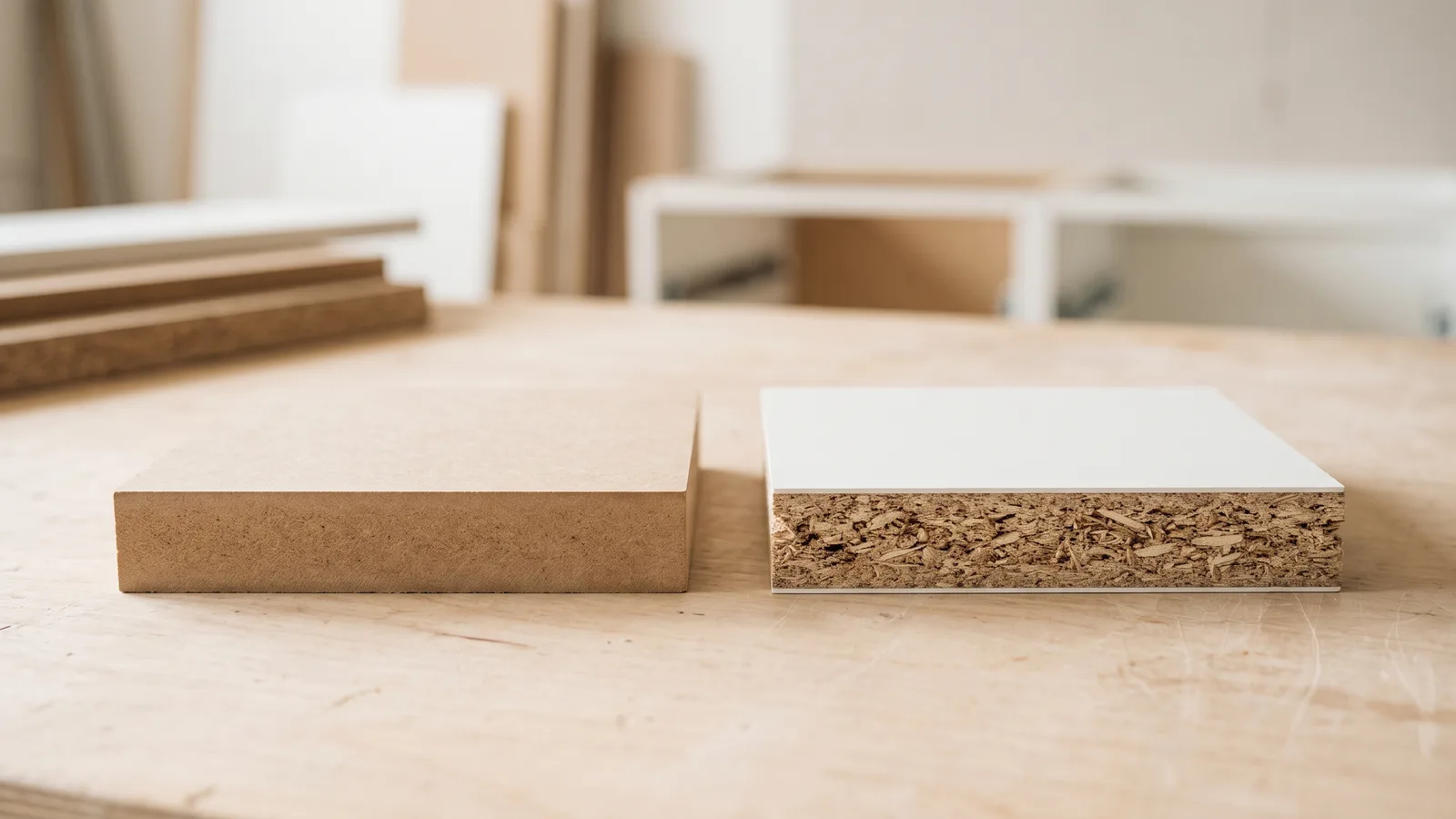
Both materials are wood-based panels, and what sets them apart is particle size. Chipboard, also known as particleboard, consists of wood chips bonded with synthetic resin, and its requirements are set by the European standard EN 312. MDF (Medium Density Fibreboard) is a fibreboard made by the dry process, and it is covered by EN 622-5. The fine fibre gives a uniform cut surface that can be routed and painted.
MFC, melamine-faced chipboard, is the same chipboard given a decorative melamine layer at the board factory. European documents call it melamine-faced board. MDF more often arrives at the furniture maker unfinished. It gets its paint, veneer (a thin slice of natural wood) or foil from the furniture manufacturer.
The table brings together the differences that matter when you order furniture.
| What we compare | MFC | MDF |
|---|---|---|
| Raw material | wood chips and synthetic resin | wood fibre, dry process |
| Cut edge | chips of different sizes are visible | smooth and uniform |
| Machining | straight cutting and edge banding | routing, rounded edges, curved parts |
| Surface | finished decor, no finishing needed | unfinished, needs paint, veneer or foil |
| Grade for humid rooms | type P3 | MDF.H |
| Where it usually goes | carcasses, shelves, flat fronts | painted and routed fronts |
At the same thickness MDF is heavier: a front made of it weighs more than the same front in chipboard.
MDF also holds fixings better. A 2020 study in the journal Maderas. Ciencia y tecnología compared MDF and chipboard panels. In almost every combination of conditions the screw was harder to pull out of MDF. In both materials a screw driven into the edge held less well than one driven into the face, the broad flat side of the board.
You can tell the boards apart by the cut edge. Chipboard usually shows chips of different sizes there, while MDF has a smooth, uniform cut. In finished furniture the edges are covered with edge banding, so the type of board is more reliably checked in the specification attached to the contract.
What is made of what in kitchens, wardrobes and commercial furniture
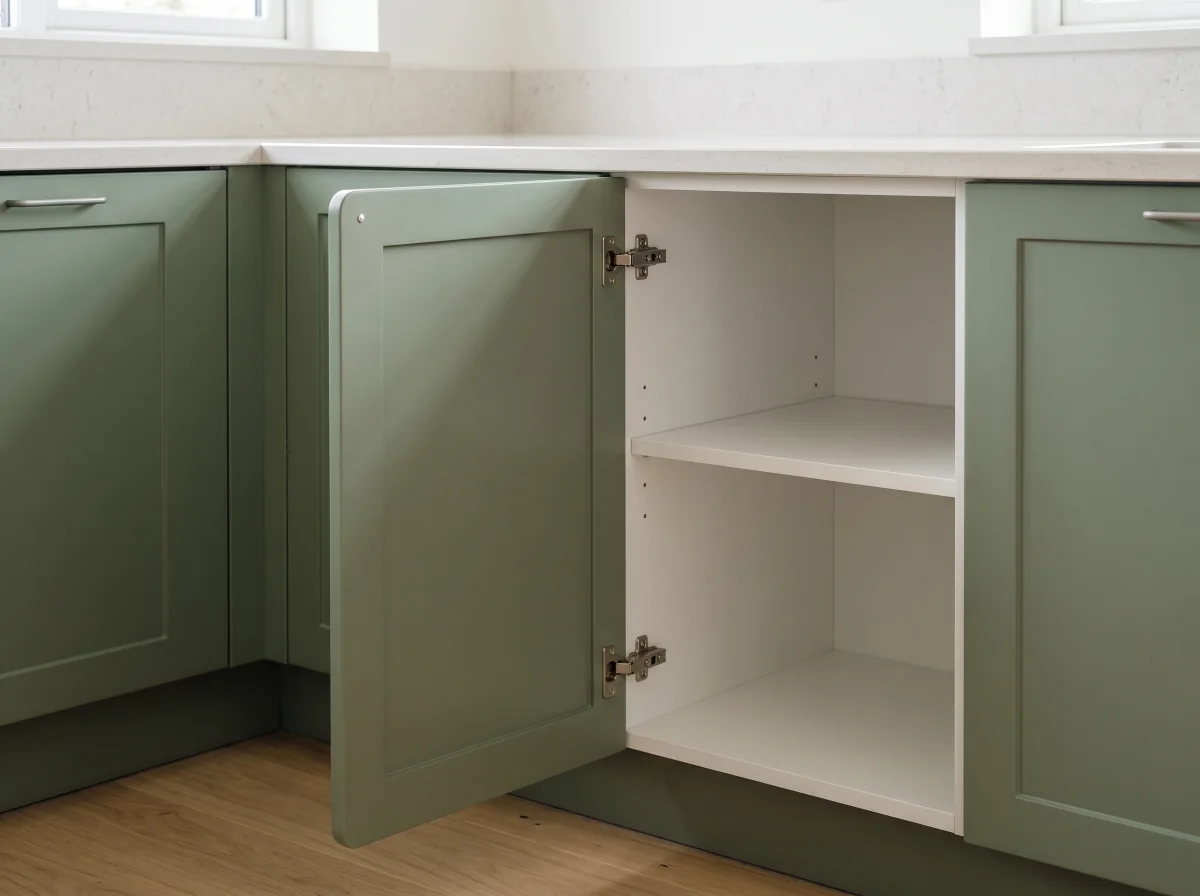
MFC goes where you need a simple shape, lower weight and a ready, hard-wearing surface. MDF comes in when a front needs a specific colour, a routed pattern or a radius. That is why, in bespoke furniture, the choice between MDF and chipboard is usually made separately for each part.
| Product | MFC | MDF |
|---|---|---|
| Kitchen | carcasses, shelves, flat fronts in a decor | painted fronts in matt and gloss, framed fronts with routed profiles, rounded islands |
| Wardrobe and walk-in wardrobe | carcass, shelves, doors in a wood decor or a plain colour | painted doors matched to the wall colour |
| Commercial furniture | shelves for shelving units, simple structures | curved reception desks, painted elements |
The choice depends on what matters more to you.
- Flat fronts in a wood decor or a plain colour, and a budget to keep to. All the furniture in MFC.
- A specific shade, deep matt, gloss, routing or rounded corners. MDF fronts for painting, MFC carcass.
- The area around the sink and dishwasher, the bathroom. Moisture-resistant grades of board, covered in the next section.
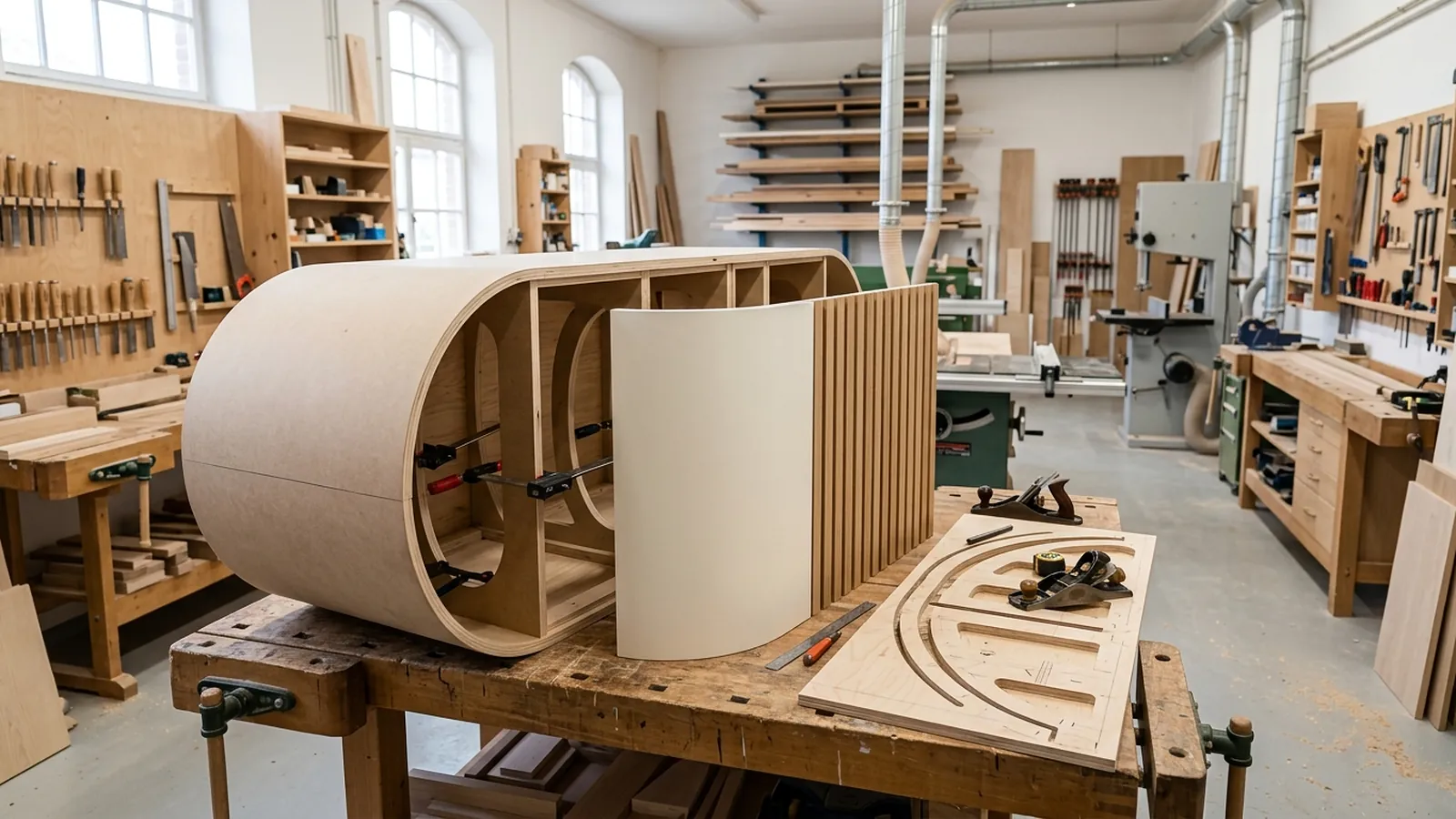
An example from our portfolio is the reception desk with slats and rounded corners. Its arched body is made of bent MDF. We explain how such shapes are designed in our article on furniture with rounded corners.
Both materials sit comfortably together in one kitchen. Painted fronts go in the places that are on show, and melamine-faced ones take the daily wear.
Two materials in one kitchen
Paint and melamine can be combined. Paint goes where the front is on show, melamine where the furniture works hard.
Moisture and heat: the weak points of both boards
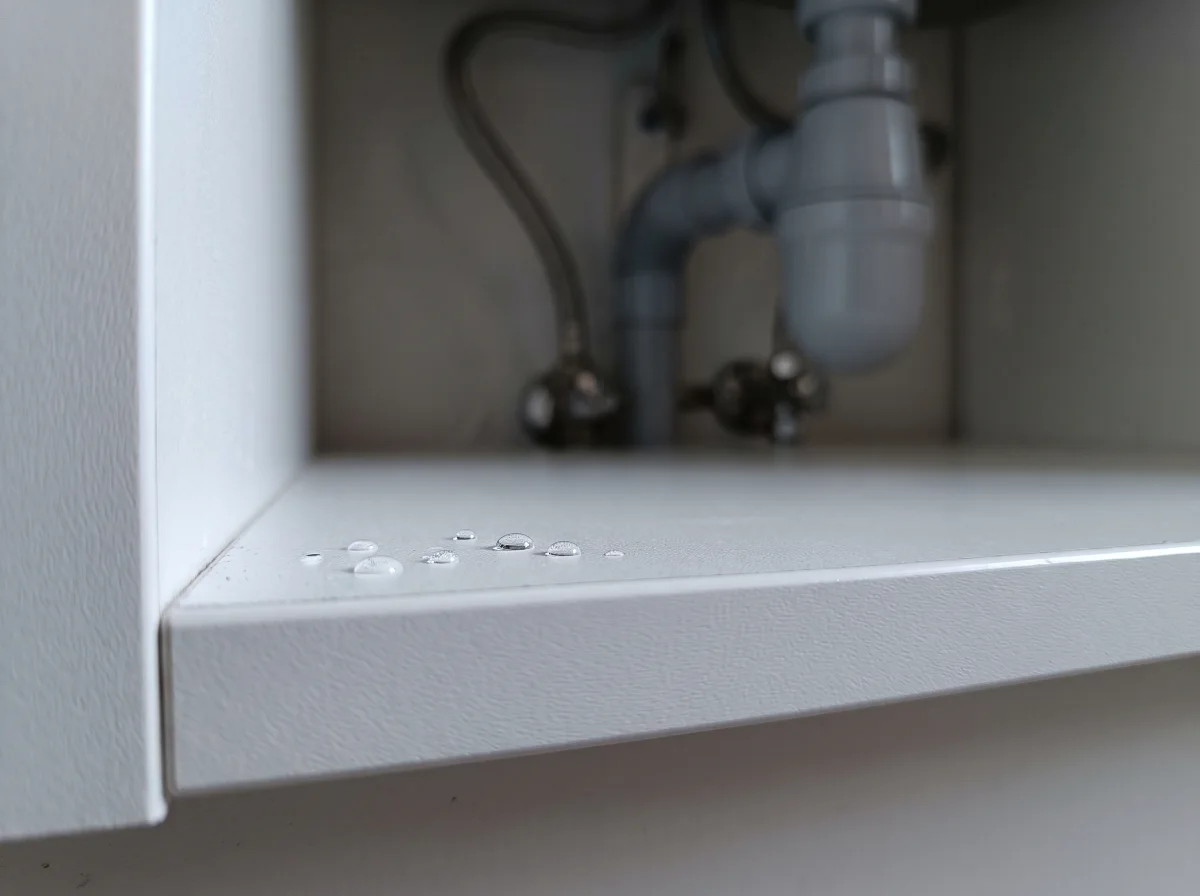
Neither of these materials is waterproof. EN 312 assigns furniture-grade P2 chipboard to dry conditions, and type P3 exists for humid ones. MDF has its own moisture-resistant grade, designated MDF.H. In both cases what decides the outcome is how well the edges and the coating are sealed, because that is how water reaches the core of the board.
A moisture-resistant board swells less than a standard one, but it still swells. In the 2020 study mentioned above, wetted samples of both boards held a screw less firmly than dry ones.
The unit under the sink is a separate conversation
Standard furniture-grade P2 chipboard is designed for dry conditions. For the area around the sink and dishwasher, and for the bathroom, ask about a moisture-resistant board: type P3 for chipboard or MDF.H for MDF.
The second enemy is heat. Constant heat harms both the board and the finish, so if an oven or a hob is being built in, it is worth asking your furniture maker about gaps and heat shields.
If the damage has already happened, a painted front can be refreshed by repainting. A swollen board is not normally repaired, so you should expect the whole part to be replaced.
Formaldehyde: one limit for both boards
When it comes to formaldehyde emissions, MDF and chipboard follow the same rules. Commission Regulation (EU) 2023/1464 bans placing on the market, after 6 August 2026, furniture and wood-based articles that emit more than 0.062 mg/m³ of formaldehyde. That is half of 0.124 mg/m³, the previous level of class E1.
The limit covers both furniture and the wood-based articles themselves. Emissions are measured in a test chamber at a temperature of 23°C and 45% humidity. The rule applies to products placed on the EU market after that date.
The limit is the same for furniture made of any wood-based panel. The type of board by itself tells you nothing about emissions: MDF and chipboard are subject to the same requirement.
How the choice of material affects price and service life
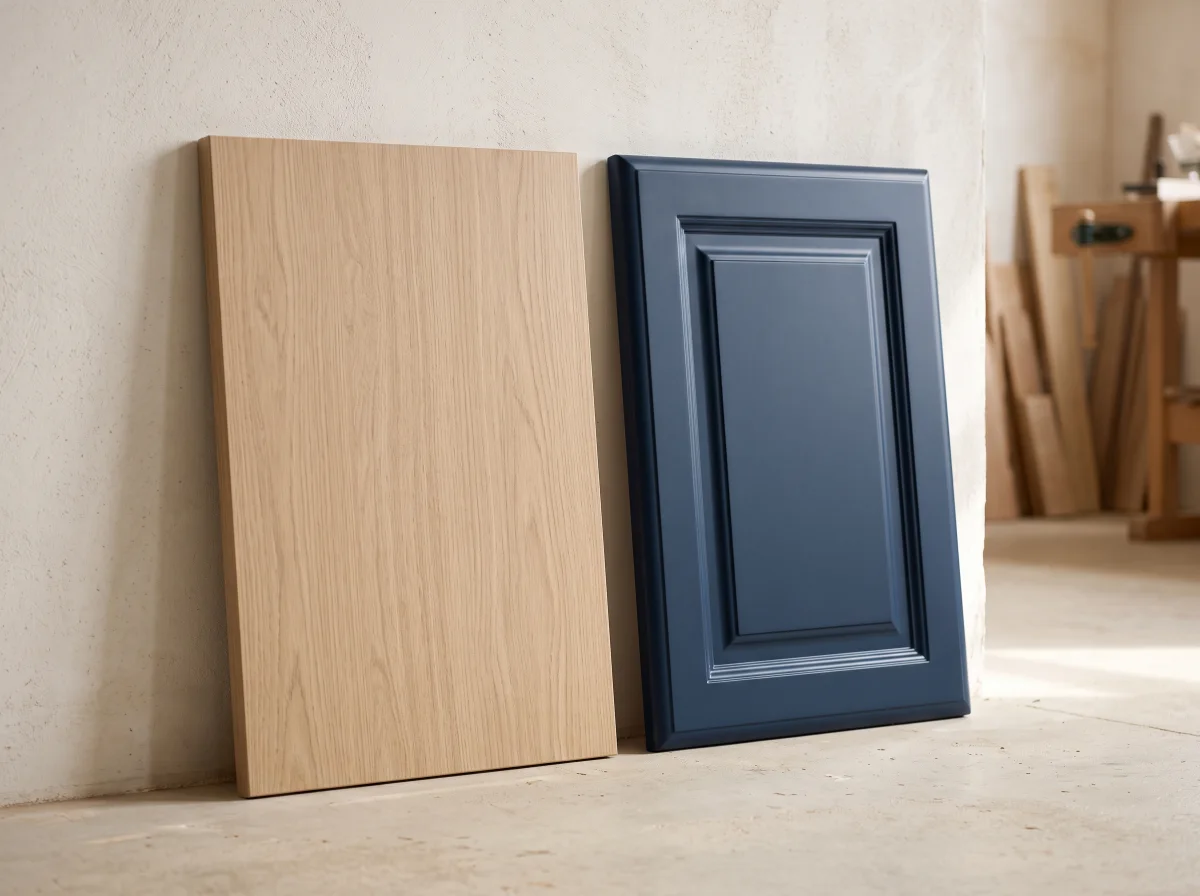
MDF fronts cost more mainly because of the finishing. MFC arrives with a ready surface, whereas MDF has to be painted or wrapped. We price made-to-measure kitchens at roughly 1 200 to 2 800 zł per linear metre. With painted fronts and soft-close hardware, a kitchen usually comes to up to 2 800 zł per linear metre.
We price wardrobes and walk-in wardrobes at roughly 1 000 to 2 200 zł per linear metre. The worktop, appliances and lighting in a kitchen are priced separately. We give the exact price after the site measurement, because the budget also depends on the hardware and the complexity of the construction.
A heavy front also affects the hardware, meaning the hinges and lift mechanisms. These are selected by the weight of the front, so a tall door in painted MDF may need stronger fittings than the same door in MFC. We cover the mechanisms themselves in our article on hardware for a made-to-measure kitchen.
We do not give a service life in years: it depends on the conditions of use and on care. In everyday use the two materials behave differently. Melamine copes well with scratches and with moisture on the surface, but the colour is limited to the decors available. Paint gives you any shade and can be renewed, though it does not get on with sharp objects. Finishes are covered in more detail in our piece on matt or gloss lacquer in the kitchen.
Production usually takes 2–4 weeks, and we write the specific date into the contract. The guarantee is from 1 to 5 years depending on the type of product, and we write the term into the contract.
What to ask your furniture maker before signing the contract
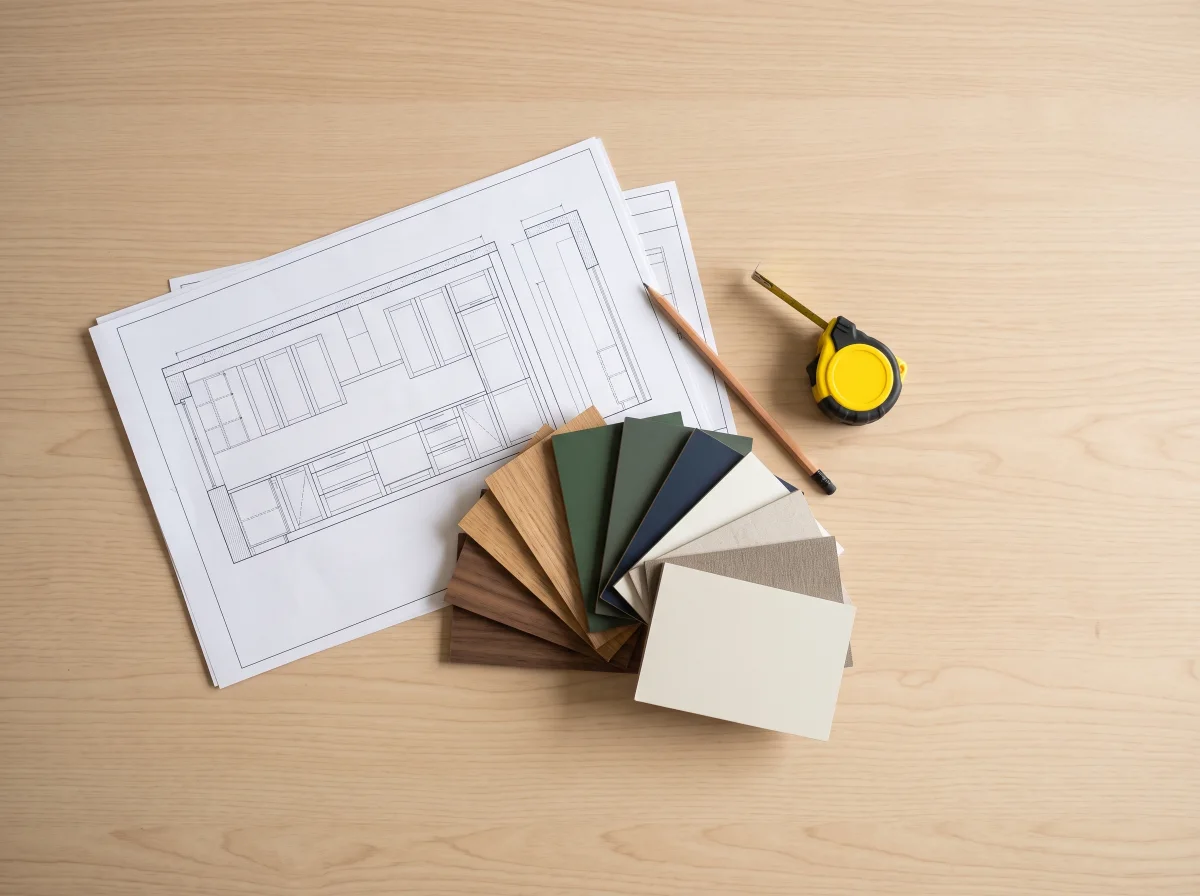
Five questions are enough to compare two quotes for the same project. It is best to get the answers in writing, in the specification attached to the contract. Then at handover you will have something to check the finished furniture against.
- Which board are the carcasses made of, and what type is it under EN 312? For dry rooms, P2 is sufficient.
- Which board will go into the unit under the sink, next to the dishwasher and in the bathroom? Moisture-resistant boards, type P3 and MDF.H, exist for humid areas.
- What are the fronts made of and how are they finished? Paint and routing mean MDF, while a flat decor usually means MFC.
- Are all edges covered with edge banding, including those that are not visible after installation?
- How has the hardware been matched to the weight of the fronts, and what does the guarantee cover?
With us, these decisions are made at the design stage, with a visualisation, before production starts. The site measurement, the design and the quote are free and without obligation. The price in the contract is fixed. Answers about the process and payment are collected in our questions and answers section.
If you are choosing a material for a kitchen or wardrobe at home, you can book a free site measurement through the quiz on our website.
Quick answers
Can all the furniture be made of MDF?
It can, but there is usually little point. The carcass is hidden behind the fronts, and MDF is heavier and needs every part finished.
Is it worth waiting before ordering?
There is no reason to wait because of the rules. The new emission limit is already in force.
Can furniture be ordered to another country?
Yes, we deliver orders from Poland across Europe. We agree the cost of travel and installation in advance and include it in the quote.
This article is for information only and does not replace a design and an on-site inspection. Standards and rules are given as of October 2026. Prices are indicative, and we give the exact price after the site measurement. We write the lead time and the guarantee into the contract.
Sources
- Commission Regulation (EU) 2023/1464, entry 77 of Annex XVII to REACH and Appendix 14 — EUR-Lex (accessed 09.10.2026)
- EN 312 — European standard for particleboards
- EN 622-5 — European standard for dry process fibreboards (MDF)
- Yorur H. et al., study of screw holding in MDF and chipboard, Maderas. Ciencia y tecnología 22(3), 2020, pp. 375–384 — abstract on the journal's website (accessed 09.10.2026)
- Questions and answers section on the Grandis Trade website
- Grandis Trade portfolio, reception desk with slats and rounded corners