Modern furniture with rounded corners is made in three ways: by rounding just the edge, by cutting a curve into the outline of a top or shelf, or by bending the whole carcass and front on a former. The method determines materials, finish, hardware and cost – which is why the scale of rounding is decided at the start of a project, not at the end.
In this article
- Three kinds of rounding in furniture
- Where rounded corners make the most sense
- How bent furniture is made: materials and technologies
- Finishing curved surfaces
- Design: what to decide at the start
- What drives the price of furniture with rounded corners
- Common mistakes
- How we do it at Grandis
- Frequently asked questions
Modern furniture with rounded corners is more than a trend for "curvy". A rounded corner on an island, counter or table is safer in a passage, nicer to touch and softens a room. But to look good and last for years it needs the right technique: a rounded edge, a curve in plan or a bent carcass.
Three kinds of rounding in furniture
When people talk about furniture "with rounded corners", three different things get mixed up. It is worth separating them, because each means a different technology and budget.
Rounded edge
The simplest option: a straight piece whose front, top and shelf edges have a small radius instead of a sharp arris. It is made with a radius router bit or with a rounded-profile edge band. This detail changes how a piece reads more than you might expect – the cabinet no longer looks sharp and your hand never meets a hard edge.
Curve in plan
A top, shelf or table has a rounded corner seen from above: an oval table, an island top with a semicircular end, bookcase shelves ending in an arc. The shape is cut on a CNC machine from a drawing, and the curved edge is banded or lacquered. The carcass underneath can stay rectangular.
Bent carcass and front
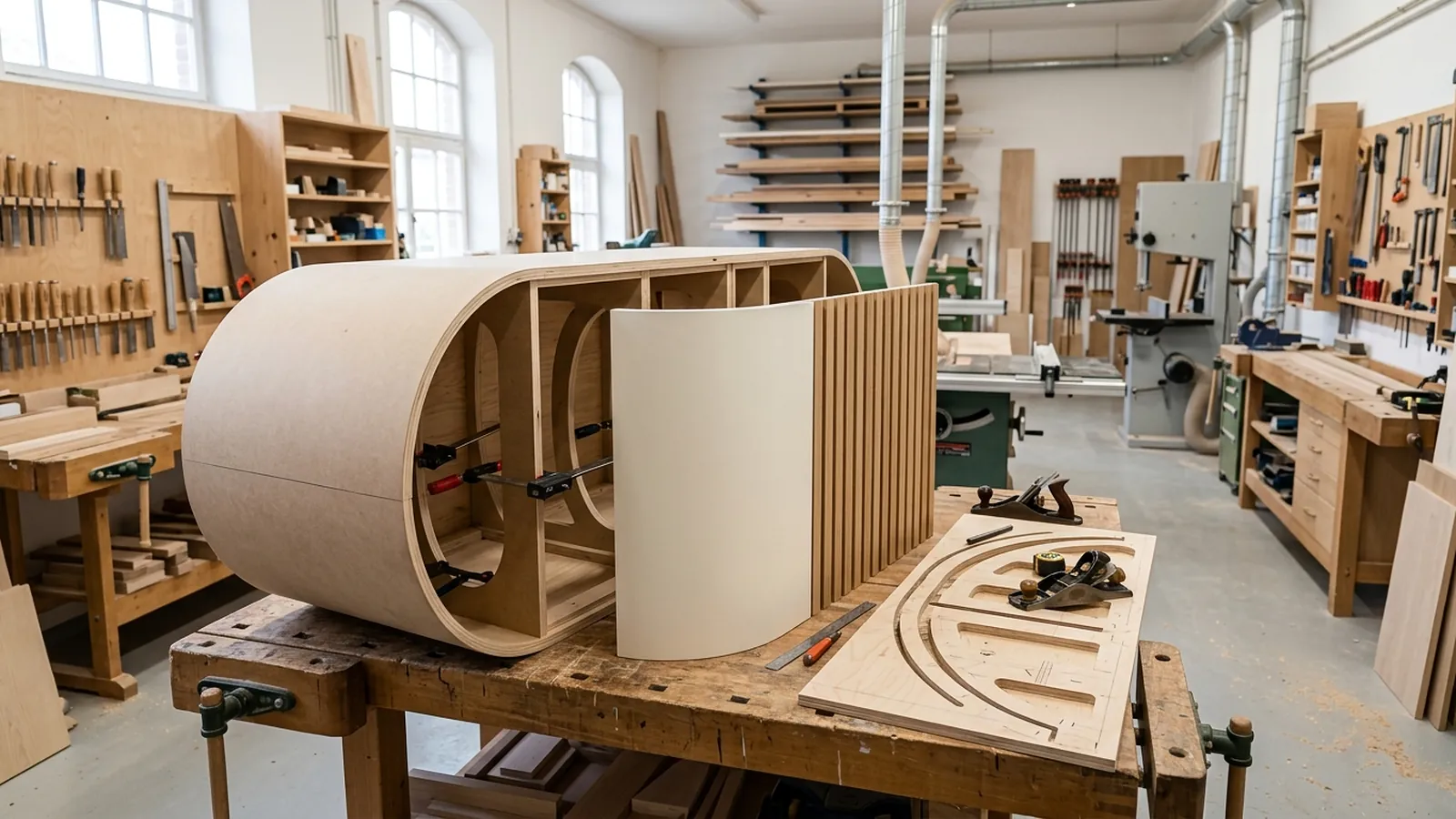
The most demanding option: the whole volume is curved – the side of an island, a counter front, a cylindrical cabinet, the wavy front of a vanity unit. The piece has to be designed around the curve: the carcass is bent on a former, the front is made from a bendable material and the interior is fitted to the arc.
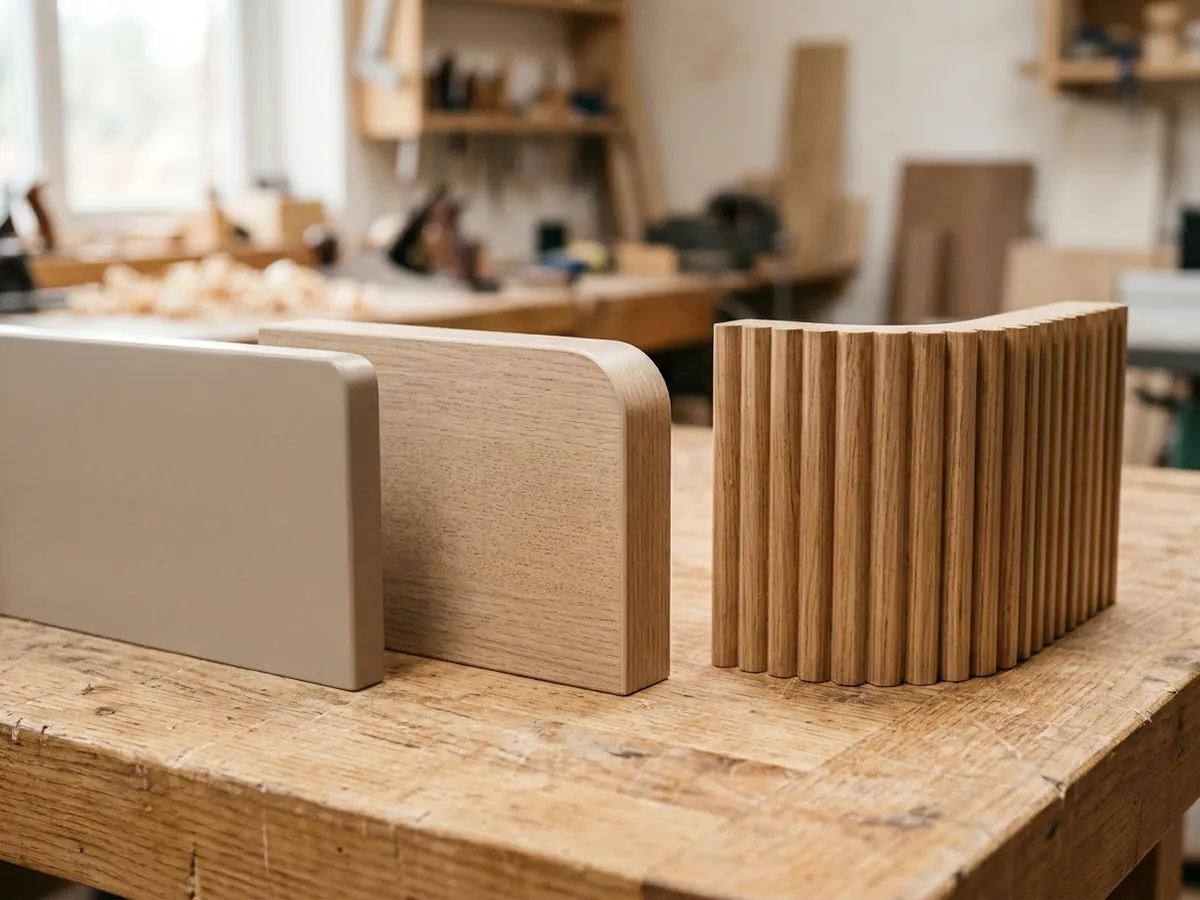
Visualisation – from left: a rounded edge, a curve in plan and a bent fluted front. Each option means a different technology and a different cost.
Where rounded corners make the most sense
- Kitchen islands and peninsulas. The island corner sits in a passage at hip height. A curve makes it easier to walk around and softens an open-plan kitchen and living room.
- Reception and bar counters. A rounded end guides customer flow and has no sharp corner at the entrance, where traffic is heaviest.
- Tables. A round or oval top seats more people comfortably, and in a small dining room a table without corners takes up less visual space.
- Children's rooms. Rounded edges and corners are a simple way to reduce the risk of bumping into a sharp edge. More in our article on furniture that grows with children.
- Vanity units and bathroom furniture. In a tight bathroom a curve makes moving around easier and softens a space full of hard tiles.
- Bookcases and units in passages. A curved end on a bookcase by a door or in a hallway is safer and looks lighter.
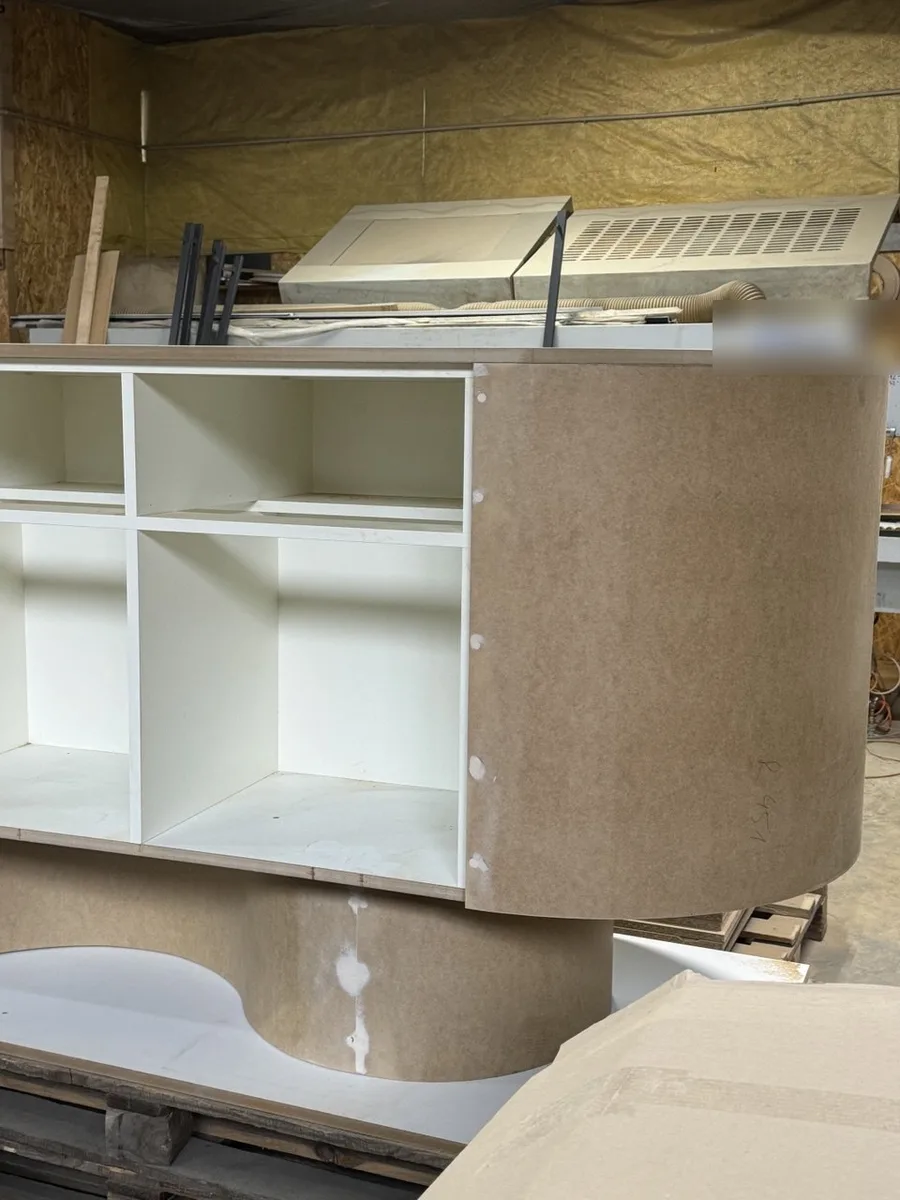
How bent furniture is made: materials and technologies
Laminated board, used for most straight cabinets, cannot be bent. Curves need different materials and a different way of working in the workshop.
| Technique | How it works | Where it is used |
|---|---|---|
| Routing a radius on the edge | The arris of a front or top is rounded with a router bit, then lacquered | Lacquered MDF fronts, tops, shelves |
| Cutting a curve on CNC | The machine cuts the outline of a top, shelf or cornice from a drawing | Oval tables, rounded tops, bookcase shelves |
| MDF formers (ribs) | Curved ribs are cut from several layers of board to define the carcass curve | Islands, counters, cylindrical cabinets |
| Flexible MDF | Board kerfed on the back with dense grooves bends and is glued to the formers | Curved sides and fronts for lacquer or veneer |
| Laminating on a mould | Thin layers are glued and pressed onto a mould until they hold the shape | Strong bent parts, bent fronts, seats |
| Slats and fluting | Narrow battens or routed grooves naturally follow the curve | Island and counter fronts, table bases |
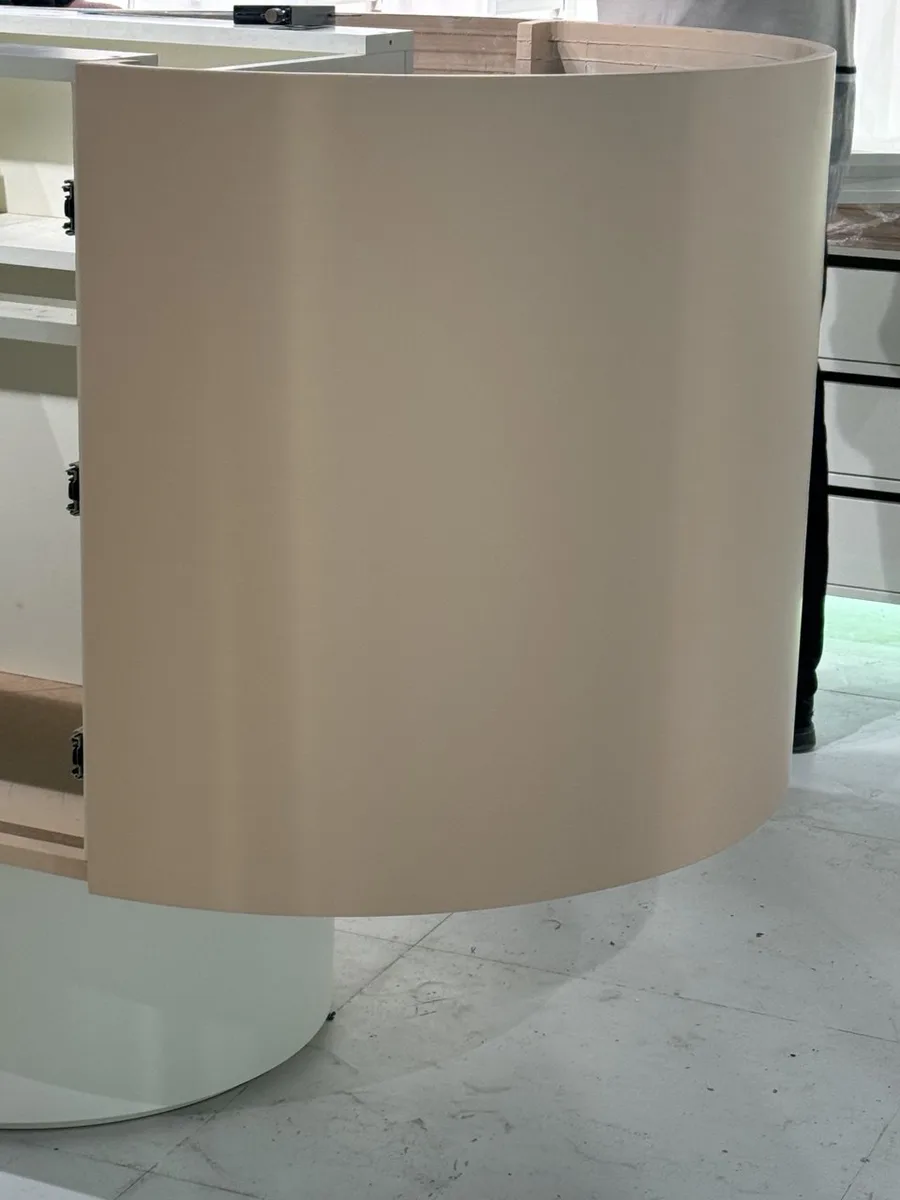
In practice techniques are combined. A typical curved counter is a frame of CNC-cut ribs, a skin of flexible MDF and a finish – lacquer, veneer or slats. A stone or composite top is made separately from a template taken off the finished carcass, so the curve of the top matches the curve below exactly.
Finishing curved surfaces
Lacquer
Matt lacquer is the most common choice for bent fronts: it gives a uniform surface in any RAL or NCS colour with no joint where a straight front turns into a curve. The condition is careful substrate preparation – any unevenness of the bent board shows under lacquer, especially in raking light.
Veneer
Natural veneer gives real wood grain even on a curve. Sheets have to be matched so the grain on the curve and on the straight parts reads as one. On tightly bent surfaces the grain usually runs vertically.
Slats and fluting
Vertical slats are the most forgiving finish for a curve: their rhythm emphasises the arc, and plinth lighting draws a soft shadow across them. They look good in both lacquer and veneer.
Edge banding
On laminated board parts with a curve in plan – shelves, for example – the edge is banded. Small radii need more handwork, so agree the radius with the joiner at the design stage.
Design: what to decide at the start
- Which elements are rounded. Curves in passages and at entrances, straight units along walls. Rounding everything raises the cost without always improving the result.
- What radius. The radius affects the look, how the piece fits and the manufacturing technique. Compare two or three options in the 3D visualisation.
- What is behind the curve. Shelves and drawers fit behind a bent front, but their fronts usually stay straight or the curve is a fixed panel. Bent doors need suitable hardware.
- How the piece meets the floor and wall. A plinth that follows the curve, lighting, wall trims – details that are easiest to spoil if not designed from the start.
- Finish and top. Lacquer, veneer or slats, with stone, composite or wood on top. The choice affects the order of work and installation.
Joiner's tip: a curved piece is always measured twice – once the room, and again the finished carcass before the top is ordered. Stone cut from a drawing rather than from the real curve is the most common cause of a gap between top and front.
What drives the price of furniture with rounded corners
Curved furniture usually costs more than straight furniture of similar size, but the difference depends heavily on the type of rounding. A rounded edge changes the cost very little. A curve in plan means extra machine time and edge work. A bent carcass and front mean formers, more production stages and manual finishing.
The final amount depends mainly on the number and length of bent elements, the radius, the finish (lacquer, veneer, slats), the top material and whether there are drawers or doors behind the curve. We give an exact price after a free measurement and 3D visualisation – and fix it in the contract. Indicative prices for other units are in our FAQ.
Common mistakes
- A curve "by eye". A radius chosen without a visualisation can look too heavy or too timid.
- A full curve in a narrow passage. A curved piece takes its space – in a narrow kitchen a rounded edge works better than a full arc.
- Gloss on a bent surface. High gloss mercilessly shows every wave of the substrate. Matt is safer on curves.
- Top ordered before the carcass. A top for a curved piece is made to the real shape, not the drawing.
- No storage plan. The curve must not eat space – the interior is designed together with the curve.
How we do it at Grandis
Bent carcasses, formers, lacquering and installation are all done by our own installation team, and we deliver the finished furniture across Europe. The process starts with a free laser measurement, then a 3D visualisation with every curve, and production begins after written approval of the design. The price in the contract does not change. We make curved furniture both for homes (custom furniture for home) and for shops, offices and receptions (custom furniture for business). How curves fit particular styles is covered in our articles on organic modern, japandi, soft minimalism and streamline.
See our projects: an island with a bent fluted front and rounded top, a reception desk on a bent MDF carcass, a bathroom vanity with a wave front and conference tables with rounded ends on fluted bases – different rounding techniques in our projects.
- Kitchen with a curved island and fluted front
- Reception desk with slats and rounded corners
- Wall-hung bathroom vanity with a wave front
- Office conference tables with fluted bases
Frequently asked questions
What are bent furniture fronts made of?
Most often flexible MDF glued to formers or thin layers laminated on a mould. The surface is then finished with lacquer, natural veneer or slats. Ordinary laminated board cannot be bent.
Can there be drawers behind a bent front?
Yes, but it has to be planned. Drawers and shelves fit behind the curve, while the curve itself is usually a fixed panel or bent doors with suitable hardware. This is decided at the design stage.
Is furniture with rounded corners more expensive?
It depends on the type of rounding. A rounded edge hardly changes the price, a curve in plan raises it moderately, and a bent carcass and front raise it the most because they need formers and manual finishing.
What radius should I choose?
There is no single value. The radius is matched to the size of the piece, the width of the passage and the style of the room. Compare a few options in the 3D visualisation before production starts.
Are rounded corners safer for children?
Rounded edges and corners reduce the risk of hitting a sharp edge, which is why they are often chosen for children's rooms and passages. They do not replace supervision or fixing furniture to the wall.
Is curved furniture suitable for high-traffic spaces?
Yes, with the right finish. Receptions and service spaces do well with durable lacquer, slats and composite or stone tops. A curve in a high-traffic spot is actually more practical than a sharp corner.
Planning a piece with a curve or rounded corners? Fill in a short design quiz or, for a business, our project brief. We will come for a free measurement and show a 3D visualisation with several curve options.