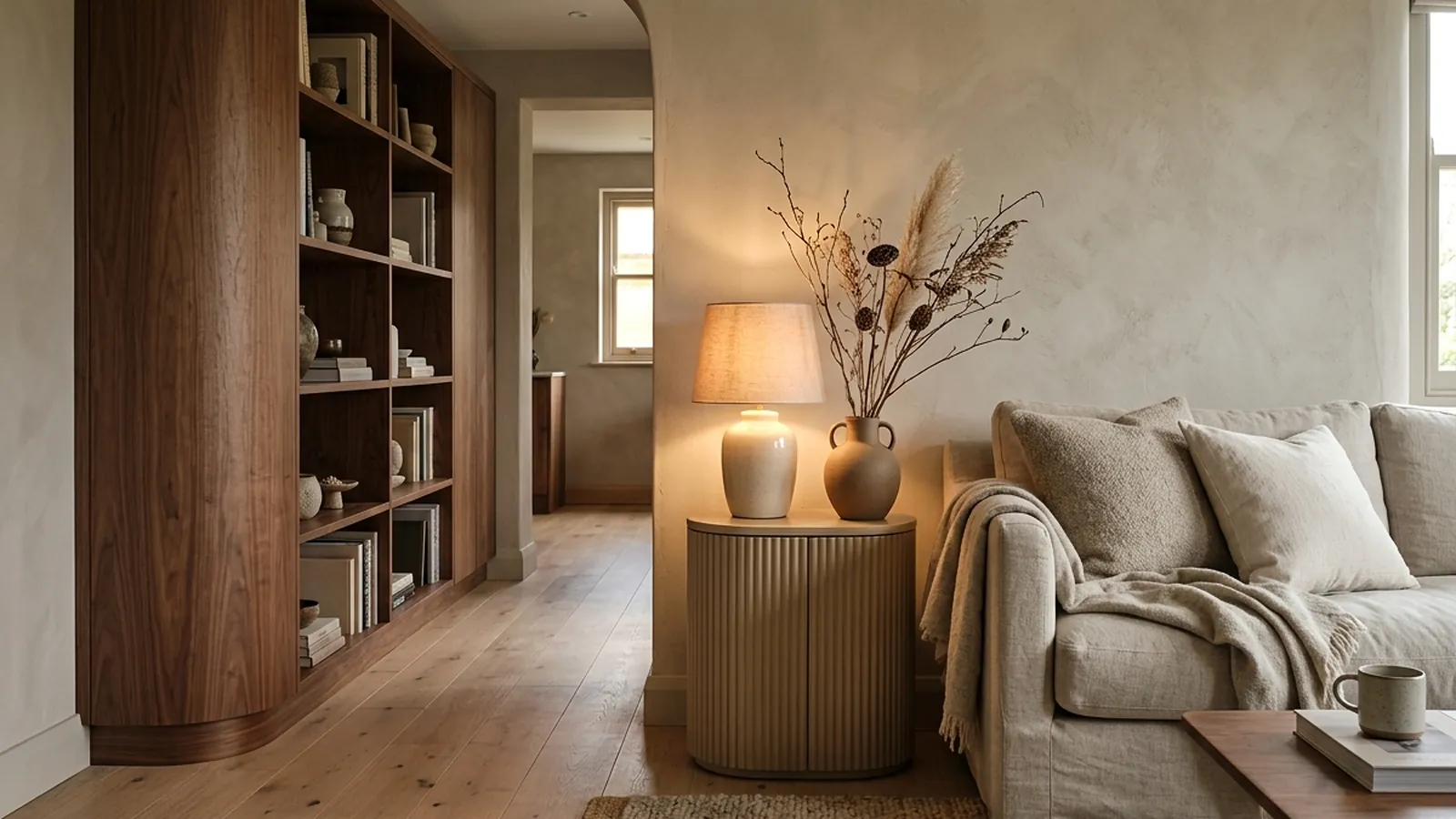
Rounded living room furniture – a curved TV unit, sideboard, arched bookcase, round table and coffee table – softens the room and removes corners from the routes people walk. It works best as one or two accents against straight cabinetry, with one radius and a well-planned interior.
In this article
- Why rounded furniture suits a living room so well
- Which rounded pieces work in a living room
- Where to round off and where to keep a straight line
- Materials and colours for rounded living room furniture
- How to plan custom rounded furniture for the living room
- Common mistakes
- How we work on rounded furniture at Grandis
- Frequently asked questions
Rounded living room furniture means curved TV units, sideboards, bookcases with arches, round tables and coffee tables – furniture without sharp corners that softens the room and makes it easier to move around. It works best when the curve appears where people walk and sit, not on every piece at once.
Why rounded furniture suits a living room so well
The living room is where we spend most of our time and the room we cross most often: from the door to the sofa, from the sofa to the dining table, from the dining table to the kitchen. Every sharp corner on that route is a place to bang a knee or a hip. Rounded furniture solves the problem simply – it has no corner.
The second reason is visual. A living room is usually full of rectangles: walls, windows, the TV, the sofa, the rug. One or two curved pieces break that geometry and make the room feel calmer and cosier. You don't need to replace everything – sometimes a rounded end on the TV unit or a round side table next to the sofa is enough.
The third is safety. In a home with small children or pets, rounded edges are simply practical, because a rounded corner is safer than a sharp one.
Which rounded pieces work in a living room
TV unit and TV wall
A long, low TV unit with rounded ends is the simplest way to add a curved accent to a living room. The curved end usually sits by the walkway, so it is practical from day one. With a full-wall unit, the curves can be repeated in open shelves, niches or the surround above the TV.
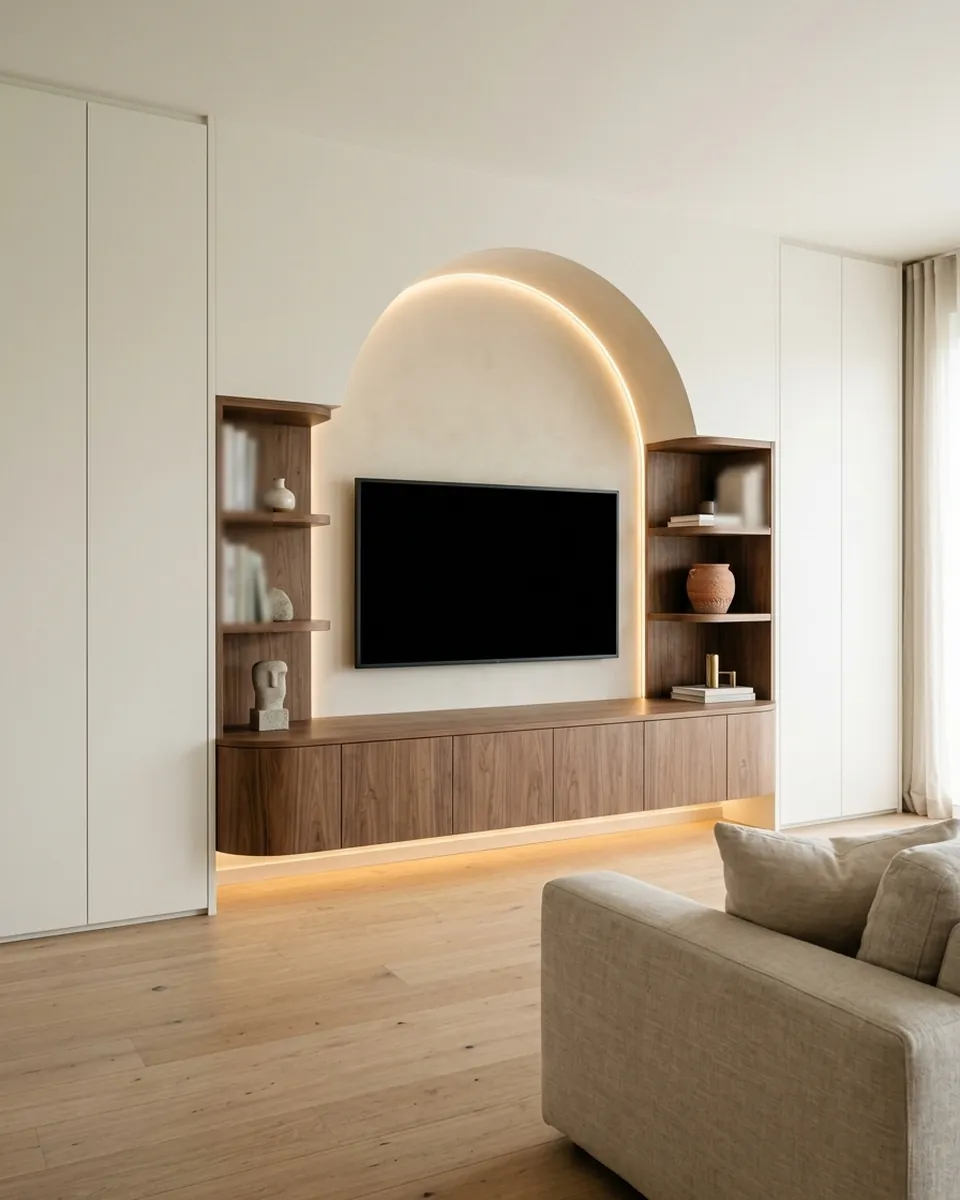
Visualisation – straight cabinets at the sides, an arch above the TV and a floating TV unit with rounded ends: the curves are gathered in one place and the rest of the wall stays calm.
Sideboard and chest of drawers
A sideboard with rounded sides and a fluted front is a piece that works as decoration in itself. It fits well by the dining area, in a hallway open to the living room or against a wall without a TV.
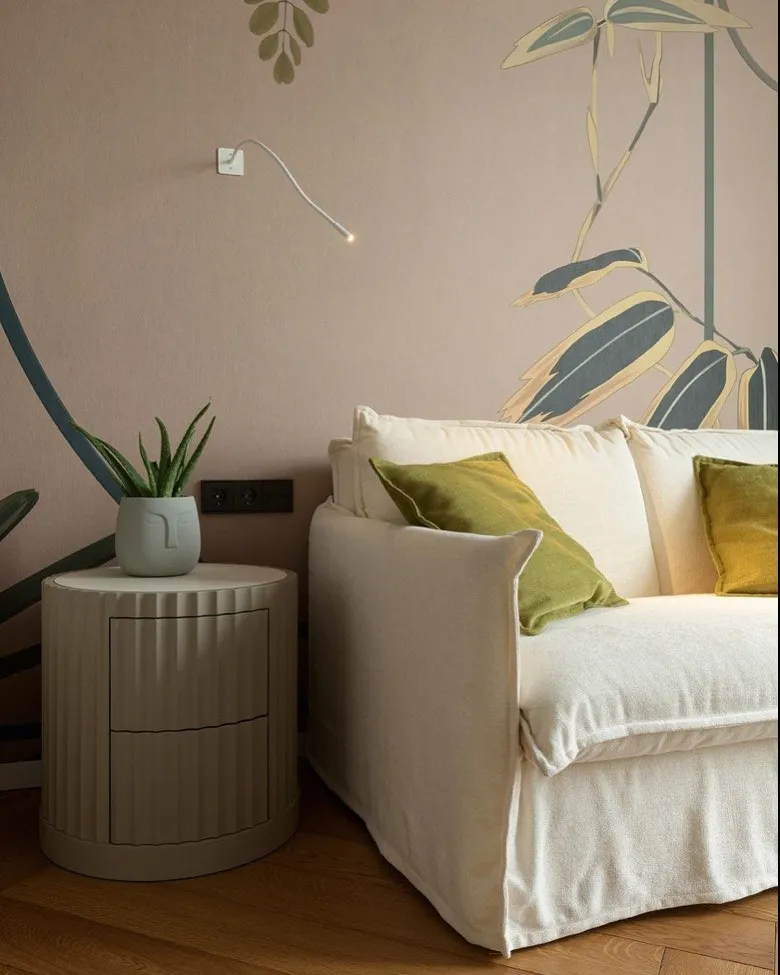
In the photo – a round cabinet with drawers and a fluted front that we made for a living room. It stands next to the sofa and replaces a side table.
Bookcase and shelves with arches
A bookcase with arched niches or shelves with rounded corners breaks up the rectangle of a large unit. It is a good idea for a wall of books or the niches on either side of a fireplace.
Round dining table and coffee table
A round table in the dining area is easier to walk around, and a table without corners seats people in a more relaxed layout. A rounded coffee table by the sofa is the spot where knees most often get knocked – this is where a curve makes the most sense.
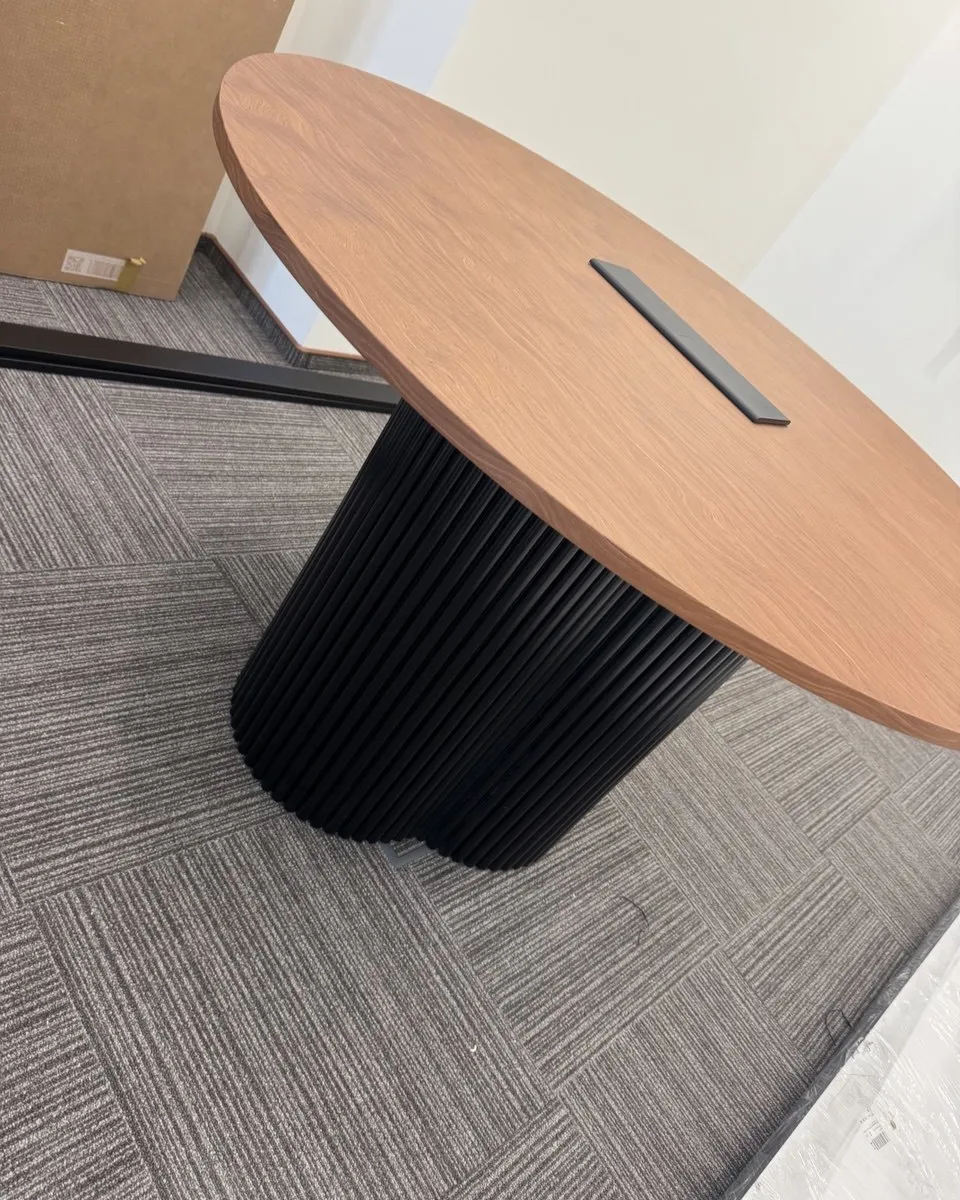
In the photo – a round table on a fluted base that we made for a meeting room. The same construction – a top on a rounded, fluted base – works just as well for a dining table in the living room.
Island or bar in a living room with a kitchenette
In an open-plan space, the kitchen island is part of the living room. A rounded end facing the living area softens the transition between the kitchen and the lounge zone and makes the island look more like furniture and less like part of the kitchen. We show curved islands in our guide to streamline furniture.
Where to round off and where to keep a straight line
A living room in which everything is curved quickly starts to look like a stage set. A curve works best in contrast with straight lines. A practical rule: round off the pieces that stand on a walkway or by the seating area, and keep the wall-to-ceiling units straight or rounded only at the ends.
| Place in the living room | Curve – yes or no | Why |
|---|---|---|
| End of the TV unit by the walkway | Yes | No corner on the route from the door to the sofa |
| Coffee table | Yes | The most common place to bang a knee |
| Dining table | Yes, if there is space | Easier to walk around, more relaxed seating |
| Floor-to-ceiling unit against a wall | Mostly at the ends | A full curve takes away storage without adding comfort |
| Bookcase | As an accent | Arched niches liven up a large, rectangular wall |
| Fireplace niche | Yes | An arch emphasises symmetry and the focal point of the room |
Materials and colours for rounded living room furniture
A rounded piece draws the eye, so its finish matters more than on a straight cabinet.
- Matt lacquer – one colour with no joins over the whole curve; warm whites, beiges, sage and terracotta look good in a living room.
- Veneer – wood that wraps around the curve; oak for light living rooms, walnut for darker, more elegant ones.
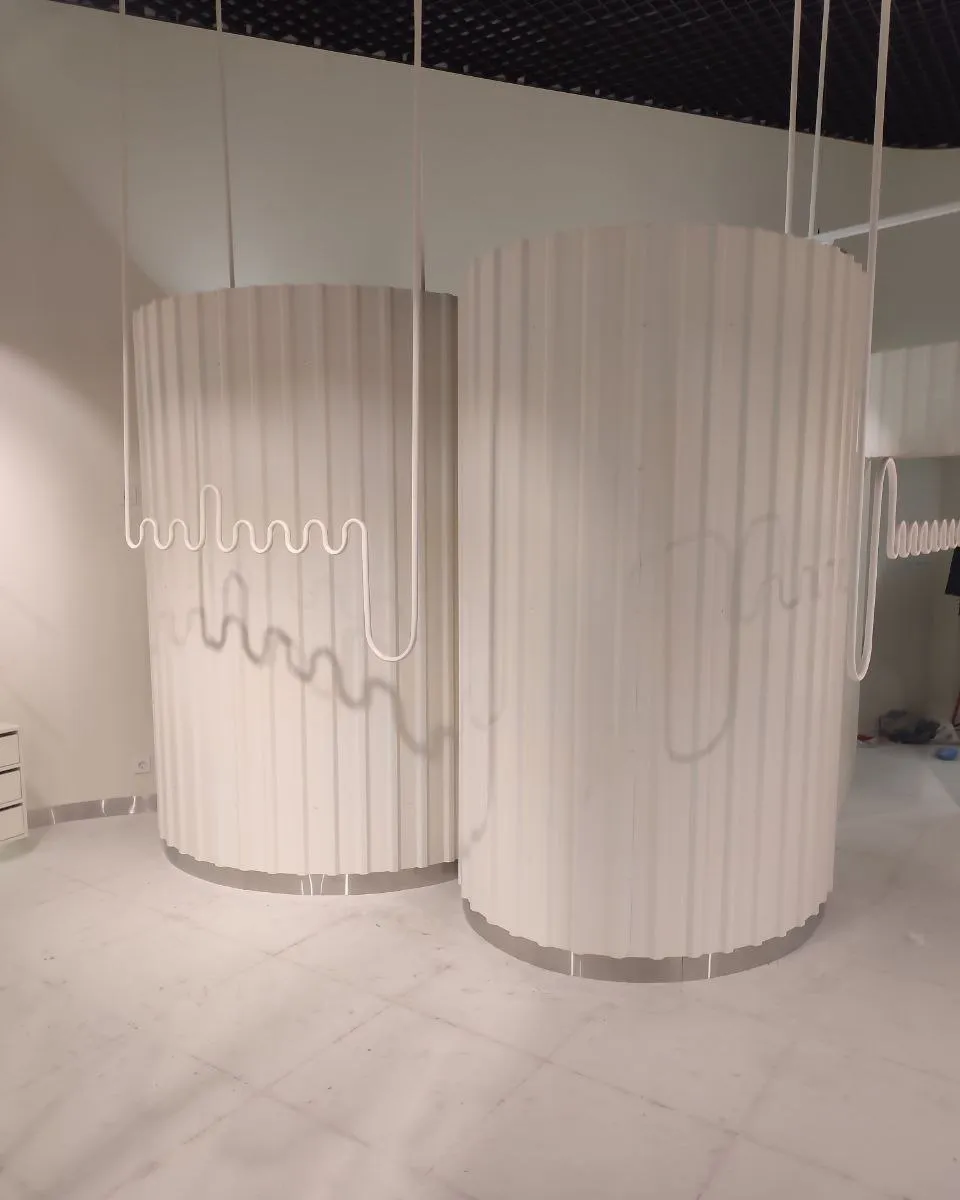
- Slats and fluting – vertical grooves on the curve play with light and are the most recognisable motif of rounded furniture.
- Fabric and upholstery – built-in rounded seating, window benches or upholstered panels go well with the soft form of cabinets.
- Stone and quartz – table tops with rounded corners matched to the base.
Choose colours to fit the rest of the living room rather than a trend. A rounded piece in the colour of the walls becomes a calm background; in a contrasting colour it becomes the main accent. If you like calm, light interiors, see also soft minimalism furniture and rounded furniture in the japandi style; if you prefer natural materials – organic modern.
How to plan custom rounded furniture for the living room
- Draw the routes. Mark on the plan how people move around the living room. Pieces on those routes are the first candidates for rounding.
- Choose one or two lead pieces. For example the TV unit and the coffee table. The rest can stay straight.
- Match the radius to the size of the piece. A small table with a large curve is simply round; a long sideboard with a small radius looks like an ordinary cabinet with a sanded corner. The radius is chosen in the 3D design.
- Plan what goes into the curve. Drawers are harder to fit into the rounded part – it can hold open shelves, a cabinet with a bent front or a closed element.
- Think about light. Lighting under the plinth or in arched niches emphasises the form in the evening. Cabling is planned before renovation.
- Check the walkways. Between the coffee table and the sofa, between the table and the wall – rounded furniture makes movement easier, but it does not replace a wide enough passage.
Cabinetmaker's tip: with a TV unit that has a rounded end, plan the cable outlet and the space for equipment in the straight part. Equipment won't fit in the curve, and cables coming out of a rounded front spoil the whole effect.
Common mistakes
- Everything rounded. A curved sofa, coffee table, sideboard, bookcase and mirror in one room – the form stops being an accent.
- A curve where nobody walks. A rounded corner hidden behind the sofa costs money and gives neither comfort nor effect.
- Mismatched radii. A table top with a different curve from its base, or different roundings on neighbouring cabinets, look accidental.
- Forgetting about capacity. A rounded body holds less than a box of the same length – take this into account when planning storage.
How we work on rounded furniture at Grandis
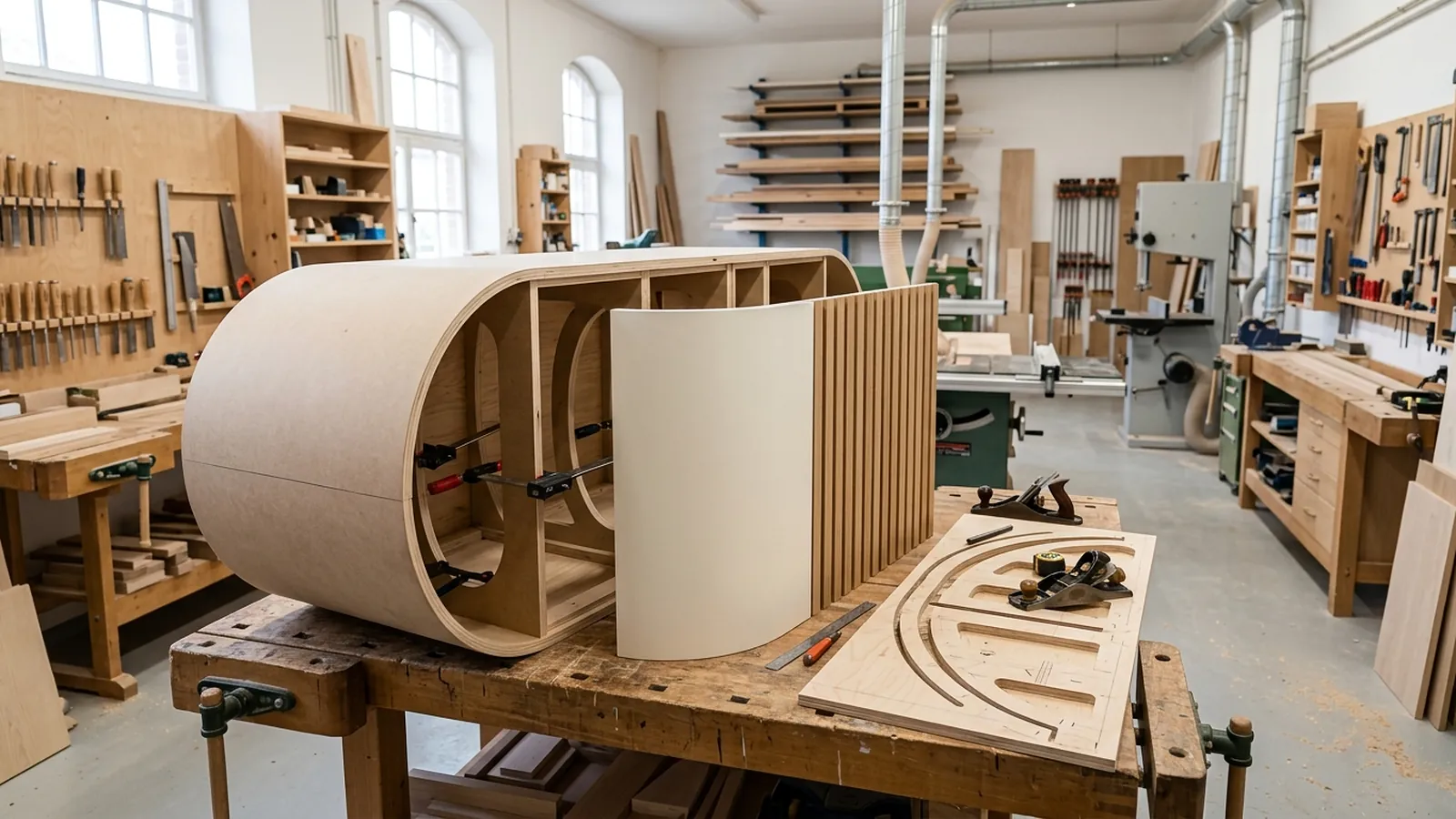
We make rounded cabinets, sideboards and tables with bending, gluing, veneering and lacquering. Every project starts with a free laser measurement and a 3D visualisation showing the curves from every side. The price in the contract is fixed, and installation is done by our own in-house team. More about furniture for the home on the custom furniture for home page, and other living rooms in our living room projects.
Frequently asked questions
Which rounded pieces work best in a small living room?
In a small living room a rounded coffee table and a TV unit with curved ends give the most. Both stand on the route people use most often, and the lack of corners makes it easier to move around a tight space.
Does rounded furniture suit a modern living room?
Yes. A curve contrasts well with the straight lines of a modern interior. One or two rounded pieces in a calm colour are enough to make the living room feel softer without changing its style.
Does a rounded TV unit hold as much as a straight one?
Not quite – the rounded part has less capacity and drawers are harder to fit there. That is why equipment and the main storage go in the straight part, and the curve is used for open shelves or decoration.
Which finish should I choose for rounded living room furniture?
Most often matt lacquer, veneer or slats. Lacquer gives a uniform colour with no joins, veneer the warmth of wood, and fluting emphasises the curve through the play of light. The choice depends on the style of the room and the radius of the curve.
Can I add a rounded piece to existing furniture?
Yes. People often start with one piece, such as a sideboard or a coffee table, matched in colour and material to what is already in the living room. It helps to show photos of the existing furniture at the measurement visit.
Want to see how a rounded piece would look in your living room? Fill in a short design quiz and we will come back with a proposal and an estimated budget. Measurement and 3D design are free and non-binding.