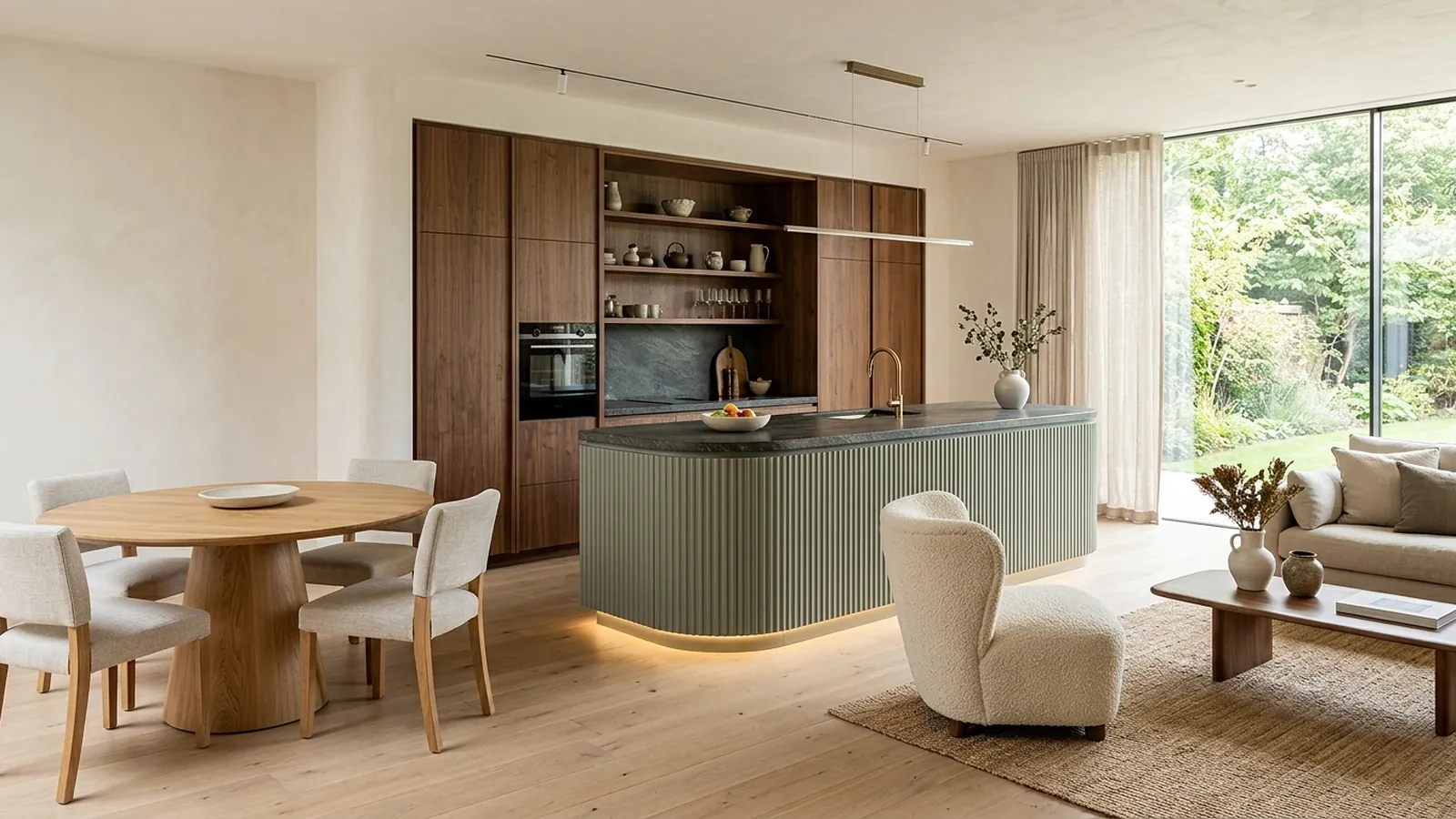
Organic modern furniture combines the clean lines of a modern interior with natural materials: wood with visible grain, stone, fabric and soft, rounded forms. In custom furniture the style comes down to three decisions: one leading natural material, rounding the pieces you touch and walk around, and a calm, earthy palette.
In this article
- What organic modern style is
- Organic modern vs japandi, soft minimalism and streamline
- Key features of organic modern furniture
- Materials and colours
- Where rounded organic modern furniture makes the most sense
- How to design custom organic modern furniture
- Common mistakes
- How we do it at Grandis
- Frequently asked questions
Organic modern furniture is modern cabinetry where simple, calm volumes meet natural materials and soft, rounded forms. Instead of cold perfection you get wood with a visible grain, stone, linen and a curve exactly where your hand or hip touches the furniture.
What organic modern style is
Organic modern grew out of two traditions. The first is modernism: order, no unnecessary ornament, flat fronts and well-planned storage. The second is the organic modernism of the mid-20th century, when designers looked to nature for forms – soft backrests, single-pedestal tables, tops with irregular outlines. Today's organic modern takes discipline from the first tradition and warmth and softness of line from the second.
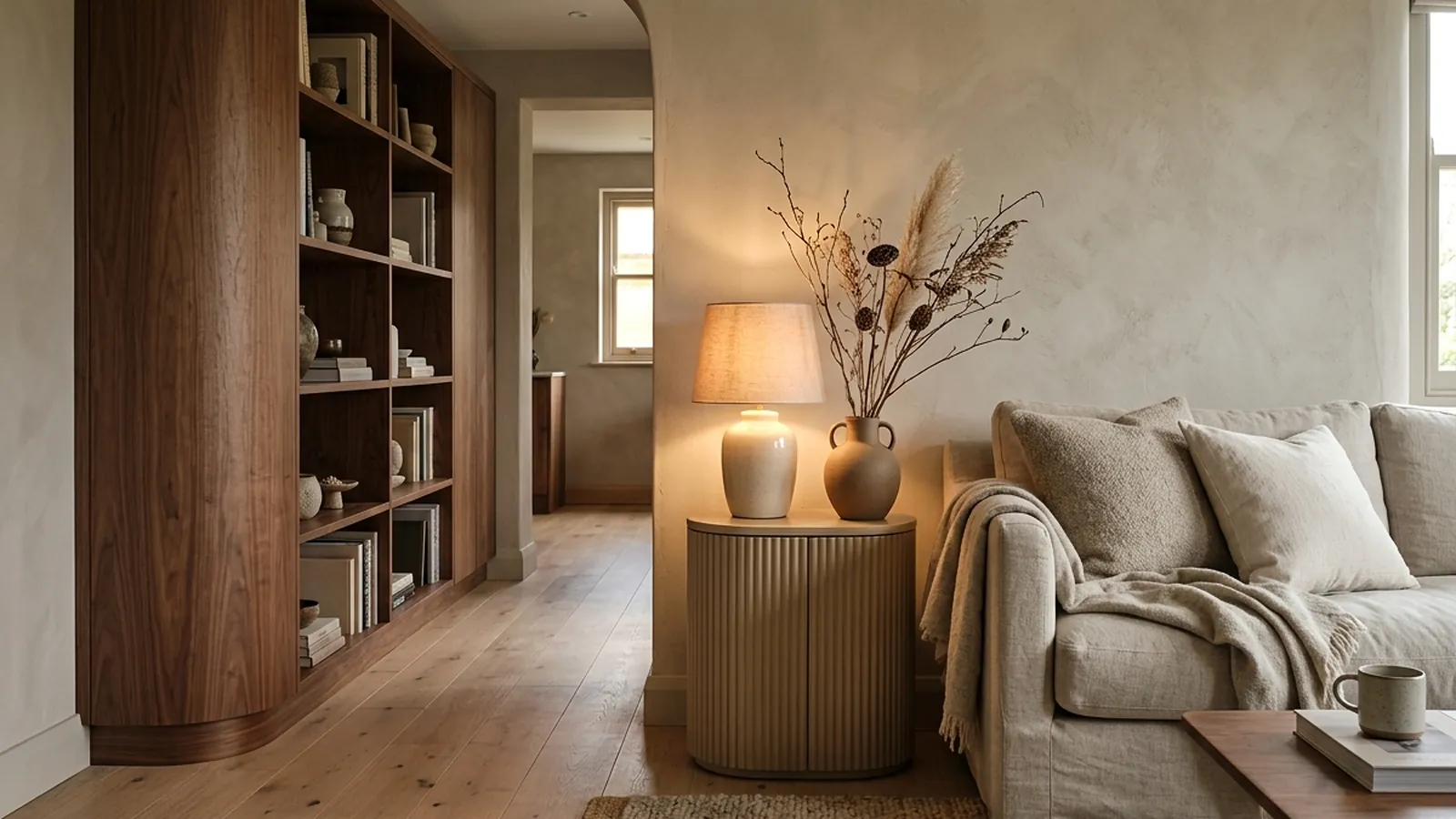
In practice this means an interior that looks modern but not sterile. There is no gloss for the sake of gloss and no decoration for the sake of decoration. Character comes from texture and form: oak or walnut grain, the porosity of stone, a fluted front casting a gentle shadow, the rounded end of an island. If you have read our guide to modern style, think of organic modern as its warmer, more tactile version.
Organic modern vs japandi, soft minimalism and streamline
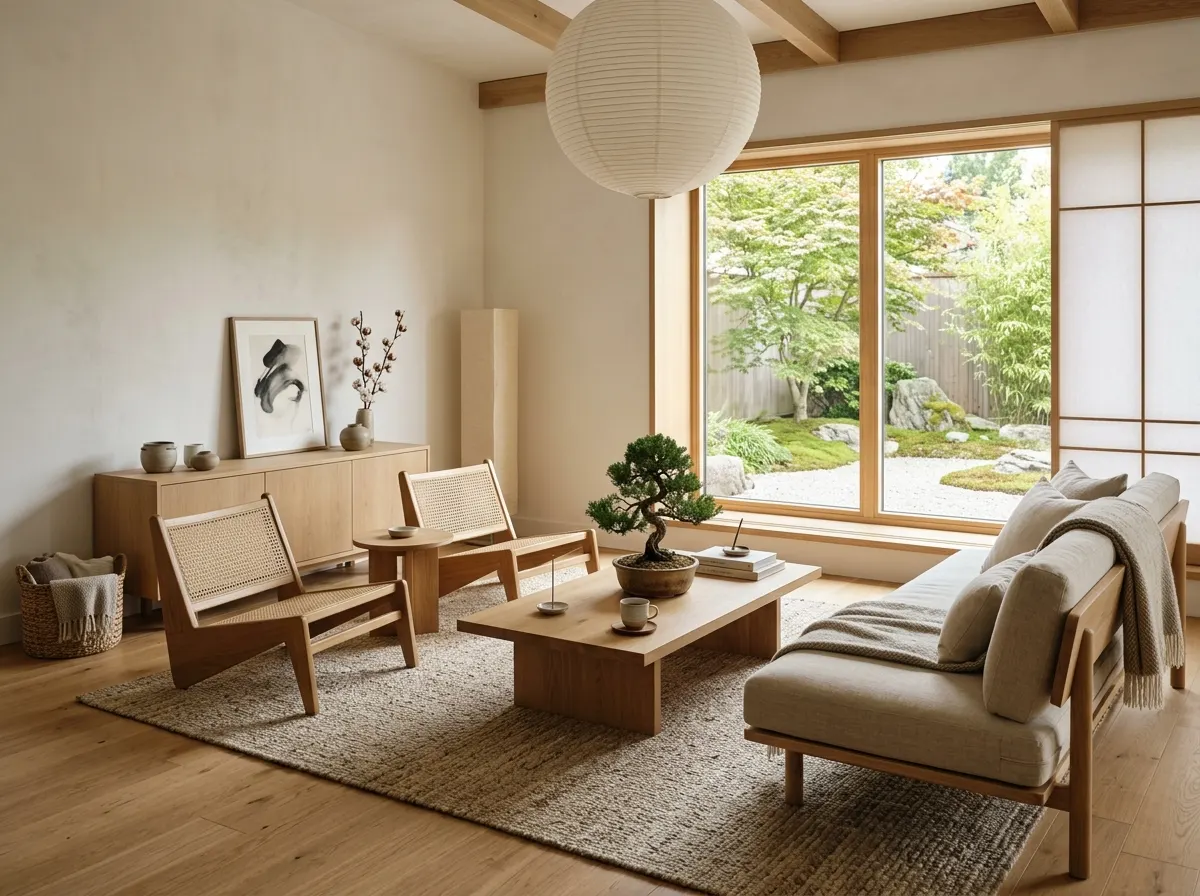
Styles with rounded furniture are often lumped together, but their accents differ. Japandi is the most restrained: low furniture, lots of empty space, craft and asymmetry – see our article on rounded furniture in japandi style. Soft minimalism stays minimalist but softens it with light, uniform surfaces and gentle edges (see soft minimalism furniture). Streamline is a dynamic, flowing line inspired by the 1930s, with horizontal divisions and semicircular ends (see streamline-style furniture).
Organic modern is the most material-driven of them. Its starting point is a natural material and a contrast of textures, and the curve appears where it follows function: on an island, a table, a reception desk or a vanity unit.
Key features of organic modern furniture
- Calm volumes. Fronts without frames, floor-to-ceiling units, hidden or routed handles. A piece should read as one form, not a set of cabinets.
- Rounded ends. A curved island end, an arched bookcase corner, a round table, a cylindrical bedside table. The curve is an accent, not a rule for every cabinet.
- Texture instead of ornament. Slats, fluting, veneer with pronounced grain, matt lacquer, bouclé on seats.
- Natural materials or honest equivalents. Solid wood and veneer, natural stone or quartz composite, linen, wool, ceramics.
- An earthy palette. Off-whites, sand, clay, sage, olive, the warm browns of walnut.
- Light that brings out texture. Lit plinths and shelves let fluting and grain work in the evening too.
Materials and colours
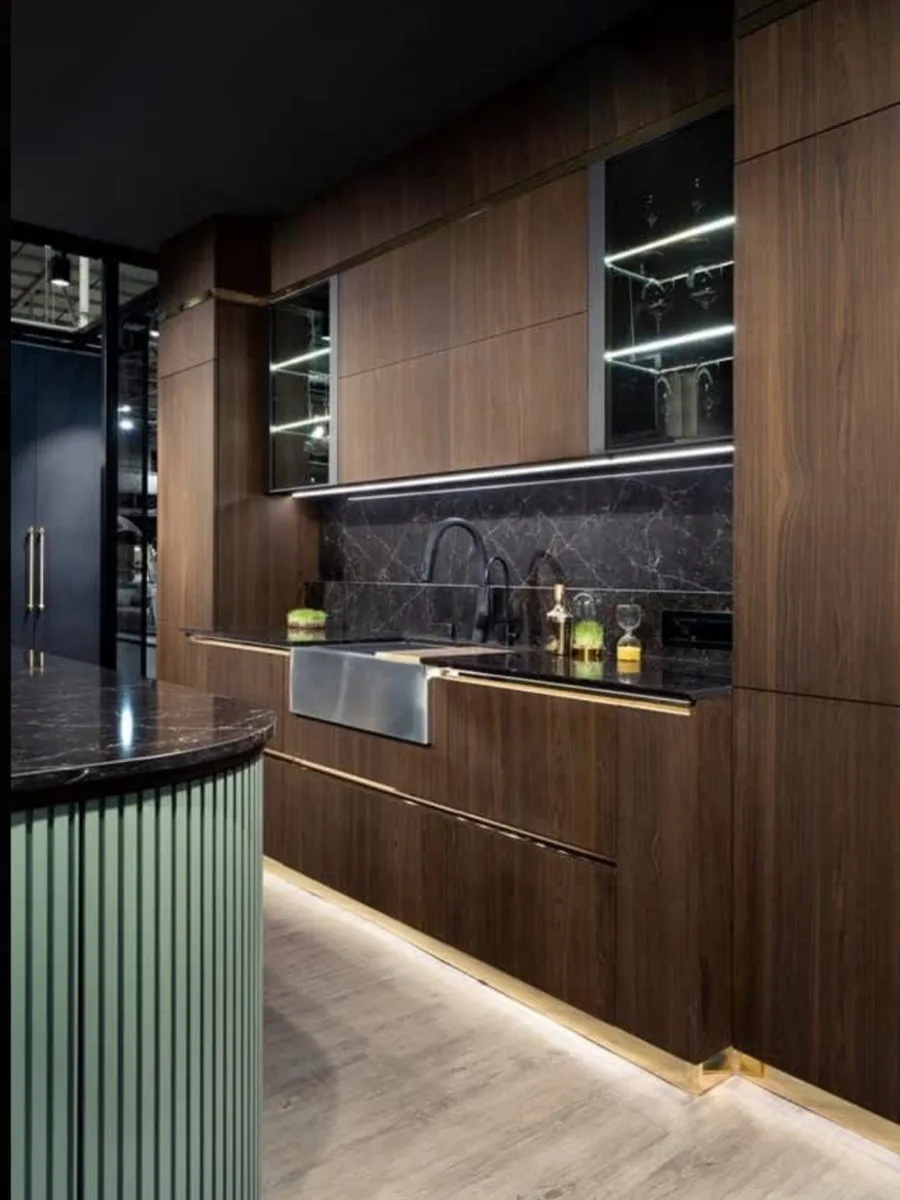
The character of the style depends above all on the material of the largest surfaces. A good rule: one leading material, one contrasting and one neutral. For example, walnut (veneer or décor) on the wall units, a sage-green island and a dark stone worktop.
| Material | Where it works | What to watch |
|---|---|---|
| Natural veneer (oak, walnut) | Large fronts, wall units, panels on curved sides | Grain matching across neighbouring fronts; careful edge finishing |
| Matt lacquer | Curved fronts, islands, fluted panels in any RAL/NCS colour | On bent surfaces the quality of substrate preparation matters |
| Natural stone, quartz composite, sintered stone | Worktops, rounded islands, bathroom tops | A curved outline needs a precise template and edge work |
| Wood-décor laminated board | Cabinet interiors, less visible fronts | It cannot be bent – curves need other materials |
| Fabric (linen, bouclé, wool) | Seats, headboards, acoustic panels | Abrasion class matched to intensity of use |
Organic modern colours resemble a landscape: sand, clay, sage, moss, warm white, graphite instead of pure black. More important than any specific shade is that all surfaces are matt or satin – gloss quickly takes the naturalness away.
Where rounded organic modern furniture makes the most sense
Kitchen and island
An island with a rounded end is the most recognisable element of the style. The curve has a job: there is no sharp corner to bump into in the passage between kitchen and living room, and movement around the island becomes smoother. The island front often gets vertical fluting, which looks especially good on a curve.
Living and dining room
A round or oval table, a TV unit with arched sides, a bookcase with rounded shelves. In the living room the curve works best on furniture you walk around. We collected more ideas in the article on rounded furniture for the living room.
Bedroom and bathroom
Cylindrical bedside tables, a headboard with rounded corners, a vanity unit with a wavy front. Here organic modern meets the need for calm – fewer edges, less visual noise. See also rounded furniture for the bedroom.
How to design custom organic modern furniture
- Start with the leading material. Decide what should dominate – wood, stone or a coloured matt – and match everything else to it.
- Decide where the curve goes. Round the pieces you walk around and touch: the island end, a bookcase corner in a passage, a tabletop. Wall units can stay straight.
- Plan the texture. Fluting, slats or strongly grained veneer on one or two planes. Texture everywhere is tiring.
- Combine form with storage. A curved front can still hide drawers and shelves – the interior just has to be designed around the curve.
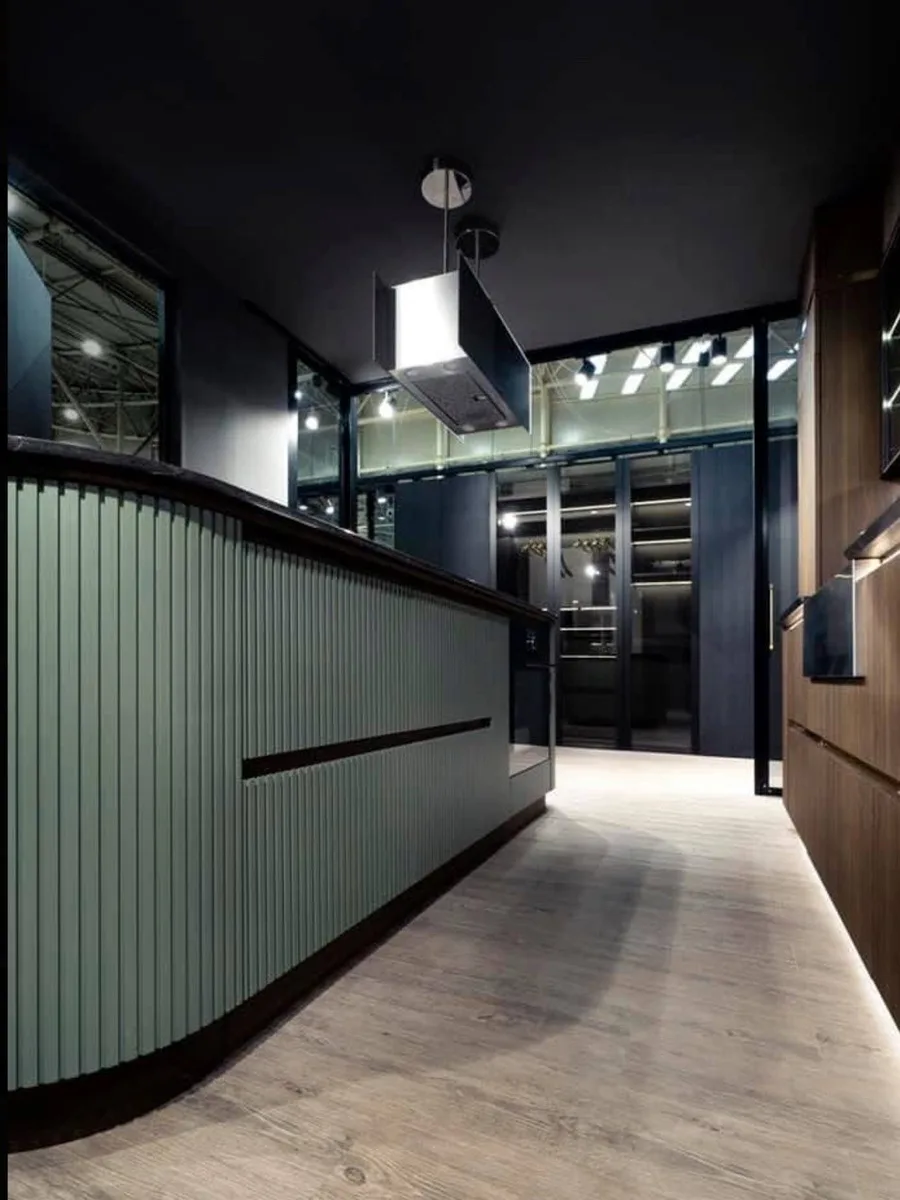
- Add light. A lit plinth and LED profiles under wall units bring out texture and visually lift a heavy volume.
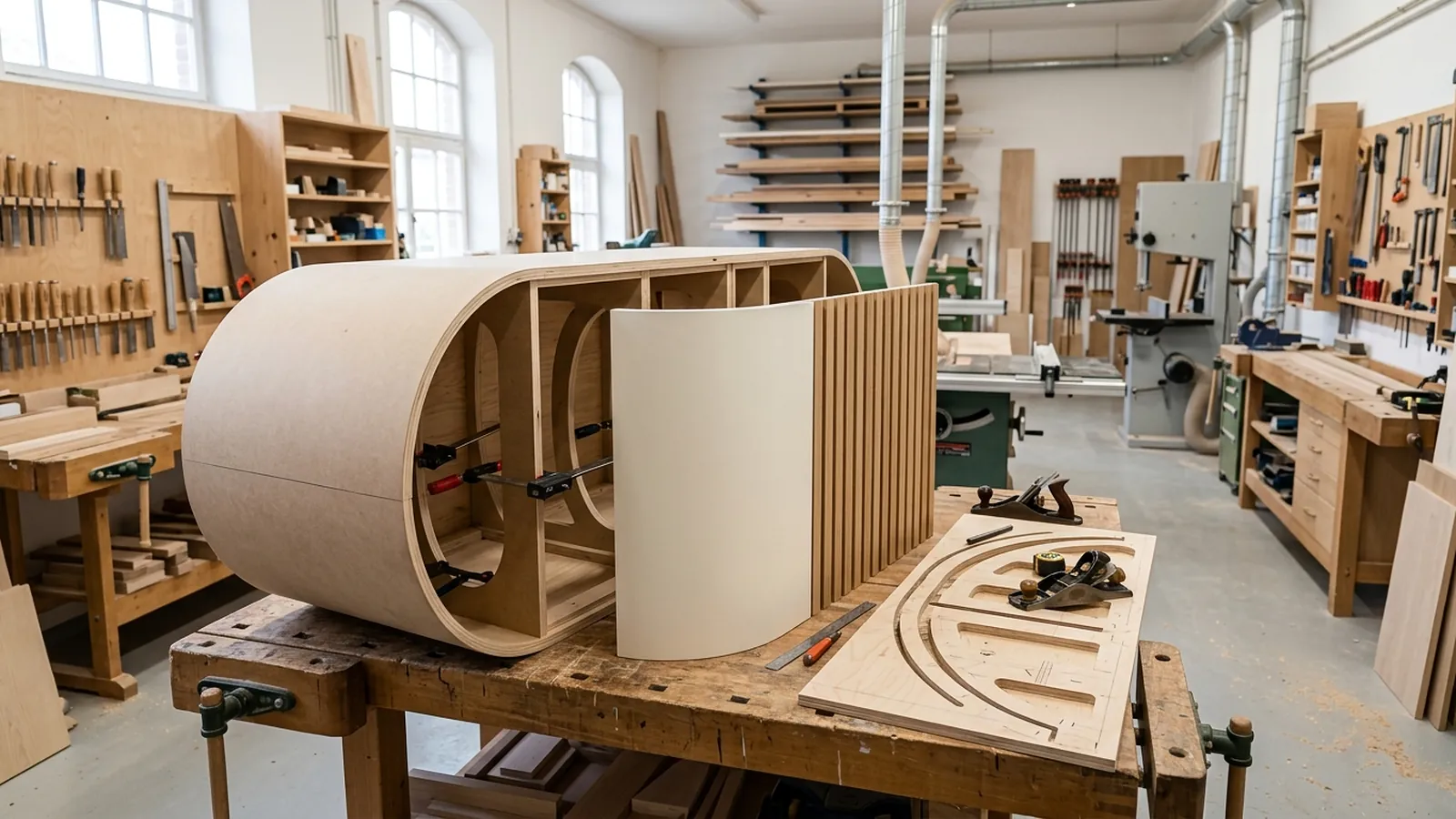
Technically, curved furniture is made differently from straight furniture: carcasses are bent on formers, fronts are made from bendable materials and edges are finished by hand. The details – radii, materials, bending and the effect on cost – are in our article on modern furniture with rounded corners.
Joiner's tip: before approving the design, look at a material sample in the light of your own room – in the morning and in the evening. Walnut veneer and a sage matt can look completely different by a north-facing window than in a showroom.
Common mistakes
- Too many curves. When everything is rounded, the contrast that makes a curve special disappears. A few rounded accents against calm, straight cabinetry are enough.
- Imitations that try too hard. A repetitive wood décor on large surfaces soon gives itself away. Where the eye rests longest, choose veneer.
- Too many earth tones at once. Sand, terracotta, olive and walnut in one room feel chaotic. Pick two colours and stick to them.
- Gloss. Shiny fronts and chrome take the softness out of the style.
- No storage plan. Organic modern should look calm, which means things need a place behind the fronts.
How we do it at Grandis
We design and build curved furniture and deliver it across Europe. We start with a free laser measurement, then prepare a 3D visualisation showing every curve, texture and material. Production starts only after written approval of the design, and the price in the contract does not change. Installation is done by our own in-house team. See home projects in our portfolio and the full scope on the custom furniture for home page.
See our projects: a rounded island with a fluted sage-green front against walnut-décor units, and a round fluted cabinet in warm beige – two ways to bring a curve into a home.
Our series on rounded furniture – read next:
Frequently asked questions
How is organic modern different from modern style?
Modern style focuses on clean geometry, smooth surfaces and often cooler materials. Organic modern keeps the simple volumes but adds natural materials, texture and rounded forms, which makes the interior warmer.
Does organic modern furniture have to be solid wood?
No. Large surfaces are often made from natural veneer, which has real wood grain and stays more stable on large fronts. Solid wood works well for tops, details and parts you touch.
Is rounded furniture more expensive than straight?
Usually yes, because it needs formers, bending and more manual finishing. You can limit the difference by rounding only the pieces that truly benefit, such as the island end rather than the whole kitchen.
Which colours suit organic modern furniture?
Earth and nature tones: warm white, sand, clay, sage, olive, wood browns, graphite. Most importantly, the finish should be matt or satin.
Will organic modern work in a small flat?
Yes. A light palette, floor-to-ceiling units and one rounded accent – such as a round table or a curved bookcase in a passage – make a small interior feel calmer and easier to move through.
Want to see how organic modern would look in your home? Fill in a short design quiz and we will come back with a proposal and an indicative budget. Measurement and the 3D design are free and non-binding.