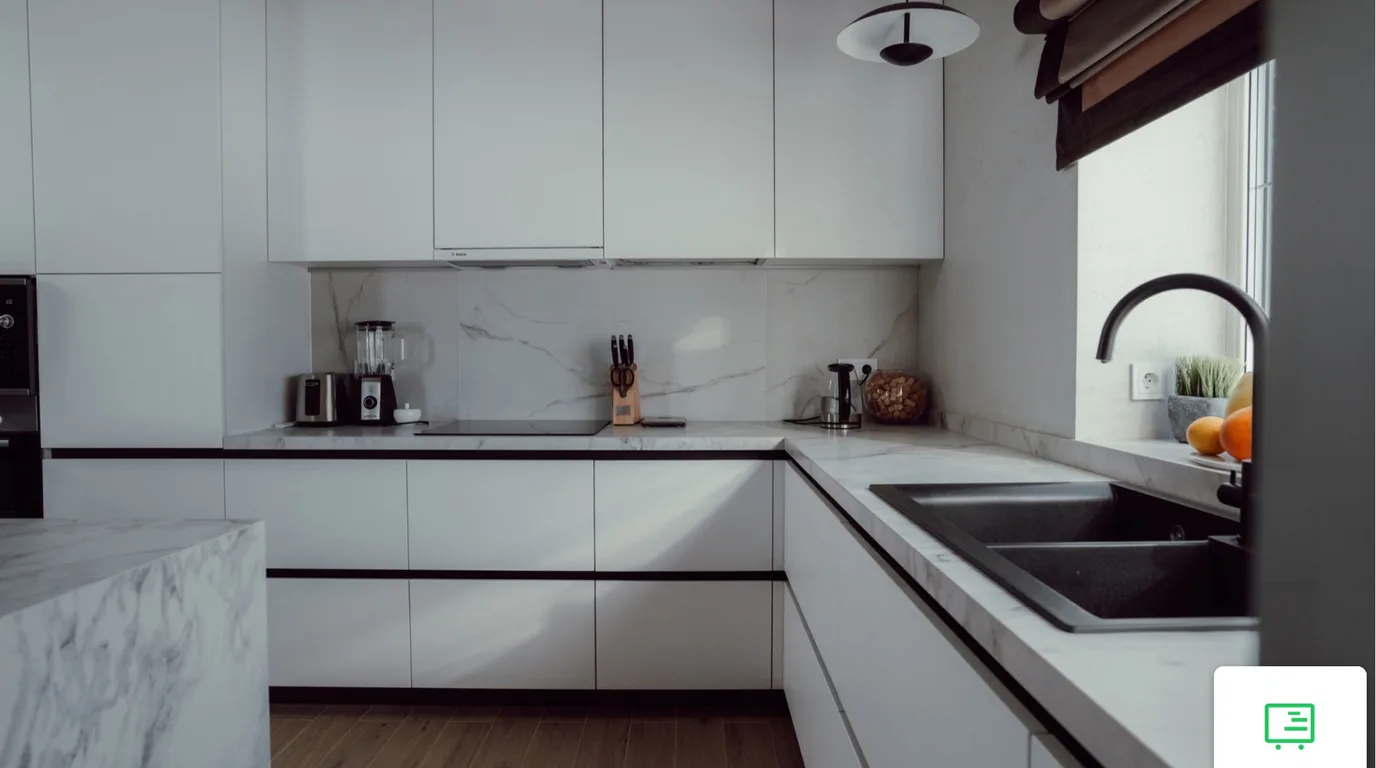
A quartz worktop is a slab of about 90% crushed quartz bound with resin and pigments. It barely absorbs water, resists scratches and needs no sealing. Its weak point is the resin: a hot pan or strong sunlight can leave a permanent mark. Daily care takes warm water, a mild detergent and a trivet for pans.
In this article
A quartz worktop is a slab of about 90% crushed quartz bound with resin and pigments. It barely absorbs water, resists scratches and needs no sealing. Its weak point is the resin: a hot pan or strong sunlight can leave a permanent mark. Daily care takes warm water, a mild detergent and a trivet for pans.
The water absorption of this material is up to 0.05% on technical data sheets. Slabs are usually 2 or 3 cm thick, and a typical format is about 3 m long. A longer worktop run therefore needs a joint. The key decisions are made when the cabinets are designed, not when the colour is chosen. Thickness, the overhang above the seating area, the sink cut-out and the position of the joint should be settled before the kitchen drawing is finished.
What quartz is made of
Engineered quartz (in Polish, konglomerat kwarcowy) is a factory-made stone. Crushed quartz usually makes up around 90% of its mass. The rest is resin, pigments and additives such as glass granules. The resin binds the grains into a dense slab and is responsible both for the material's strengths and for its limits.
Two other materials are often confused with it. Sintered stone (spiek kwarcowy) is made without resin, by firing ground minerals at a high temperature. Granite is a natural stone cut from a rock block. Comparing them by the same criteria shows where quartz wins and where something else is the better choice.
| Feature | Engineered quartz | Sintered stone | Granite |
|---|---|---|---|
| Composition | approx. 90% quartz, resin, pigments | ground minerals fired without resin | natural stone |
| Water absorption | up to 0.05%, no sealing | very low | higher than quartz |
| Hot pans | only on a trivet | withstands high temperatures | withstands high temperatures |
| Sunlight | resin may yellow | does not fade | also suitable outdoors |
| Pattern | slabs look alike | depends on the collection | every slab is different |
If you often put pans down straight from the hob, sintered stone is the safer choice. Quartz works where an even colour, low maintenance and a predictable look across the whole kitchen matter. A thinner and lighter alternative is compact HPL, which we cover in a separate article.
Pros and cons in everyday cooking
Quartz copes well with water, grease and daily wiping. Three things cause trouble: high heat, dyes left for a long time and knocks to the edge. Each of them can be limited by a simple habit or a design decision.
Pros
- Water absorption up to 0.05%. Water and grease stay on the surface, so they are easy to wipe off.
- No sealing. You do not need to reapply treatments, as you would with marble.
- Resistant to scratches and moisture. It needs far less care than wood.
- Predictable look. Slabs differ from each other less than natural stone, so the whole kitchen is easier to plan.
Cons
- The resin dislikes high heat. A hot pan can leave a brown or yellow discolouration.
- Strong dyes, such as beetroot juice, are best wiped off at once, before they dry.
- Edges and areas around cut-outs are sensitive to pressure and impact. That is where chips appear most often.
- The resin yellows under UV light.
Manufacturers quote heat resistance very differently, and in practice the resin can discolour even from a moderately hot pan left in one spot for a long time. So anything taken off the hob or out of the oven goes on a trivet.
A trivet next to the hob. Burnt resin leaves a brown or yellow mark that a specialist cannot always remove completely. A trivet kept permanently next to the hob costs less than a repair.
Thickness, slab sizes and joints
Thickness and the number of slabs are decided together with the cabinet design. The most common slabs are 2 and 3 cm, thinner versions are 12 mm. A thicker slab carries an overhang better and looks more solid, but it also weighs more. The length of the run, in turn, decides whether a joint is needed.
Typical formats are about 3.0 × 1.4 m and larger, about 3.2 × 1.6 m. A run longer than the slab, and often an L- or U-shaped kitchen too, requires two pieces to be joined. The joint is filled with a rigid adhesive in the colour of the stone. A well-made joint is less than 1 mm wide and must sit on full support.
Weight matters when carrying the slab in and for the cabinets that hold it. The density of quartz is 2,200–2,400 kg/m³. From this figure it is easy to work out the mass of a given section.
| Thickness | Mass of 1 m² | Section 3.0 × 0.6 m (1.8 m²) |
|---|---|---|
| 12 mm | 0.012 m × 2,200–2,400 kg/m³ = 26–29 kg | 1.8 × 26–29 kg = 48–52 kg |
| 2 cm | 0.02 m × 2,200–2,400 kg/m³ = 44–48 kg | 1.8 × 44–48 kg = 79–86 kg |
| 3 cm | 0.03 m × 2,200–2,400 kg/m³ = 66–72 kg | 1.8 × 66–72 kg = 119–130 kg |
The last column was calculated from the unrounded mass per square metre. Density is an approximate value, so the real mass depends on the specific slab and the number of cut-outs.
Overhang, island and quartz table
An overhang is the part of the worktop that projects beyond the cabinets, for example above the seating at an island. Quartz is heavy and rigid, so a longer overhang needs brackets or steel reinforcement. The limit depends on slab thickness.
Installation guidelines allow an unsupported overhang of about 30 cm for a 2 cm slab and about 38 cm for a 3 cm slab. In practice many installers play it safer with smaller values: about 15 cm for 2 cm and about 30 cm for 3 cm.
| Slab thickness | In practice, cautious | Limit from guidelines | Full support from |
|---|---|---|---|
| 2 cm | up to approx. 15 cm | up to approx. 30 cm | approx. 45 cm |
| 3 cm | up to approx. 30 cm | up to approx. 38 cm | approx. 60 cm |
In the design it is better to stick to the cautious values. An overhang longer than the guidelines allow may void the slab warranty.
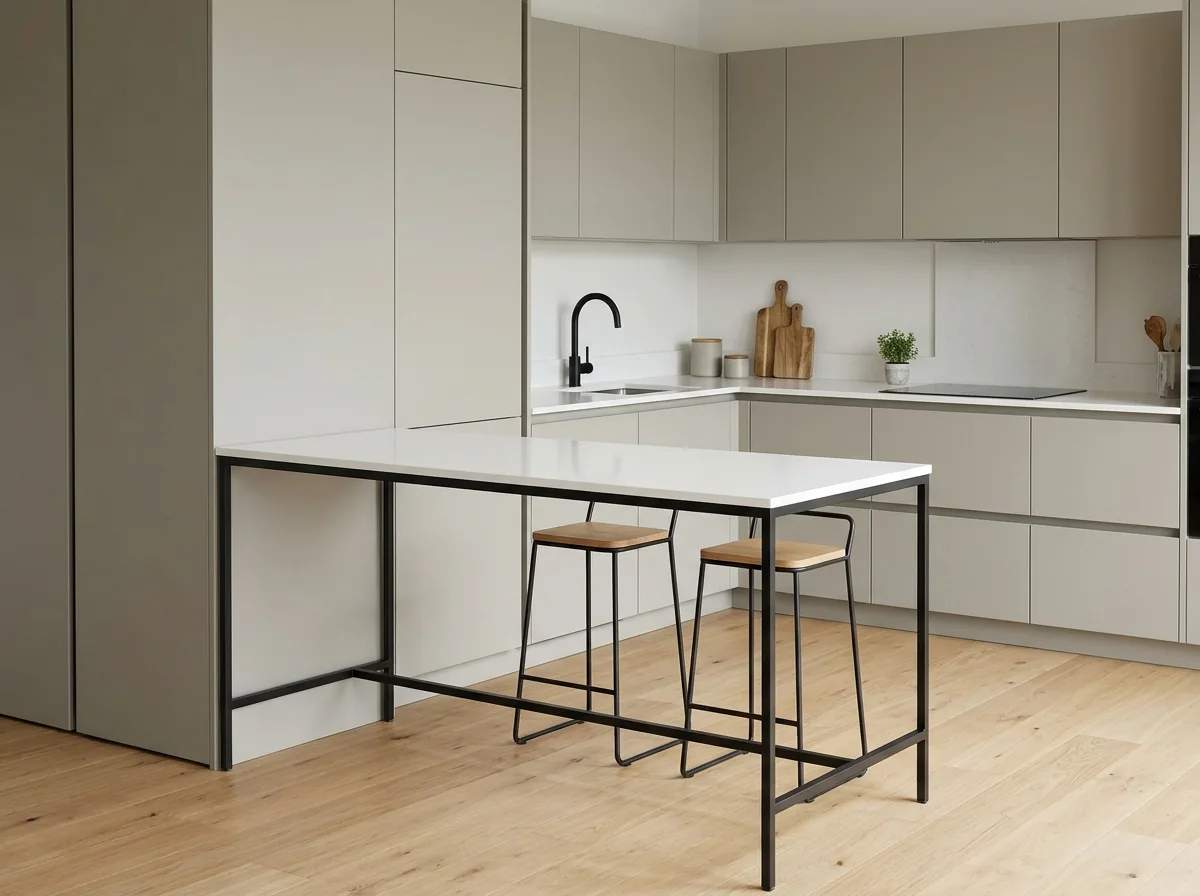
In our grey and beige corner kitchen a peninsula on a slim black metal frame extends from the shorter leg of the units. There are no cabinets underneath, so you can sit comfortably on any side. A frame like this is a good way to make a table from a heavy material. The slab rests on the structure rather than hanging over cabinets. A quartz table works on the same principle, and edges projecting beyond the legs follow the same limits as an overhang.
 AI-generated
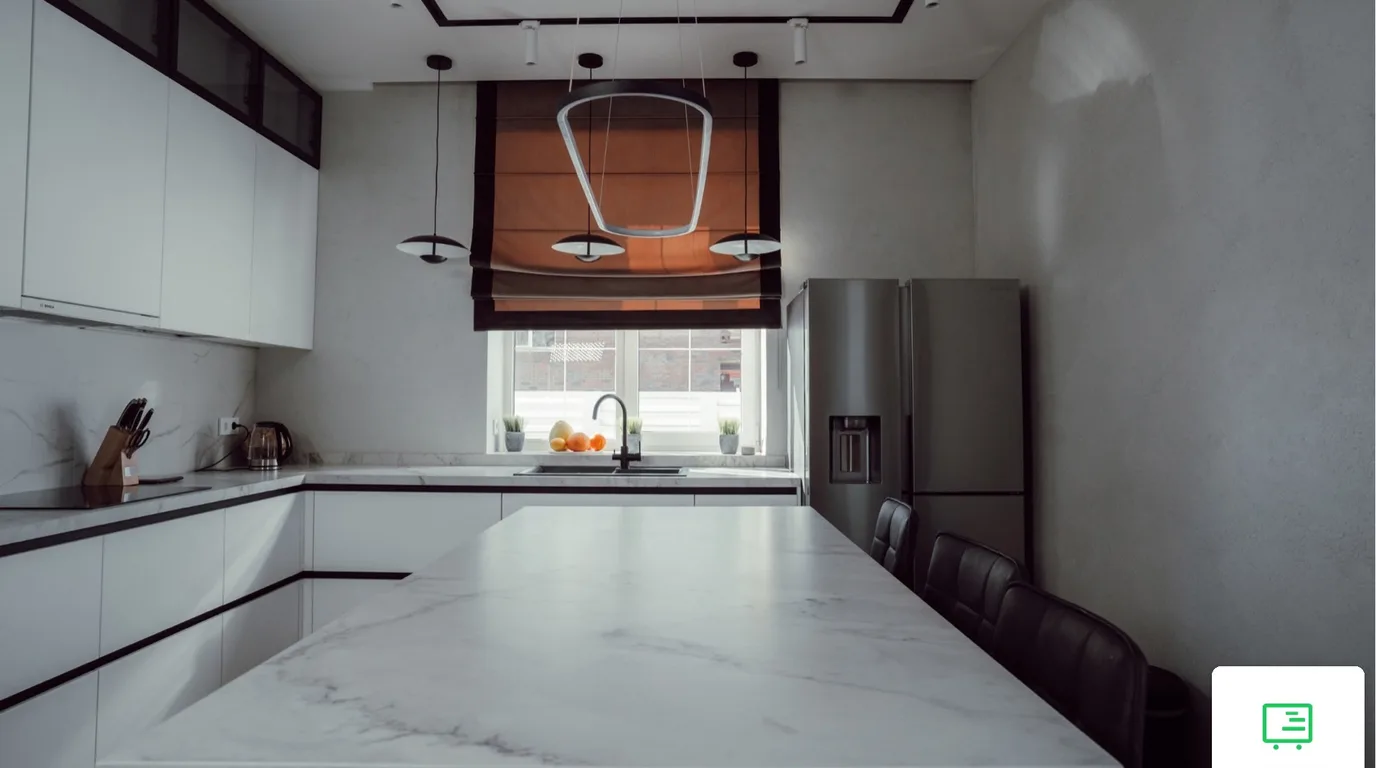
A similar stone-look effect can be seen in our black kitchen with an island: the worktop continues into a side panel reaching the floor, so the end of the island shows the same pattern. With quartz, such a panel is an extra piece that increases material use and changes the cutting plan. The same material can also run up the wall. We collected ideas in our article on the wall above the worktop.
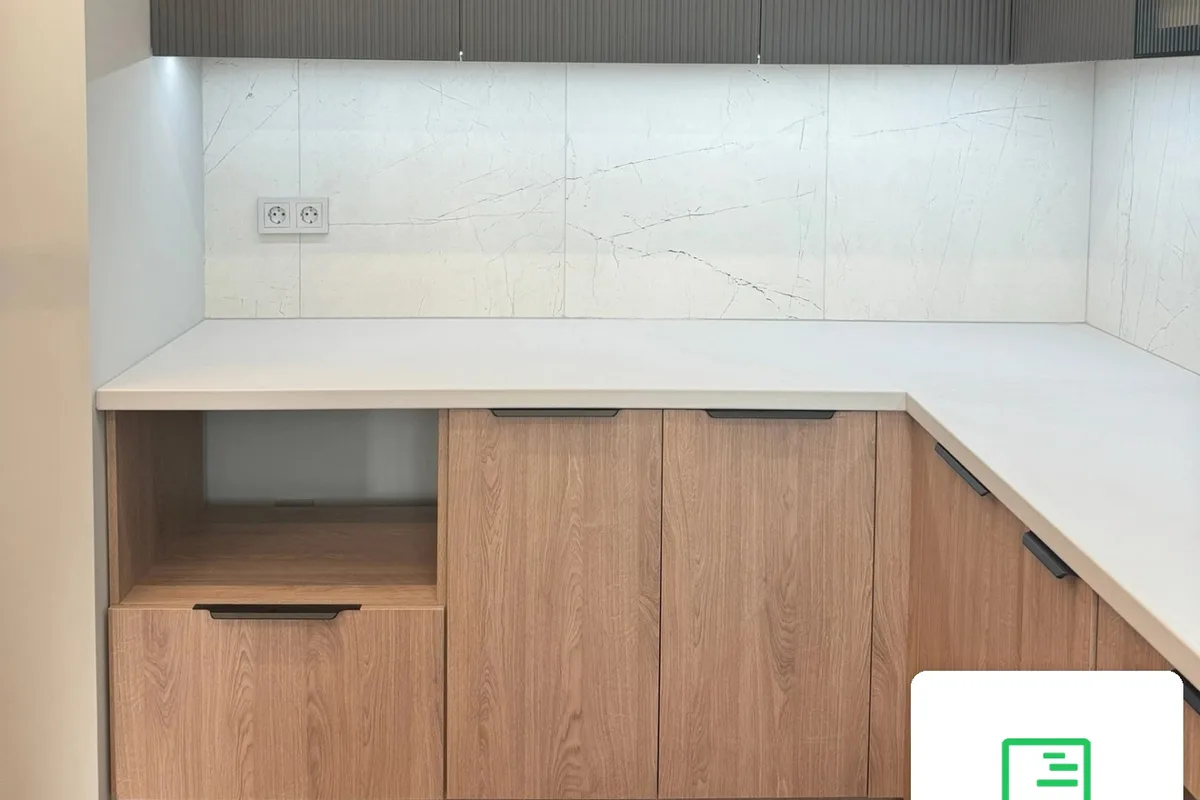
Decisions like these are easiest to make on the plan of a specific room. How we work from measuring to installation is described on our custom furniture page.
Sink, hob and cut-outs
Cut-outs are the weakest points of a slab. The material around the opening is narrower, and at the sink water and hand pressure add to the load. That is why openings are designed with rounded corners. Support is placed no further than about 7.5 cm from the edge of the cut-out.
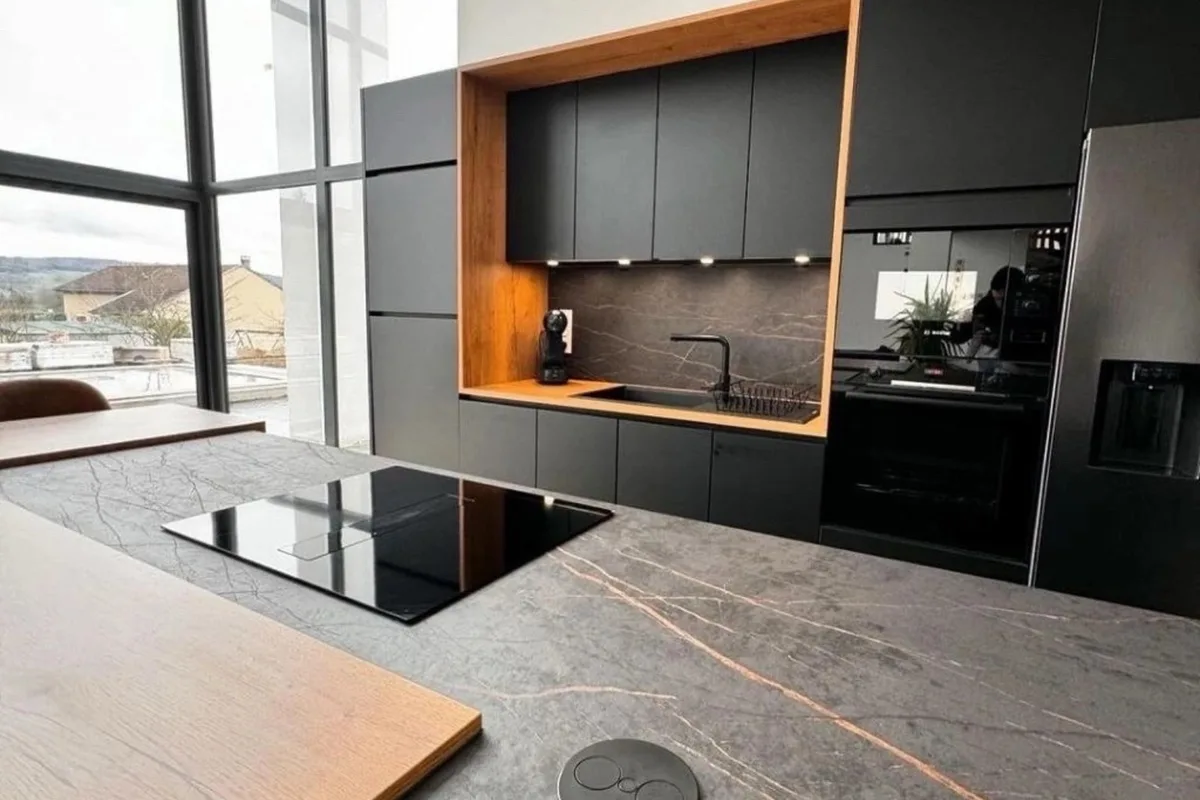
With an inset sink, the edge of the opening is covered by the sink rim. With an undermount sink, the edge remains visible and must be carefully finished. Around the opening, avoid leaning with your full weight or knocking the edge with heavy pans.
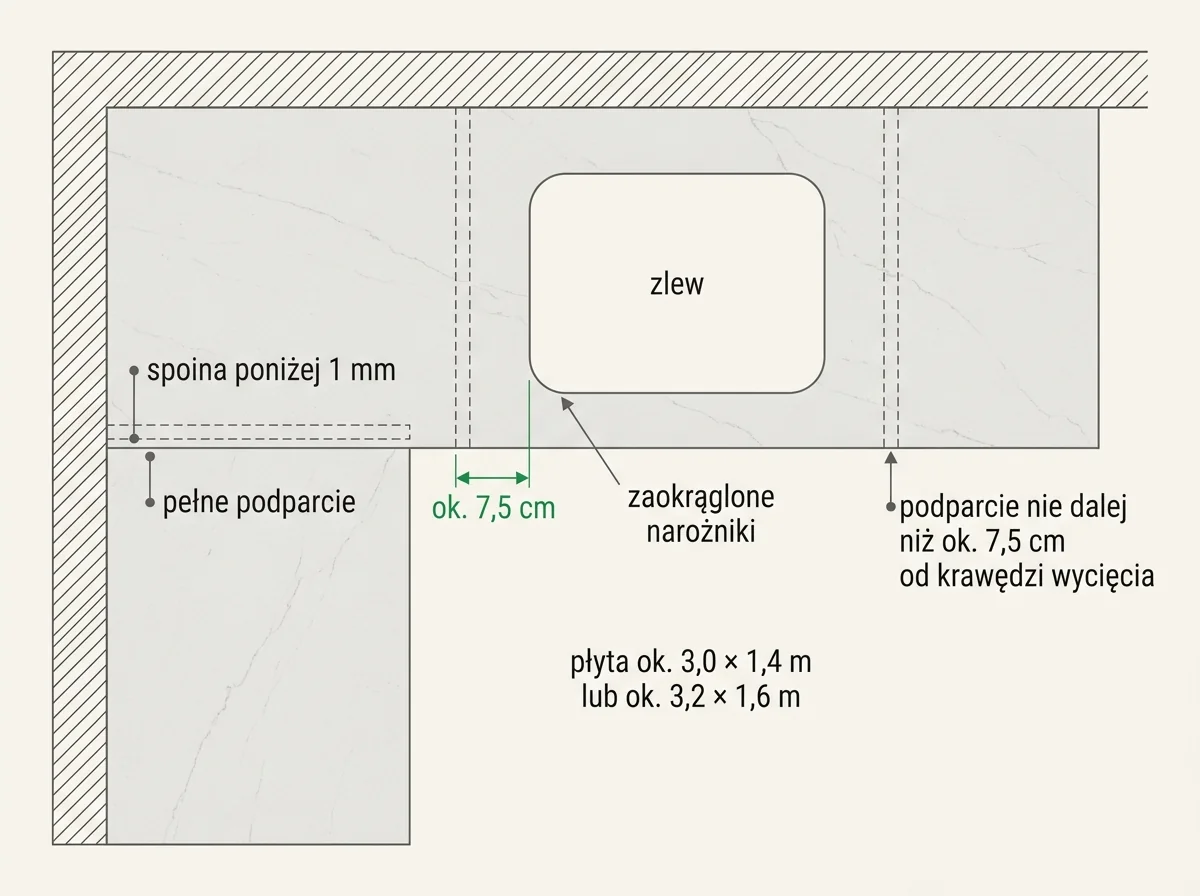
Next to the hob, a section of worktop set aside for hot pans is useful. Ideally a trivet lies there permanently, so nobody puts a pan straight on the stone. The positions of the sink and hob are worth fixing before the slab is cut, because they determine where the joint will fall.
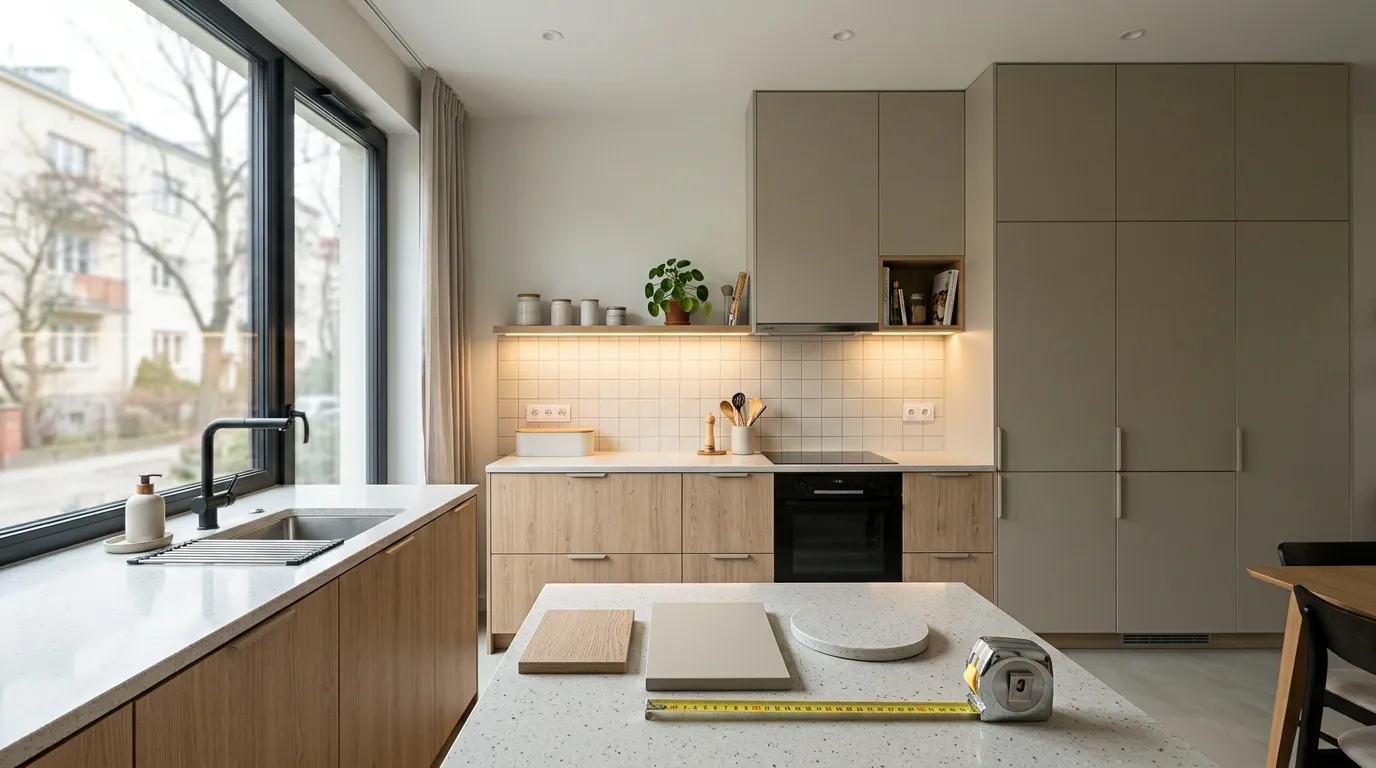
Slab sizes, joint positions and cut-outs are set from the exact dimensions of the kitchen. So before choosing a slab, it is worth it to book a measurement — it is free.
Quartz worktop care: cleaning and what to avoid
Day to day, quartz only needs cleaning. It does not need sealing, polishing or oiling. What matters is reacting quickly to spills and choosing the right products.
- Wipe the surface daily with a soft cloth or non-scratch sponge, warm water and a mild detergent. Then rinse with clean water and dry.
- Wipe up spills at once, strong dyes like beetroot juice first.
- Soften dried dirt with water, and for a stubborn stain use a quartz cleaner tested first in a corner of the worktop.
- Keep a separate cloth for the stone, because the one used for dishes spreads grease.
Strong acids and alkalis damage the resin. This applies to oven and grill cleaners, dishwasher detergents, solvents and paint strippers. Granite and marble cleaners are not suitable either, nor are oil-based products that leave a greasy film. If such a product gets on the surface, rinse it straight away with plenty of water.
A simple kit is enough. For daily cleaning, warm water, a mild detergent and a soft cloth are enough. Stronger products are kept for rare, stubborn stains and always tested in a corner.
A matt finish needs wiping a little more often than a polished one. Marks from metal pans and greasy fingerprints are easier to see on matt. Most of these marks come off with an ordinary cloth. Metal and rust marks are removed with a small amount of a mild oxalic acid cleaner on a damp cloth, without an abrasive sponge.
Chip, stain or burn: what to do
First, check whether only the surface is damaged or whether a crack runs through the slab. A surface chip or scratch can usually be filled with resin matched to the colour of the stone. A crack needs assessment by a specialist, because it may mean missing support underneath.
Damage at the sink cut-out and at the joint is the hardest to repair. A crack by the sink comes from stress in the slab, so filling it with resin only hides it. A lasting repair requires correcting the support around the opening. A joint that has opened or shifted is repaired by a stonemason. A resin burn is brown or yellow. A specialist can usually remove it, but not in every case. A dye stain is cleaned following the steps in the previous section.
What affects the cost and how to plan your order
In a custom kitchen, a quartz worktop is planned together with the cabinets. They determine the supports, the cut-outs and the position of the joint. The cost of the stone comes from several decisions made precisely at the design stage.
- The type and pattern of the slab and its thickness.
- The number of slabs, which depends on the length of the run and the shape of the kitchen.
- The number and type of cut-outs: sink, hob and tap hole.
- Edge finishing, island side panels reaching the floor and a wall panel.
- Brackets or a frame under the overhang.
- Delivery and installation of heavy pieces.
We give the exact amount after a free laser measurement, in a quote attached to the design with visualisation. The price is written into the contract. If you would like to plan a kitchen with this finish, you can read more about how we work on our page on furniture for homes.
This article is for information only and describes the properties of engineered quartz as of October 2026. The parameters of a specific slab, including heat resistance, are given on its technical data sheet.
We start every made-to-measure kitchen with a stone-look worktop with a free laser measurement. Just book a measurement, and we will plan thickness, joints and overhang on exact dimensions.
Frequently asked questions
Is a quartz worktop harmful to health?
There is no dust in a finished kitchen: it is released when slabs are cut and ground, not during cooking or cleaning. The risk concerns people who process the slabs. Inhaled silica dust can cause silicosis, a lung disease. For this reason, Australia banned the processing and installation of new engineered stone products from 1 July 2024. The ban does not cover sintered stone and ceramics without resin.
How is quartz different from quartzite?
Quartzite is a natural stone cut from a rock block. Quartz is made in a factory from crushed quartz and resin. Quartzite contains no resin, so it copes better with sunlight. On the other hand, it absorbs more water and usually needs sealing like natural stone.
Does a white quartz worktop get dirty quickly?
Not faster, but coffee, wine and beetroot juice show more on a light background. Wipe them off at once. A matt finish also needs wiping a little more often than a polished one. A light marble-look worktop with a similar appearance can be seen in our white kitchen with an island.
Is quartz suitable for a terrace or outdoor kitchen?
Standard quartz is not. The resin yellows under UV light, and white stone turns cream. Slab warranty terms often exclude outdoor installation and full sun, so check them before ordering. Sintered stone, granite or ceramics are better for a terrace.
Can you cut directly on quartz?
Better not. The surface resists scratches well in everyday use, but always use a chopping board for cutting. Keep knives and other sharp objects away from the slab.