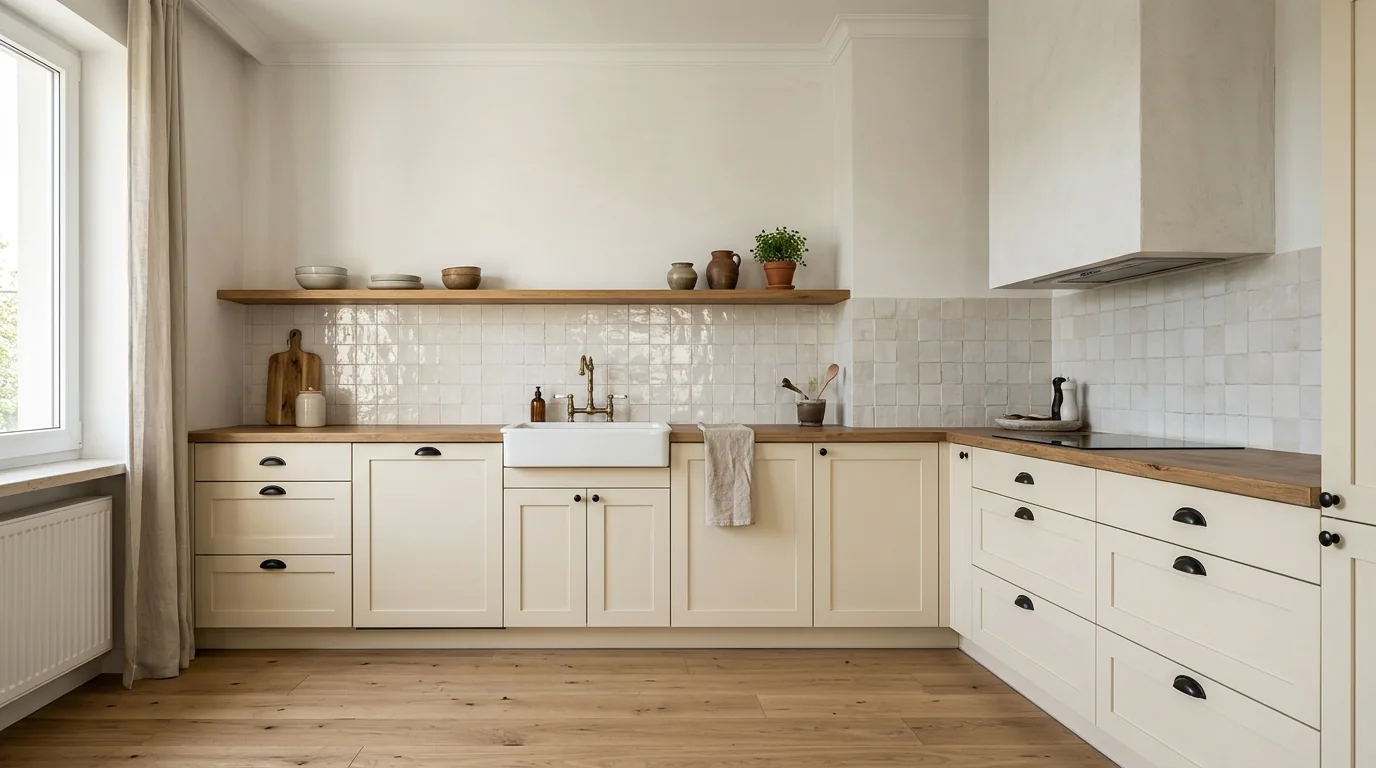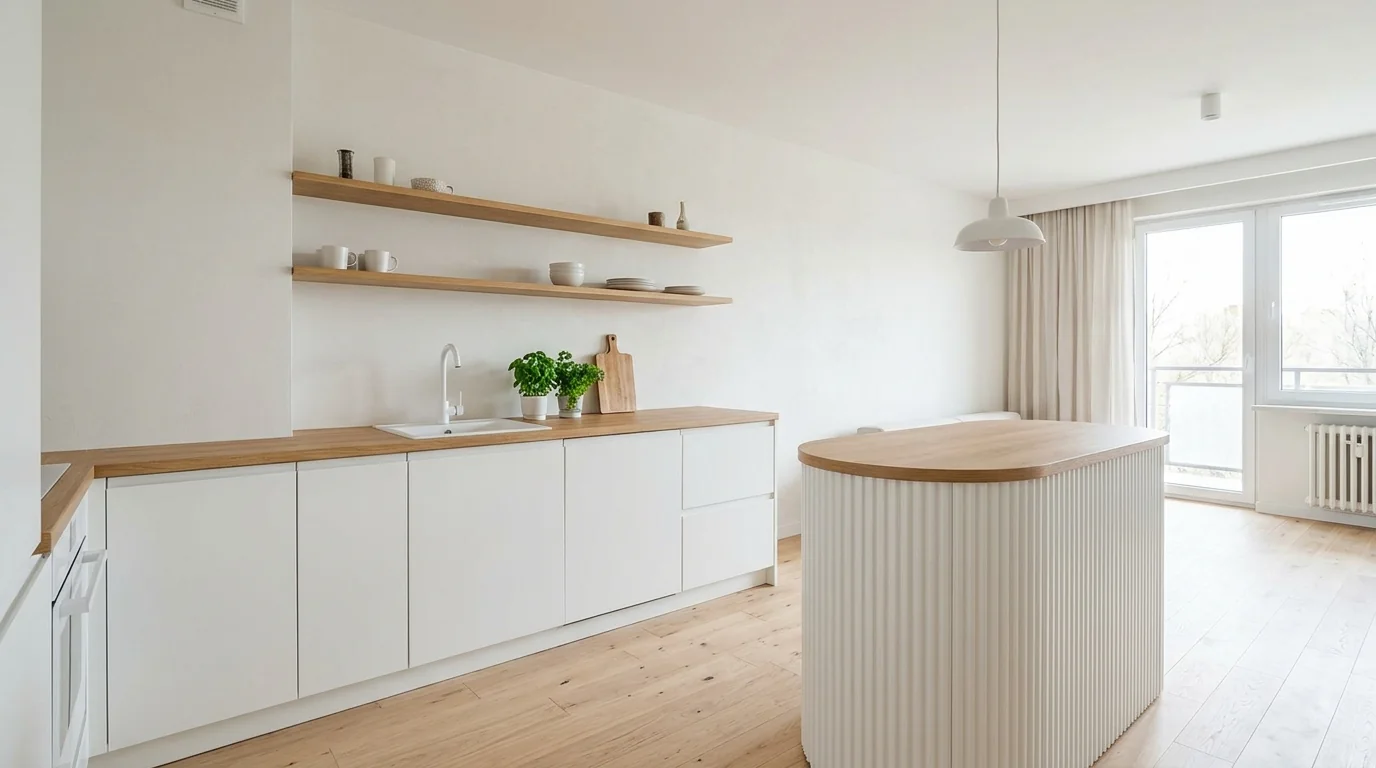
A Scandinavian kitchen rests on three decisions. The background is light: white, pale grey or warm beige. Add one light wood, such as birch, ash or oak. The fronts are smooth, and the handles are discreet or hidden. Everything else, from the worktop and shelves to the lighting, serves everyday cooking rather than decoration.
In this article
- Light: where the design begins
- Palette: white, pale grey, beige and one wood
- Fronts and handles: smooth and unadorned
- Open shelves: how many to keep
- Worktop: wood or a calm alternative
- Small Scandinavian kitchen
- Scandinavian vs Japandi kitchen
- How to order a custom Scandinavian kitchen
- Frequently asked questions
A Scandinavian kitchen rests on three decisions. The background is light: white, pale grey or warm beige. Add one light wood, such as birch, ash or oak. The fronts are smooth, and the handles are discreet or hidden. Everything else, from the worktop and shelves to the lighting, serves everyday cooking rather than decoration.
The style is a good answer to a lack of daylight. In Stockholm the shortest day of the year lasts 6 hours 5 minutes. In Warsaw it is 7 hours 42 minutes, and in early winter the sky is overcast or mostly cloudy 72% of the time. A kitchen in Poland has the same problem that Scandinavia solved with light-coloured furniture. That is why this article starts with light and then matches colour and material to it.
General principles of the style, such as hygge, lagom and common mistakes, are in our guide to Scandinavian style in custom furniture. Here we stay in the kitchen.
Light: where the design begins
A Scandinavian kitchen should reflect every bit of light that comes in. So light, matte surfaces go where daylight falls from the window. Wall cabinets should not block it, and in the evening under-cabinet lighting takes over.
In practice, that means a few simple design decisions:
- The window stays uncovered. If you need a shade, a light roller blind works better than a heavy curtain.
- No tall unit goes next to the window, where it would cast a shadow on the worktop. Tall units with appliances are better placed at the end of the run.
- The wall above the worktop is light and matte or satin. Gloss near the window creates glare.
- A continuous line of light runs under the wall cabinets. Without it, the worktop sits in the shadow of its own cabinets in the evening.
Artificial light in this style is warm. Pendants over an island or table are treated as part of the decor, not just as a light source. We explain how to plan task lighting in a separate article on kitchen lighting.
Palette: white, pale grey, beige and one wood
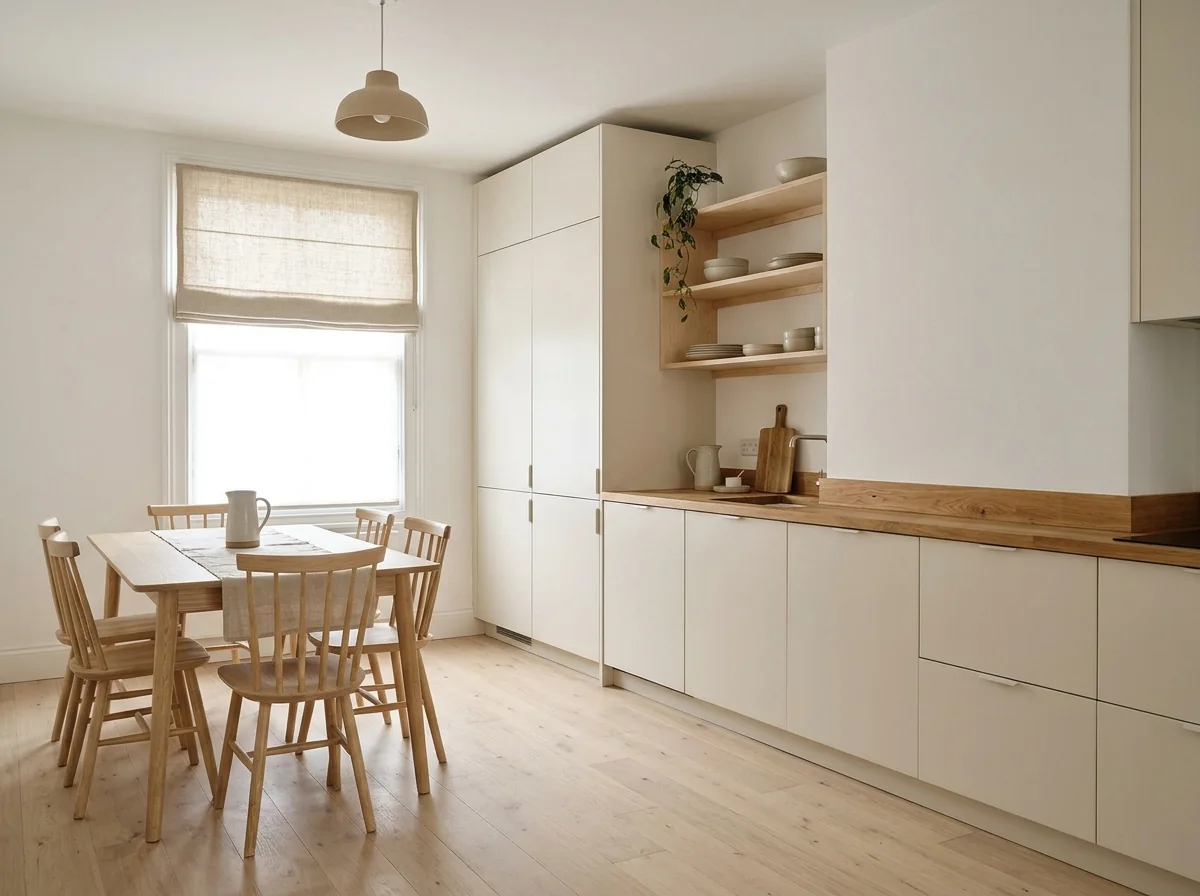
The palette of a Scandinavian kitchen is one light background and one wood. White can be pure or off-white, with a hint of grey or cream. Pale grey and beige help when pure white feels too cold. There is one accent: black details, green or a muted blue.
| Background | When to choose it | What to watch |
|---|---|---|
| Pure white | small kitchen, little daylight | can look sterile under cool light |
| Off-white, cream | kitchen open to the living room, warm wood on the floor | looks dirty next to pure-white appliances, so match the appliances to the colour |
| Pale grey | south-facing kitchen, lots of sun | turns grey and gloomy in a dark room |
| Beige, greige | kitchen that should feel warm without much wood | easy to overdo the number of beige shades |
 AI-generated
Wood brings the warmth that white lacks. Four species appear most often in this style:
- Birch is the lightest, with a calm, even grain. It works well on shelves and fronts in a small kitchen.
- Ash is light, with a more visible, fine grain. It suits the table and chairs next to the kitchen.
- Oak is the most common choice for the worktop, fronts and floor.
- Pine is the traditional wood of the North, but it gives a more rustic feel. We cover that side in our article on the rustic kitchen.
One rule ties it all together: one wood species per room. An oak worktop, birch shelves and a pine table are three different shades competing with each other. The wood does not have to be solid. Board in a wood decor gives the same effect on fronts and is easier to look after. We show how to combine white and wood in detail in our article on the white kitchen with wood.
Fronts and handles: smooth and unadorned
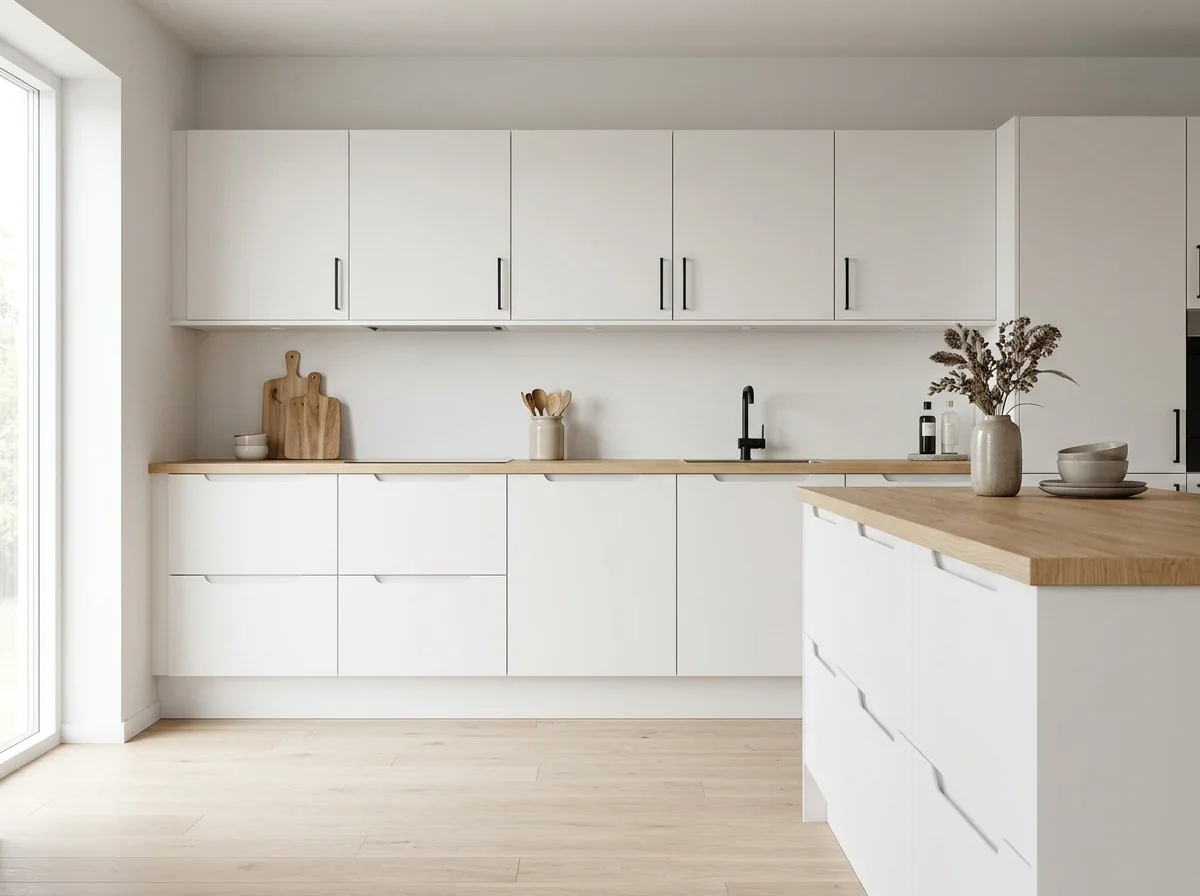
Fronts in a Scandinavian kitchen are smooth and matte, most often white or light wood. A more classic version uses routed fronts with a simple frame. Handles are thin and short, or there are none at all.
A matte finish in a light colour makes practical sense. It reflects less spot lighting, so you don't see every glare from a lamp.
For handles, there are three options. The first is thin bars or knobs in black, steel or wood. The second is an edge pull, almost invisible on the top edge of the front. The third is a fully handleless kitchen that opens via a profile or push-to-open.
 AI-generated
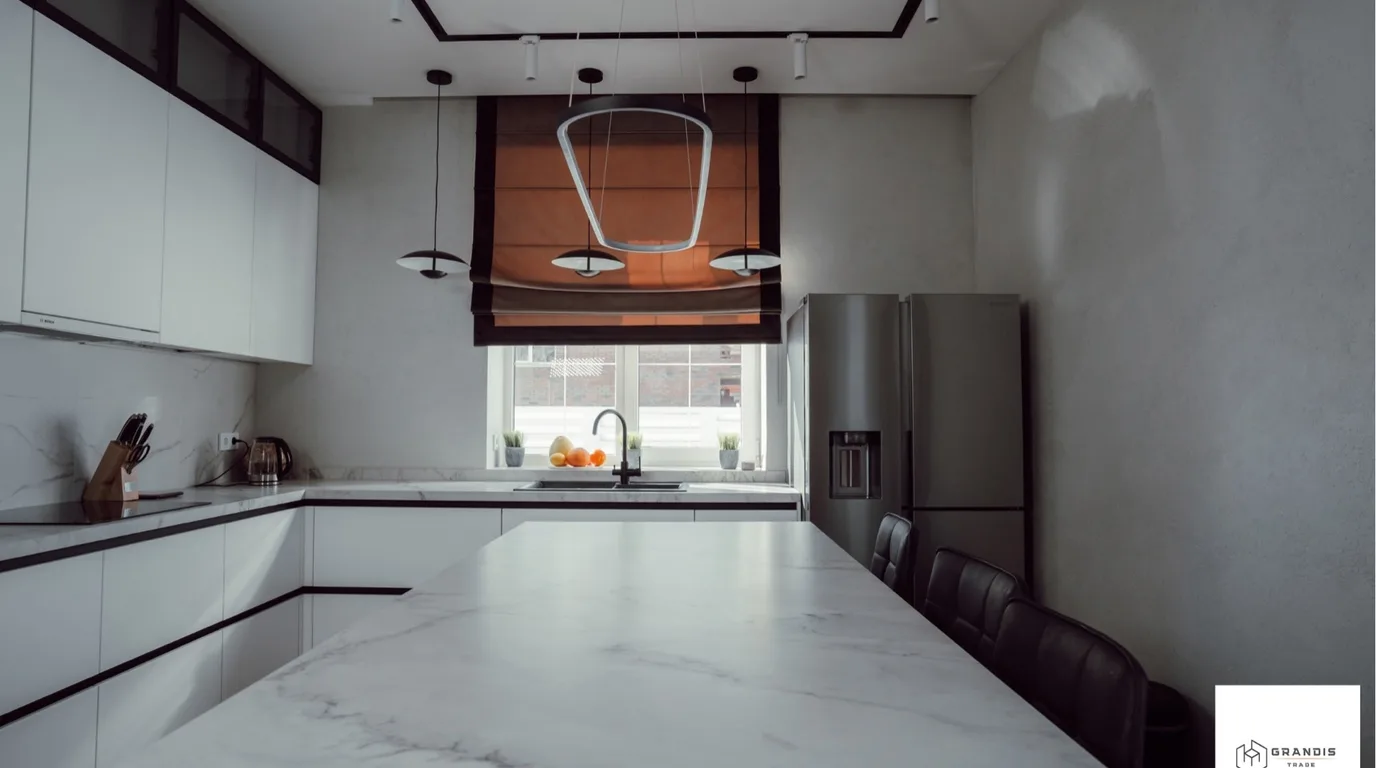
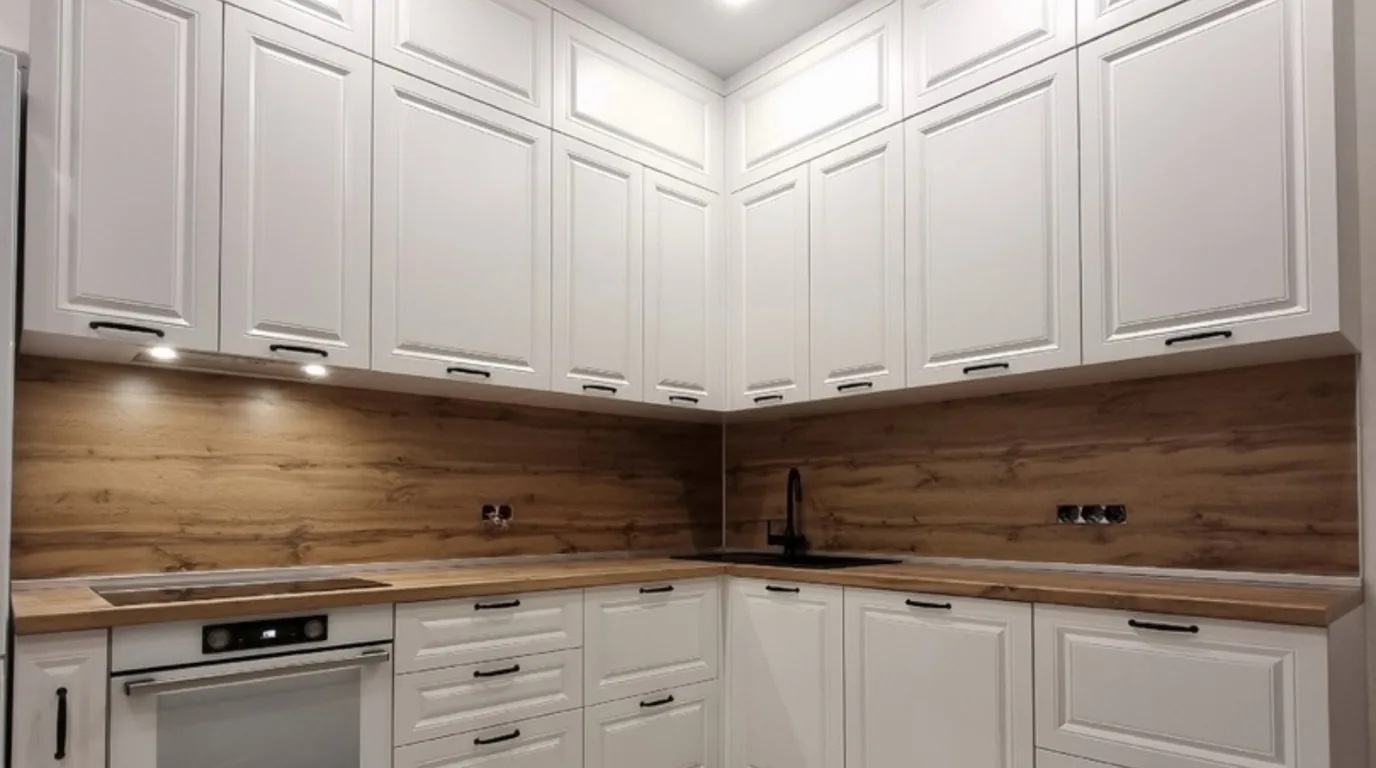
Two projects from our portfolio show both extremes. The white corner kitchen with routed fronts has black handles that form one clear line together with the sink and tap. The worktop is in a warm wood decor. The white handleless kitchen with an island has smooth matte fronts, while the worktop, the wall above it and the island share the same white marble decor. It is a light kitchen without visual noise, just with a stone decor instead of wood.
A black accent in three places. Black handles look coherent when something else repeats them: the tap, the sink or a lamp. A single black detail in a white kitchen looks like an accident.
Open shelves: how many to keep
Open shelves are associated with the Scandinavian kitchen, but in daily use they cause trouble. Cooking steam binds dust and grease into a sticky layer that a dry cloth won't remove. To keep shelves looking good, you have to wipe them practically every week, item by item.
That is why we usually suggest a compromise. By the hob and sink, the cabinets are fully closed with fronts. One or two open shelves go where there is least grease: by the window, at the end of the run or above the table. They hold things you use every day, such as mugs, glasses and jars of grains. That way dust has no time to settle.
A shelf in the worktop colour, or in the same wood as the table, pulls the kitchen together.
A shelf above the hob is the worst spot. Grease settles fastest above the hob. An open shelf there means frequent washing of everything on it.
Worktop: wood or a calm alternative
The worktop in a Scandinavian kitchen does not have to be white. Wood is the most typical choice because it warms up light fronts. Light stone or a stone look works too, as does laminate in a wood decor. The choice depends on how much maintenance you are willing to accept.
| Worktop | Look in this style | Everyday use |
|---|---|---|
| Solid wood (oak, ash) | the most natural, warms up white | needs oiling, wipe water and grease immediately |
| Laminate in a wood decor | similar effect, even pattern | no oiling, but edges and the joint at the sink must be well sealed |
| Light-coloured quartz composite | calm, uniform surface | stain-resistant, but feels cooler |
| Thin compact worktop | light, modern option | thin edge, looks good in a minimalist kitchen |
A wooden worktop by the sink needs attention. Spilled water is wiped dry, and grease and beetroot juice are removed straight away because they leave stains. Every so often the wood gets a new coat of oil. If you don't want that, choose laminate in a wood decor.
Small Scandinavian kitchen
The Scandinavian style works especially well in a small kitchen, because light colours and smooth fronts make the room look bigger. The key is floor-to-ceiling cabinets in one colour. Limiting materials to two also helps, and handles should be flat or hidden. We cover layouts and furniture for compact kitchens in more detail in a separate article.
A few solutions that work in a small room:
- Wall cabinets up to the ceiling, in the same colour as the wall. The cabinets blend into the background and don't overwhelm.
- Base units with drawers instead of doors. You see everything from above, with no bending to reach the back of the cabinet.
- A worktop that extends into an eating spot. You then don't need a separate table.
- One wood and one accent. Every extra material in a small kitchen looks like clutter.
Some of these solutions can be seen in our grey-beige corner kitchen with a table. The cabinets reach the ceiling, the fronts are matte, smooth and handleless, and the peninsula table extends the worktop and provides an eating spot. The white kitchen with routed fronts mentioned above was, in turn, designed to fit as much storage as possible into a small room. That is why it has two rows of wall cabinets up to the ceiling.
If you want to check how many cabinets will fit in a specific room, we start with a laser measurement, which is free. Book a measurement.
Scandinavian vs Japandi kitchen
Japandi combines Scandinavian and Japanese style, which is why the two kitchens are easy to confuse. The difference lies mainly in the depth of colour. A Scandinavian kitchen is light and airy. Japandi brings darker wood, muted earthy colours and more empty space.
| Feature | Scandinavian kitchen | Japandi kitchen |
|---|---|---|
| Background | white, pale grey, light beige | off-white, cream, taupe, warm grey |
| Wood | light: birch, ash, light oak | light and medium, with a dark accent such as walnut |
| Accent | black, green, pastel | muted, dark tones |
| Accessories | textiles, plants, lamps as decoration | fewer objects, handmade ceramics |
| Mood | bright and cosy | calm and restrained |
In practice, many kitchens combine both aesthetics. Light fronts come from Scandinavia, while a darker worktop or a single walnut front adds Japanese calm. Read more about Japandi in our article on Japandi style in Poland.
How to order a custom Scandinavian kitchen
A custom kitchen in this style is planned in reverse order to a modular one. First you decide where the light comes from and where the appliances will go. Only then do you choose the front colour and the wood. Check the front colour and a worktop sample in the light of that particular kitchen: white in a showroom and white by a north-facing window look different.
Our process has five steps. First comes a conversation about how you cook. Then we carry out a free laser measurement, after which we prepare a design with visualisation and a quote. The fourth step is the contract and production, and the last is delivery and installation by our own team with a handover protocol. The price written in the contract is fixed and changes only if the client changes the scope. Production usually takes 2–4 weeks, and we put the specific date in the contract. The cost depends most on the worktop material, the type of fronts and the hardware, not on the style itself.
More about how we work is on the page custom furniture for the home. After the conversation, the next step is a free measurement.
This article is for information only and describes solutions as of November 2026. We give the exact quote and lead time after the measurement and put them in the contract.
Frequently asked questions
What colours suit a Scandinavian kitchen?
The base is white, off-white, pale grey or beige. Add one light wood and one accent: black, green or a muted blue. More colours in one kitchen start to break the calm character of the style.
Does a Scandinavian kitchen have to be white?
No. White is the most common, but greige or pale grey fronts give the same light-background effect. What matters more than the colour itself is that the fronts are light, matte and smooth, and that wood appears on the worktop, shelves or table.
Which wood should I choose for a Scandinavian kitchen?
Most often oak, because it copes well with everyday use and has a warm tone. Birch and ash are lighter and work on shelves and fronts. In one room it is best to stick to one species or one decor.
Does a Scandinavian kitchen need open shelves?
No. Shelves need frequent wiping because dust and grease settle on them. One or two away from the hob, for everyday items, are enough, and the rest is better hidden behind fronts.