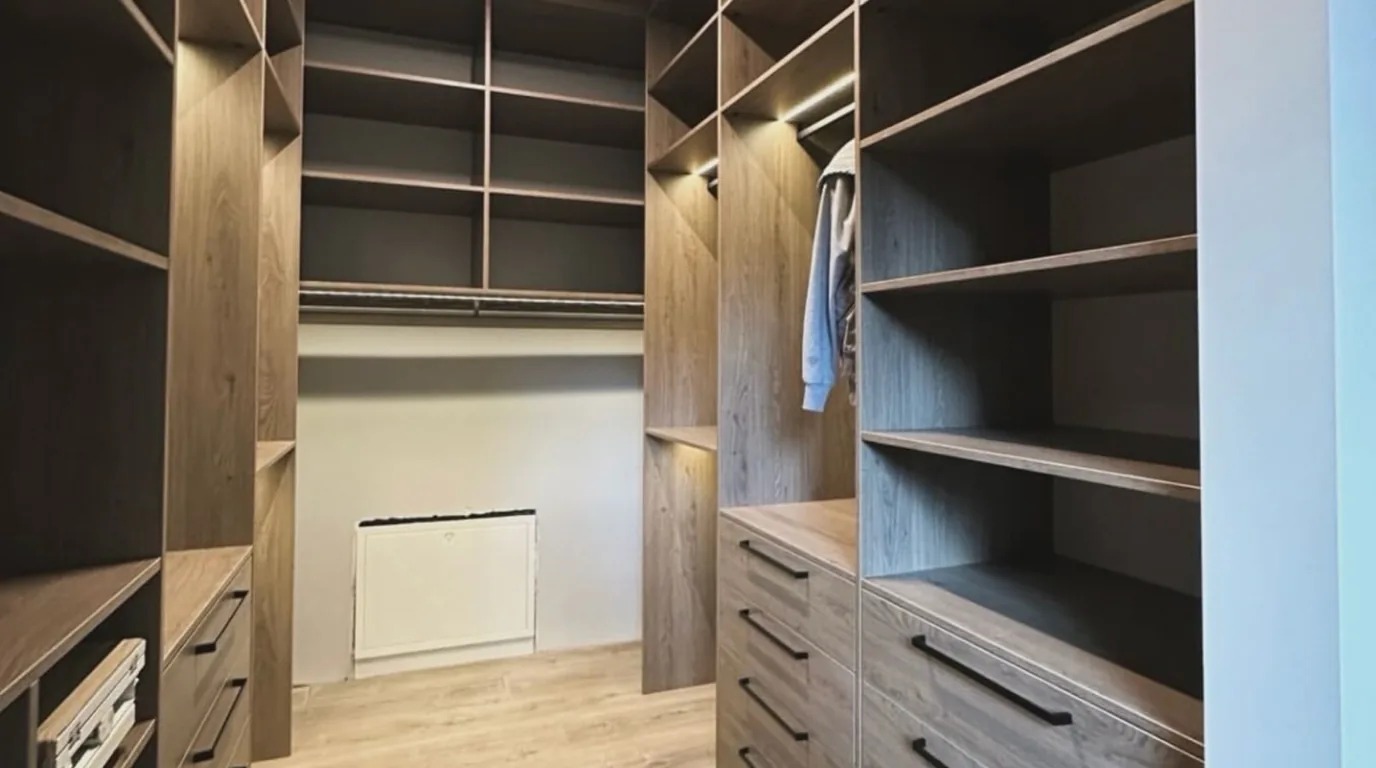
To organise a wardrobe, start with a list of your clothes, not with the shelves. Everyday items go at hand and eye level, drawers at the bottom and boxes of seasonal things at the top. Rail length depends on the number of hangers, section height on the length of your clothes. Shelves for folded items are usually 30 cm high.
In this article
- First the inventory, then the layout
- Three height zones: bottom, middle, top
- How much height hanging clothes need
- Rail length and the number of hangers
- Shelves and drawers: what to fold and what to tuck away
- Example layout of a 3 m wardrobe
- A wardrobe for two, for a child and for the change of season
- What to prepare before the wardrobe is measured
- Frequently asked questions
To organise a wardrobe, start with a list of your clothes, not with the shelves. Everyday items go at hand and eye level, drawers at the bottom and boxes of seasonal things at the top. Rail length depends on the number of hangers, section height on the length of your clothes. Shelves for folded items are usually 30 cm high.
A few numbers are enough to plan the interior without guesswork. A shirt on a hanger needs about 7 cm of rail, a coat 11–12 cm. Short items take up about 100 cm of height, while a rail for long coats can sit as high as 175 cm. A single rail should not be longer than 100 cm, or it sags under the weight of the clothes. Deep shelves are the most common letdown. On a shelf 60 cm deep, things end up in two rows and whatever is at the back quickly disappears from view.
First the inventory, then the layout
An organised wardrobe starts with counting what goes into it. The split between rails, shelves and drawers follows from the mix of your clothes. Someone who wears shirts and jackets needs more rail. Someone who wears knitwear and T-shirts needs more shelves and drawers.
Five groups are enough for the list.
- Short hanging items — shirts, blouses, jackets, short coats.
- Long hanging items — dresses, skirts, coats.
- Trousers — hung folded in half or full length.
- Folded items — jumpers, T-shirts, sweatshirts, jeans.
- Small and seasonal items — underwear, socks, belts, bedding, suitcases.
Before counting, set aside what nobody wears. A simple test helps. Turn every hanger hook-forward, and after wearing an item put it back on the rail the normal way. Whatever is still hanging reversed after about three months can be given away. Only clean, washed clothes go into the wardrobe.
Three height zones: bottom, middle, top
A wardrobe is divided vertically into three zones by how often you reach into them. In the middle, at hand and eye level, hang the clothes you wear every day. At the bottom are drawers or pull-out shelves. Up high, above eye level, sit boxes and things used a few times a year.
The bottom is the place for drawers. In practice, shelves 60 cm deep are not fitted lower than 90 cm, because you have to bend down and reach blindly to get to the back. A drawer slides out fully and shows everything from above. This zone also holds baskets for shoes and bags.
The middle is for rails on one or two levels. This is where the clothes you take out daily hang, along with shelves for your most-worn knitwear.
The top is the overhead storage level: the highest part of the wardrobe, above the main doors or under the ceiling. It holds suitcases, duvets waiting for the next season and labelled boxes. If the top zone is meant for daily use, a pull-down wardrobe rail (pantograph) is fitted. The mechanism is mounted on the sides of the section under the ceiling, and the rail swings down to arm's reach. These mechanisms come in several width ranges, roughly from 45 to 120 cm, so the section width is chosen to suit the mechanism, not the other way round.
How much height hanging clothes need
The height of a hanging section depends on the longest garment. Shirts and short dresses need about 100 cm of vertical space. The rail for skirts and coats is fixed at about 140 cm, for long men's coats at about 175 cm. Trousers folded in half hang on a rail at 80 cm, full-length ones at 120–130 cm.
| Clothes | Vertical space / rail height from section floor | Rail per item |
|---|---|---|
| Shirts, blouses, short dresses | about 100 cm of space | about 7 cm |
| Jackets, blazers, short coats | about 100 cm of space | 11–12 cm |
| Skirts, coats | rail at ~140 cm | 11–12 cm (coat) |
| Long men's coats | rail at ~175 cm | 11–12 cm |
| Trousers folded in half | rail at ~80 cm | depends on the hanger |
| Full-length trousers | rail at 120–130 cm | depends on the hanger |
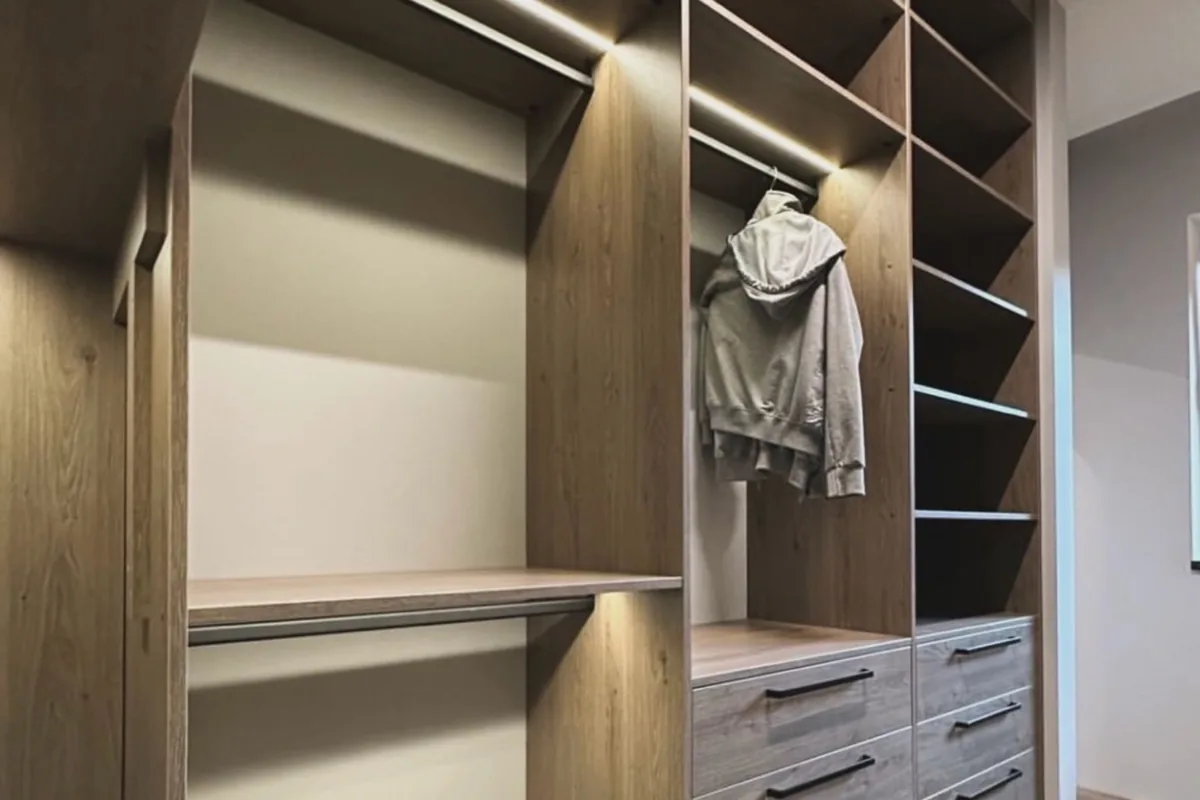
When planning a section for long items, measure your longest coat together with its hanger and add a few centimetres to spare. In practice, this part of the wardrobe is at least 150 cm high.
These figures give a double-hang layout, with two rails one above the other. The lower one hangs at about 100 cm, the upper one at about 200 cm. Leave at least 5 cm between the upper rail and the shelf above it so a hanger lifts off easily. A layout with rails at 103 and 208 cm from the floor is also common.
Rail height and your height. An upper rail at about 200 cm means reaching up with your arm. For shorter people, or in a section just for long items, it is better to lower the rail and put a shelf for boxes above it.
Rail length and the number of hangers
Rail length follows from the number of hanging items. Allow about 7 cm for a shirt, dress or blouse, and 11–12 cm for a coat, jacket or blazer. Leave at least 3 cm between hangers so clothes do not crease. A 100 cm rail therefore holds about 14 shirts or 8–9 coats.
Packed tightly, with items touching, a metre of rail can take as many as 26 shirts or 13 jackets. In a wardrobe you use every day, it is safer to plan more loosely.
An example inventory for one person, converted into centimetres of rail:
| Items | Number | Per item | Rail |
|---|---|---|---|
| Shirts and blouses | 30 | 7 cm | 30 × 7 = 210 cm |
| Jackets and short coats | 8 | 12 cm | 8 × 12 = 96 cm |
| Total short | — | — | 306 cm |
| Long dresses | 5 | 7 cm | 5 × 7 = 35 cm |
| Coats | 3 | 12 cm | 3 × 12 = 36 cm |
| Total long | — | — | 71 cm |
306 cm of short items on two rails one above the other means 153 cm of wardrobe width (306 ÷ 2). Since a single rail should not exceed 100 cm, this is split into two 80 cm sections. They give 320 cm of rail (2 sections × 2 rails × 80 cm), which leaves a little spare. The long items, 71 cm, fit into one section 80 cm wide.
Shelves and drawers: what to fold and what to tuck away
Shelves are for things that fold well. Jumpers, sweatshirts and T-shirts need a shelf 45–60 cm wide and about 30 cm high. Bedding and towels fit on shelves 50–100 cm wide and 30–40 cm high. Keep the piles low, because pulling something out of the middle makes the whole stack slide.
Knitwear is better folded than hung. A heavy jumper on a hanger stretches at the shoulders and loses its shape. At most, hang light cardigans, draped over the hanger's crossbar.
A deep shelf is a common wardrobe mistake. At 60 cm deep, things are stacked in two rows, and looking for something at the back makes the front collapse. There are two fixes. The first is pull-out shelves or baskets on runners in the same section. The second is a shallower shelving section next to a deeper part for hanging.
Drawers for underwear, socks, belts and ties are made shallow, up to 12 cm. In a deep drawer small things pile up on top of each other and you have to dig through them. It is worth ordering dividers, inserts with compartments for socks and underwear. Towels fit in drawers 30–40 cm deep.
Example layout of a 3 m wardrobe
The items counted above give a wardrobe with four sections. Partitions are usually planned on a 10 cm module, most often every 40, 50, 60 or 80 cm. In this example the interior is 250 cm high, measured from the wardrobe floor.
| Section | Width | What is inside, from the bottom up |
|---|---|---|
| 1. Short items | 80 cm | rail at 100 cm, rail at 200 cm, shelf at 205 cm, 43 cm above it for boxes |
| 2. Short items | 80 cm | same as section 1 |
| 3. Long items | 80 cm | 35 cm for shoes under the dresses, rail at 175 cm, shelf at 180 cm, two shelves above it for seasonal items |
| 4. Shelves and drawers | 50 cm | drawers up to 90 cm, shelves every 30 cm up to 210 cm, about 40 cm above them for bedding |
The interior width is 80 + 80 + 80 + 50 = 290 cm. Add three partitions, which take up 5.4 cm in 18 mm board (3 × 1.8), plus the wardrobe sides. Above the upper rail there is 250 − 205 − 1.8 = 43.2 cm left for boxes and suitcases. In section 3, dresses 140 cm long end 35 cm above the floor (175 − 140), so a shoe shelf fits beneath them.
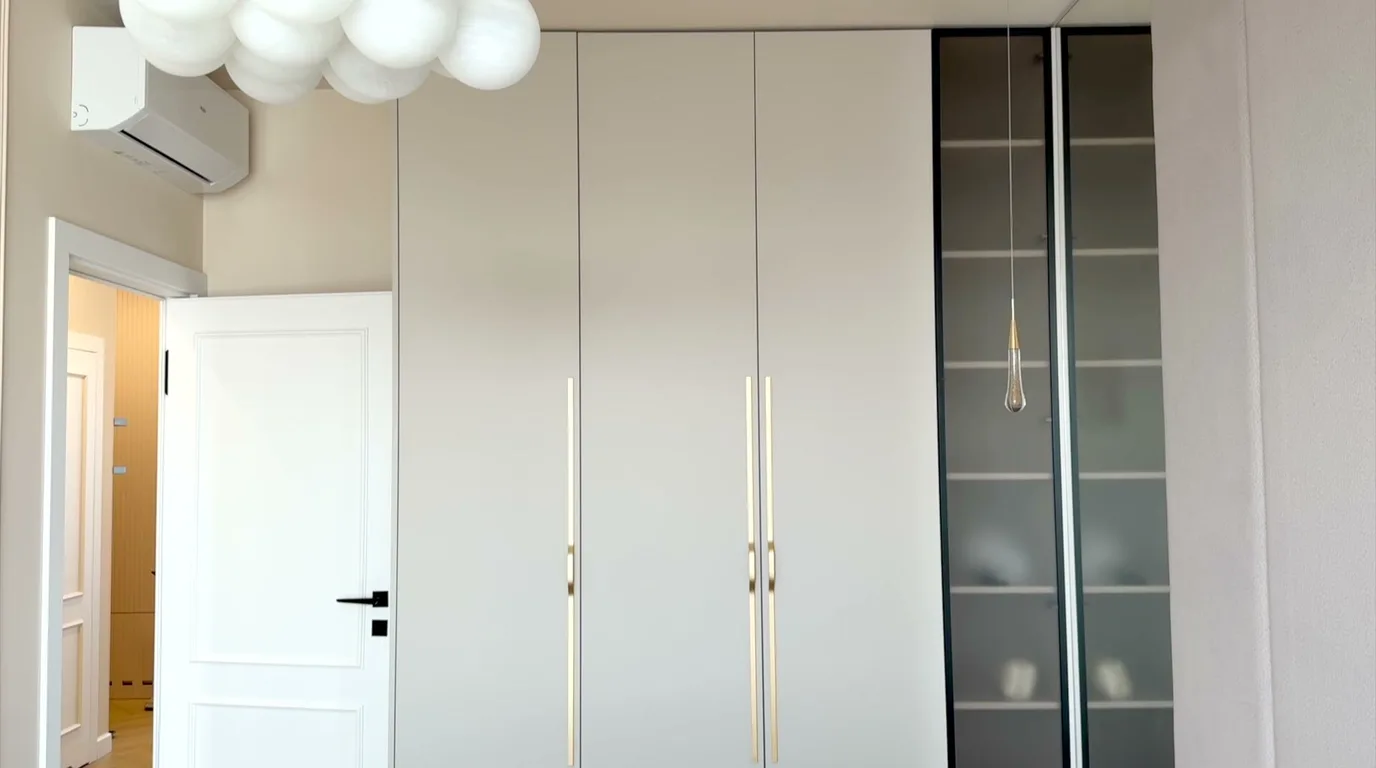
We arranged the sections by type of item in a bedroom wardrobe with tinted glass. Behind the glass doors are two hanging sections, each with a top shelf, a rail and a shelf at mid-height. Below it, a trouser rack slides out on full-extension runners. Trousers hang on separate bars and take no space on the rail. Behind the solid door are open shelves and three handleless internal drawers for underwear and small items.
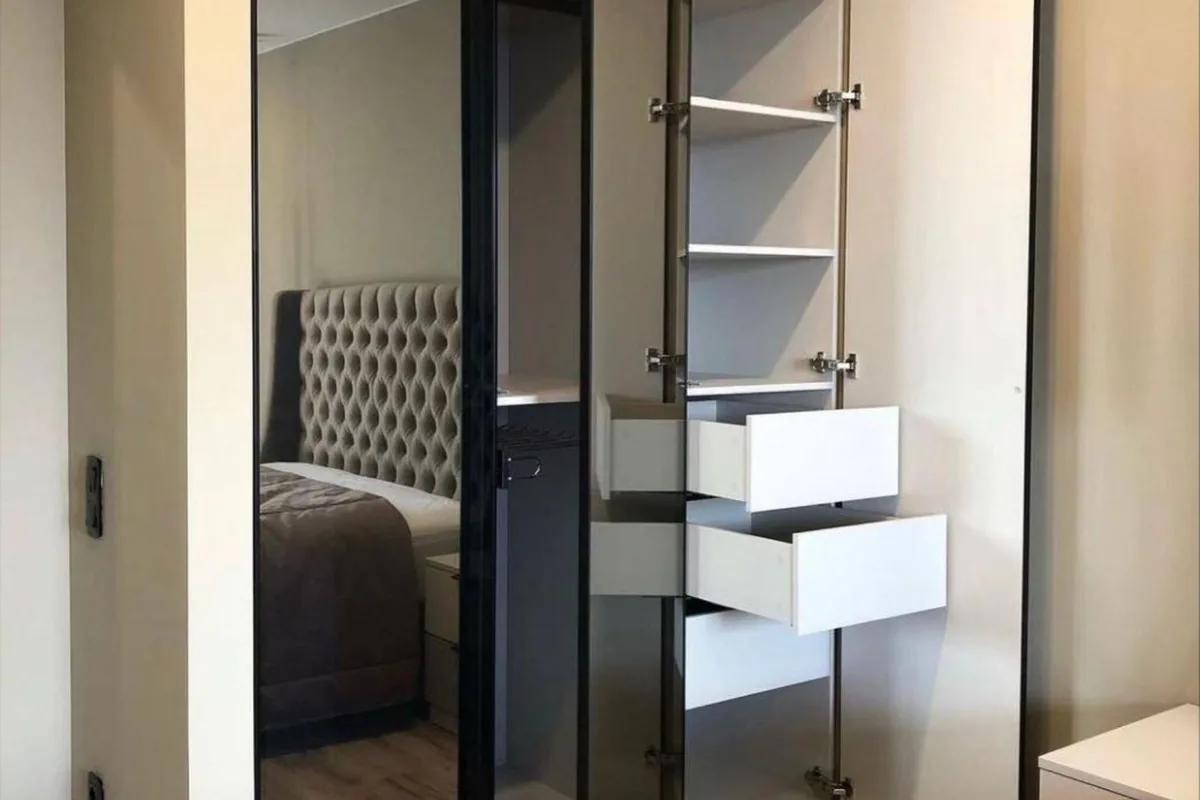
The interior is designed together with the doors. With sliding doors, the internal partitions should line up with the joins between the fronts, and drawers must not hit the door profile. We explain how to handle this in our article on a sliding wardrobe for an alcove. Sliding and hinged doors are compared in the article on wardrobe and walk-in doors. If you want to check a layout like this on your own wall, you can book a measurement.
A wardrobe for two, for a child and for the change of season
A wardrobe for two. The simplest option is to split it into two parts with separate sections rather than mixing things on one rail. Each part gets its own list and its own heights. The upper rail in each part is fixed to suit its owner's height.
A child's wardrobe. For a small child the lower rail goes at about 76 cm. As the child grows, a section with adjustable shelves and a rail that can be moved higher comes in handy.
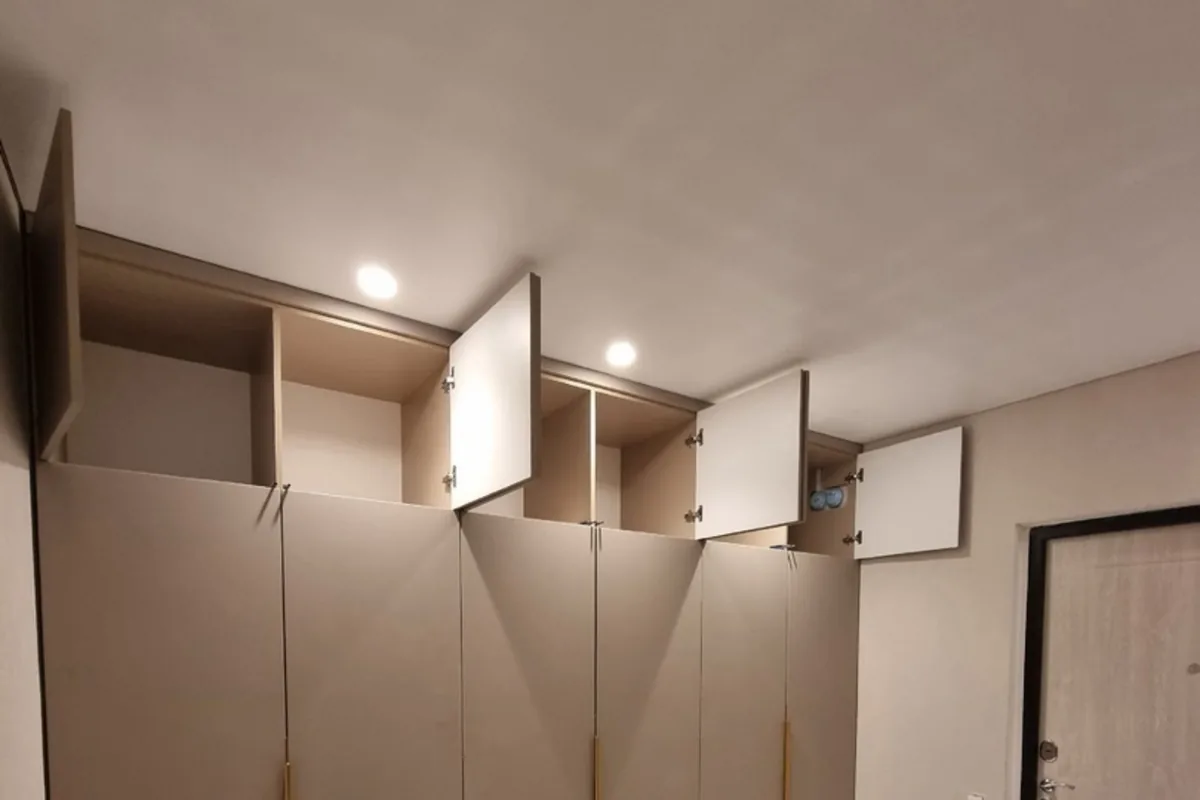
Seasonal items. Winter jackets and summer dresses do not need to hang in the middle of the wardrobe all year. When the season changes, items from the rail move up to the top level in labelled boxes or bags. In a hallway wardrobe with gold handles, building up to the ceiling added an extra level for suitcases and seasonal things. The hanging sections there have two rails one above the other, so jackets and shirts hang on two levels.
When a wardrobe is no longer enough. If your list adds up to more than a few metres of rail, consider a separate room. We cover walkway sizes, layouts and shoe zones in the article on a walk-in wardrobe.
A hallway wardrobe works a little differently from a bedroom one. Every day it takes jackets and shoes, often wet. These need hangers and somewhere to dry, and a closed wardrobe must be ventilated. How to fit one into a narrow corridor is covered in our article on a small, narrow hallway.
What to prepare before the wardrobe is measured
A made-to-measure wardrobe makes sense when the interior is designed around your own list of things. Ready-made modules have fixed widths and rail heights. A wardrobe built for an alcove is divided according to the centimetres in the tables above.
Before the measurement, prepare three things.
- A list of clothes in the five groups, with the number of hanging items.
- The length of your longest coat or dress, measured with the hanger.
- A list of what else has to fit besides clothes: suitcases, bedding, a vacuum cleaner, an ironing board.
The cost of a wardrobe depends on several things. Width and height of the built-in unit and the number of fronts matter. Much depends on the interior fittings: drawers, pull-out shelves, trouser racks and pull-down rails. Then come the door type and the front material.
We have been making custom furniture for more than 15 years and have completed over 300 projects. Laser measurement is free of charge. After it, we prepare a design with a visualisation and a quote, and the price is written into the contract. Production usually takes 2–4 weeks, and the exact date is set in the contract. More about how we work is on the custom furniture for home page. Once your list is ready, you can book a measurement.
This article is for information and describes solutions as of November 2026. The heights and gaps given are values used in practice, adjusted to the height of the household members and their clothes.
Frequently asked questions
How do you organise a small wardrobe?
In a small wardrobe every centimetre of height counts. Two rails one above the other hold twice as many short items as one. The overhead level under the ceiling is for seasonal things, and drawers replace deep shelves at the bottom. Out-of-season items are best moved higher up or elsewhere.
How deep should a wardrobe for clothes be?
A wardrobe for coats and jackets on hangers needs about 60 cm of internal depth, because a men's jacket hanger is 42–45 cm wide and a women's one 38–40 cm, plus the bulk of the garment. For blouses and summer dresses, 50–55 cm is enough. Where space is tight, a shallow wardrobe about 35 cm deep holds folded items on shelves.
How do you organise a wardrobe with only shelves?
A wardrobe without a rail is organised with drawers, baskets and pull-out shelves. Shelves about 30 cm high hold folded items in low piles. If the shelves are 60 cm deep, split front and back with baskets that lift out whole. In a made-to-measure wardrobe, one section can later be converted to take a rail.
How do you keep a wardrobe tidy for longer?
Every group of items has a fixed place, and the things worn most often sit at hand and eye level. At each change of season, go through the wardrobe and give away what nobody wore. Drawer dividers keep small items from getting mixed up.