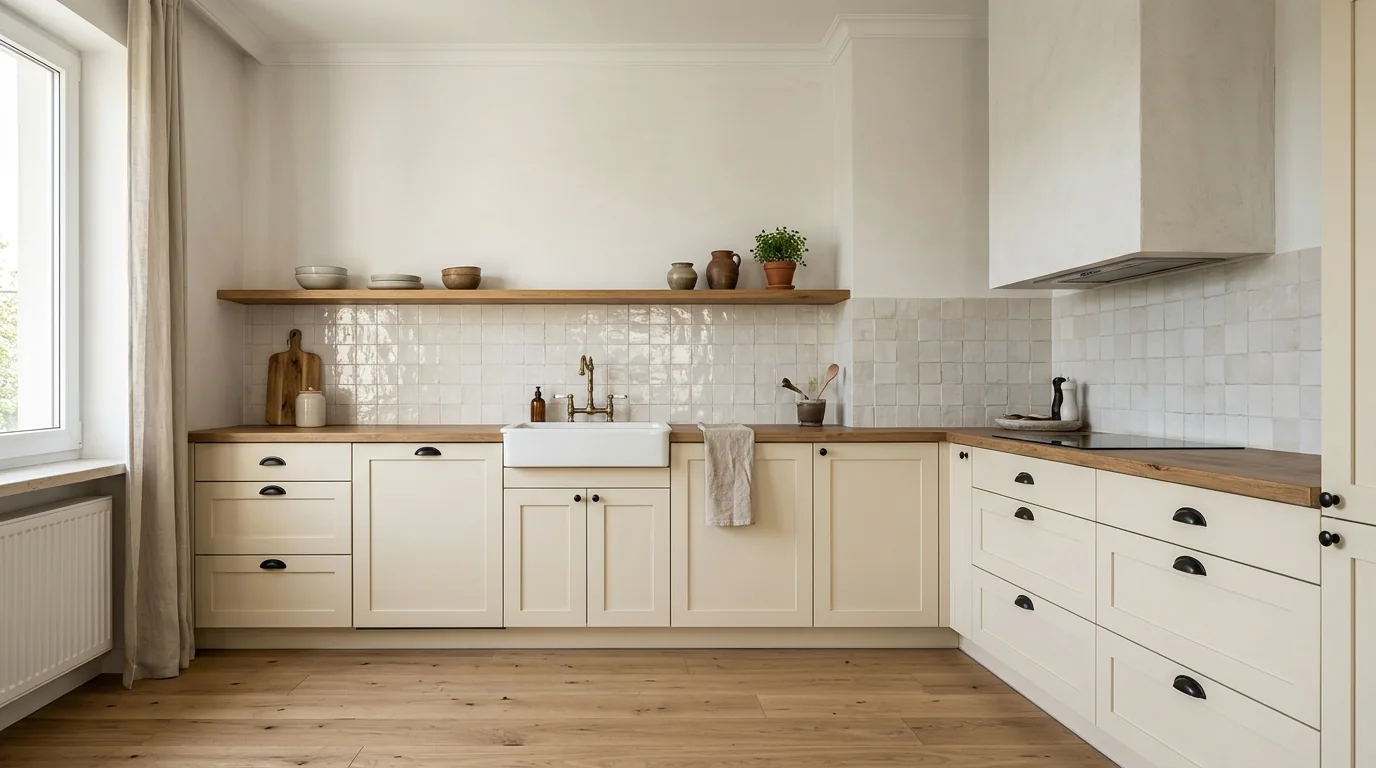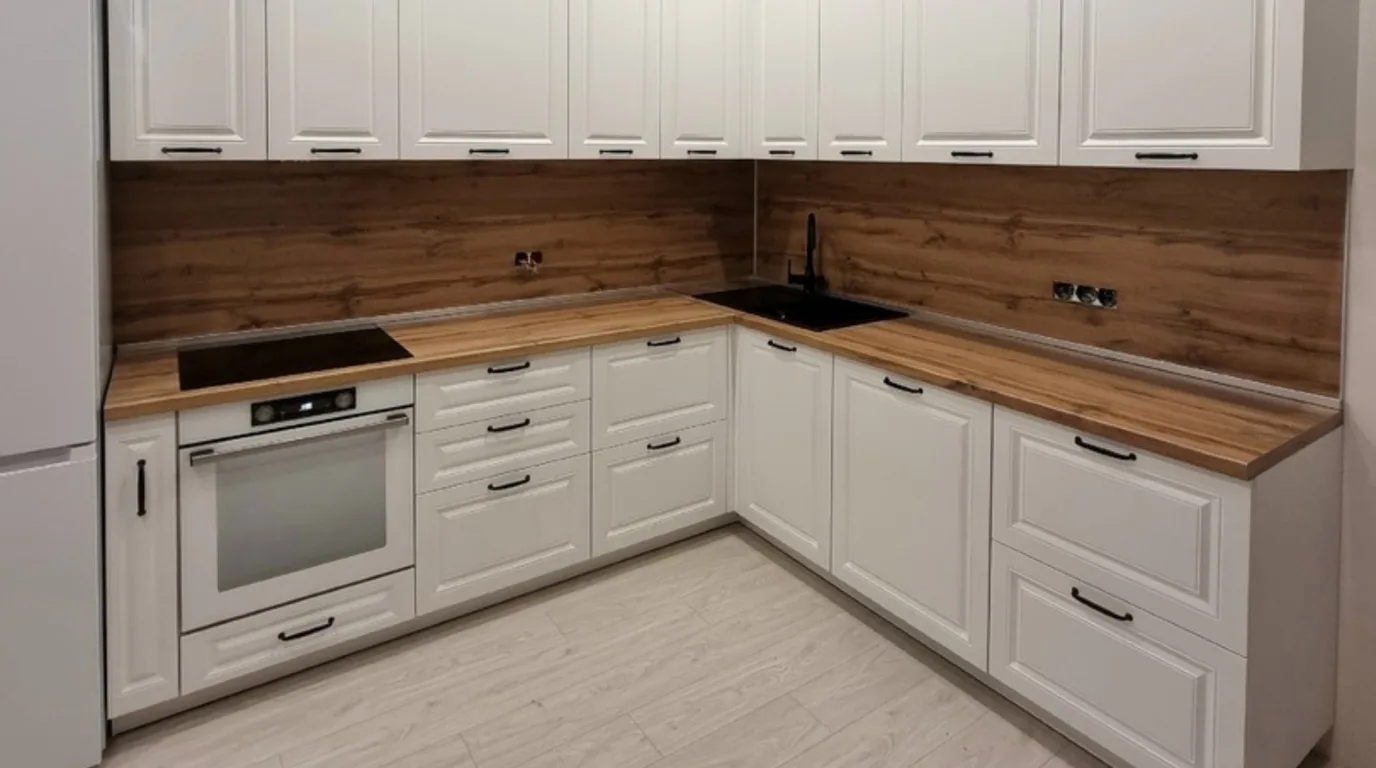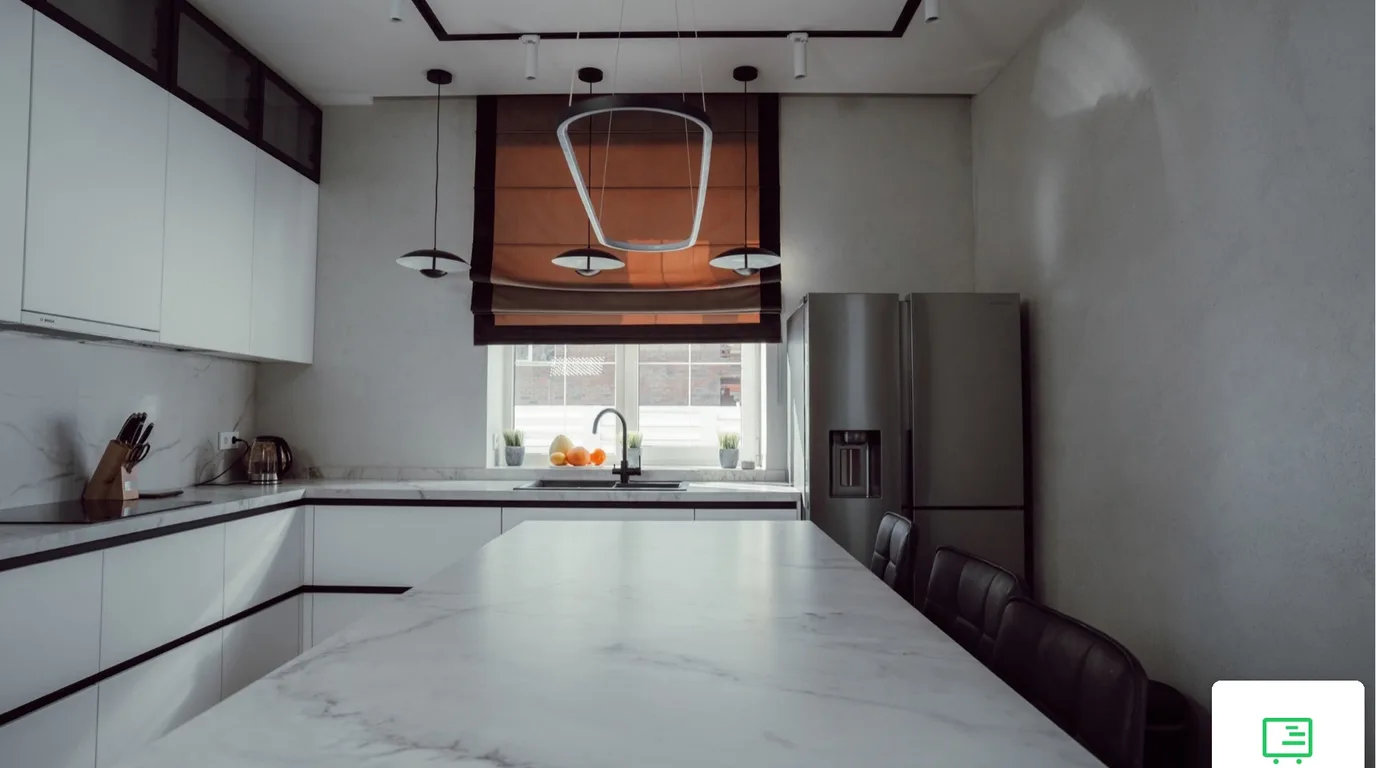
A wooden kitchen looks best when the wood has a partner. Warm oak or walnut pairs well with graphite, black, stone, concrete, metal or glass. The wood takes one zone, such as the base cabinets, tall units or a recess, and the second material keeps it in order. First, though, decide between solid wood, veneer and wood-effect board.
In this article
- Solid wood, veneer or wood-effect board
- Where wood goes in a kitchen and where another material does
- Wood with graphite and grey
- Wood with black
- Wood with stone, engineered quartz and concrete
- Wood with metal and glass
- How to care for wood in a kitchen
- Bespoke wooden kitchen: what the cost depends on
- Frequently asked questions
A wooden kitchen looks best when the wood has a partner. Warm oak or walnut pairs well with graphite, black, stone, concrete, metal or glass. The wood takes one zone, such as the base cabinets, tall units or a recess, and the second material keeps it in order. First, though, decide between solid wood, veneer and wood-effect board.
These three materials look alike, but they handle water, light and years of use differently. Furniture veneer is usually a layer of wood about 0.6 mm thick glued onto a board. Solid wood moves as humidity changes, and it moves many times more across the grain than along it. Wood-effect board is a printed pattern on a panel. It does not move like wood, but it cannot be renewed by sanding either. This choice decides where wood can go in the kitchen and how you will look after it.
Solid wood, veneer or wood-effect board
"Kitchens made of wood" covers three different builds. Solid wood means fronts and worktops made of glued boards. Veneer is a thin sheet of real wood on MDF or particleboard. Wood-effect board is printed paper soaked in resin and pressed onto a panel. Here they are against the same criteria.
| Solid wood | Veneer | Wood-effect board | |
|---|---|---|---|
| What it is | glued boards of one species | wood sheet approx. 0.6 mm on a board | resin-soaked print on a board |
| Grain pattern | every board differs | every sheet differs | repeating |
| Moisture and temperature | moves, can warp and open gaps | as stable as the board beneath | as stable as the board beneath |
| Colour over the years | changes with light | changes with light | printed, no natural colour change of wood |
| Repair | sanding and refinishing | thin veneer only gently, thicker veneer can be sanded | the damaged part is replaced |
| Where it works in a kitchen | breakfast bar, shelves, fronts away from steam | fronts, tall units, recesses, panels | any zone, a sealed edge matters by the sink |
Solid wood wins on texture and on the fact that it can be renewed even after many years. It does have its demands, though. Glued-panel fronts need room for the material to move, and a board right next to the dishwasher gets a dose of steam every day. Veneer gives real grain on a stable board, so it works well on large areas of fronts and tall units. Wood-effect board copes best with heavy use, but up close you can see the pattern repeat.
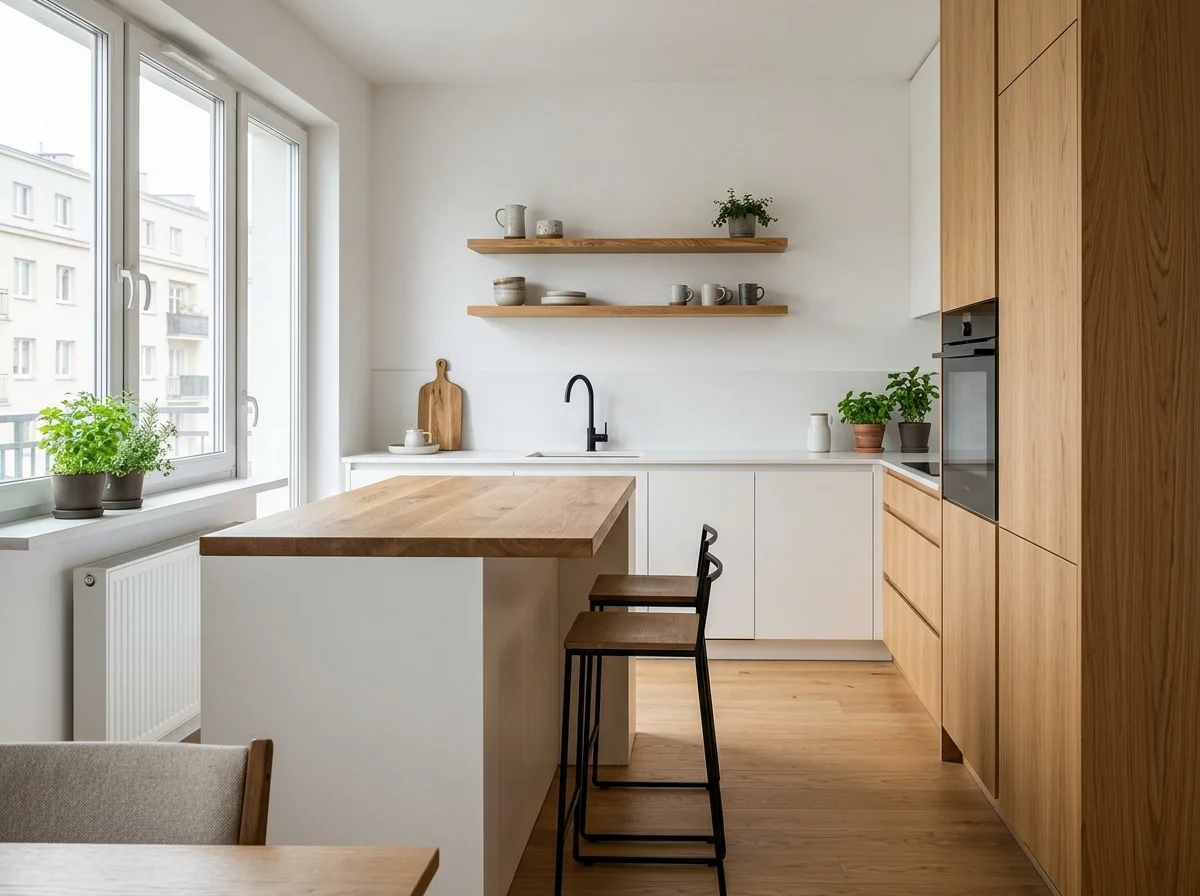 AI-generated
What veneer and wood-effect board are glued onto, and what the carcass is made of, we cover in the article on how MDF differs from particleboard.
One kitchen, several finishes. You do not have to choose one material for the whole kitchen. A common layout is wood-effect board or veneer on the fronts and solid wood only where it is touched, for example on a breakfast bar or shelves.
Where wood goes in a kitchen and where another material does
Wood is happiest where it is dry and does not get scrubbed. Tall units, recesses, base fronts away from the sink, shelves and a breakfast bar are safe places. The sink, dishwasher and hob zone calls for more care. There, wood-effect board, oiled or lacquered wood, or a different material altogether works better.
A practical split usually looks like this:
- Worktop by the sink and hob. Stone, engineered quartz or a stone-effect worktop. By the sink, wood works either oiled (easy to renew) or lacquered (copes better with water), but in both cases water is wiped up straight away.
- Front and worktop above the dishwasher. Steam from an open dishwasher settles on the underside and edge of the worktop above it. This is the place for a moisture-resistant material and for protective tape on the underside of the worktop.
- Base cabinets, tall units, recesses. Here wood, veneer or wood-effect board look their best and wear the least.
- Breakfast bar, shelves, table. The place for solid wood, because it is touched with a hand rather than a wet sponge.
How to choose the material for the work surface and the wall above it is covered in more detail in our article on the worktop and splashback.
Wood with graphite and grey
Graphite and grey are the safest partners for wood. A cool, matt colour calms the grain pattern, and wood warms up a dark surface. The rule is simple. The dark colour gets one zone, the wood gets another, and a light band between them helps separate the two.
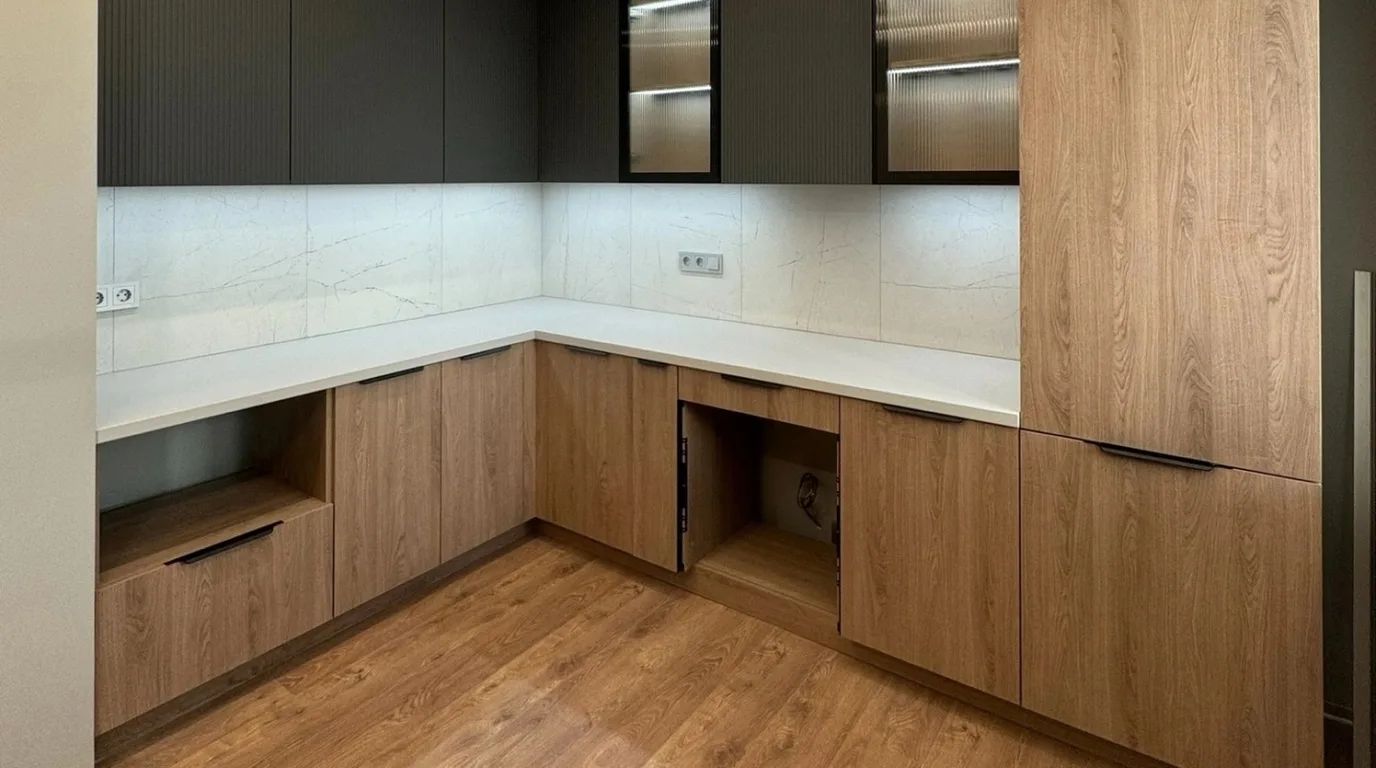
That is how our L-shaped graphite and wood-look kitchen came about. The brief was a dark kitchen that would not overwhelm the room. Graphite stayed only at the top, on matt fluted handleless fronts. The base cabinets and a tall unit up to the ceiling have smooth oak-look fronts. Between them runs a white worktop and a wall in a light marble effect.
Grey kitchen units with wood do not have to be dark. In our floor-to-ceiling kitchen with white gloss above, the bottom row is light grey and matt, because those fronts are touched most often and fingerprints show less. Wood appears in the block of tall appliance units, in a grey-brown oak effect. Grey and wood meet here in the shade itself, because the oak effect has a greyish tone of its own.
When pairing grey with wood, the undertone of both colours decides the result. The same graphite looks different next to honey oak than next to grey-brown oak. So it is worth looking at colours from the chart side by side, in the light of that particular kitchen, not on a screen.
Wood with black
Black with wood gives the strongest contrast, which is why it needs discipline. When whole walls of cabinetry are black, the wood should take a defined place. That can be a recess, a frame or a breakfast bar. Small wooden pieces scattered across the whole kitchen on a black background look random.
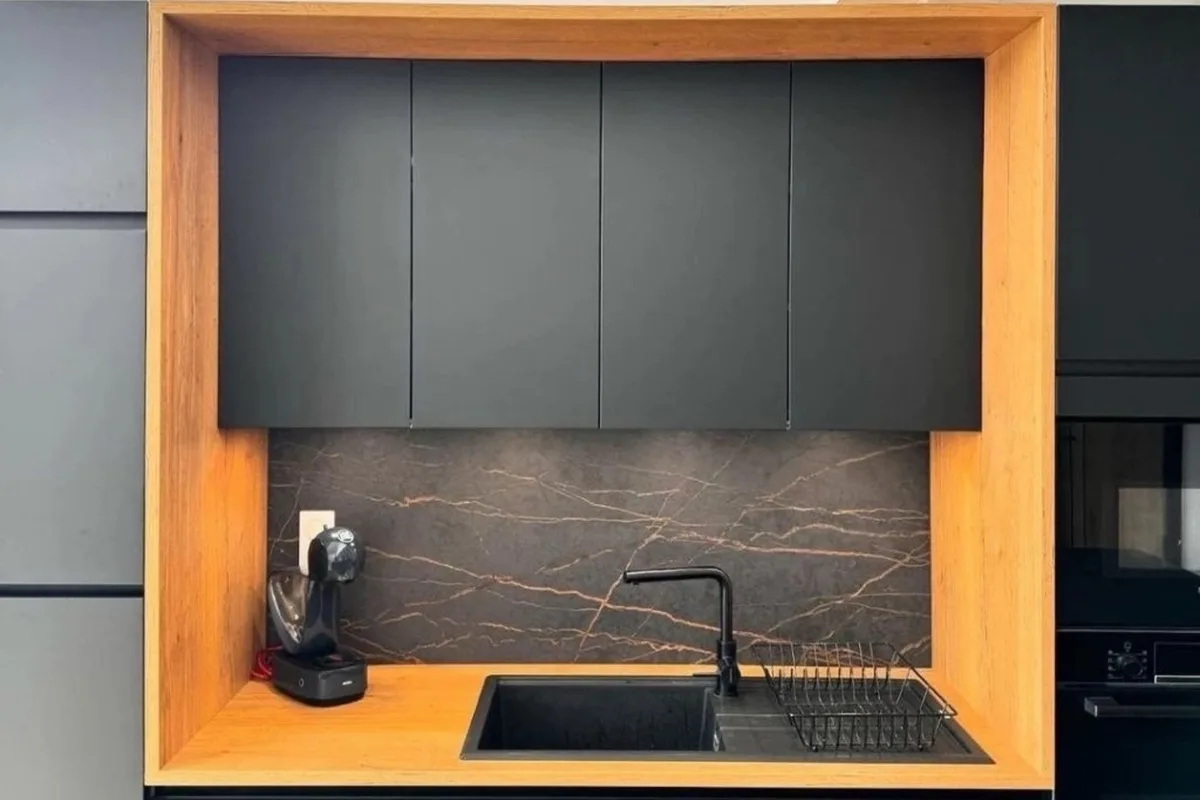
In our matt black open-plan kitchen, almost the entire wall is smooth black handleless fronts matching the window frames. We marked out the sink zone with a recess in an oak-look frame. The warm wood breaks up the black surface and shows at once where the water is in the kitchen. On the island, on the living room side, an oak-look top sits on a worktop in a dark stone effect. The result is a breakfast bar for three.
This example shows two ways of combining wood with black. Wood can form a portal in a dark wall or a separate layer on top of another material. In both cases it has a clear boundary and one function.
Matt black and handprints. Fingerprints show more clearly on matt black fronts than on wood. We describe the difference between matt and gloss in the article on matt and gloss kitchen fronts.
Wood with stone, engineered quartz and concrete
Stone and wood are a classic pair in which each material has its own role. Stone or engineered quartz takes the worktop, the water and the hot pans. Wood stays on the fronts. When choosing patterns, it helps to stick to one rule. If the wood has a strong grain, keep the stone calm, and vice versa.
In the kitchen with white gloss and oak-look tall units, the worktop and wall panel have a black marble effect with white veining. In the black kitchen, the island worktop has a dark stone effect with copper veining. There the wood is a calm oak effect, so the bold stone pattern does not compete with the grain. How to choose and care for such a worktop is covered in our separate article on engineered quartz.
Concrete, whether real or in the form of panels and effect boards, pairs with wood the same way graphite does. Too much concrete or metal makes a kitchen look stark. Wood and warm light restore the balance. Most often the concrete goes on the wall above the worktop or on the worktop, and the wood on the base fronts or the island.
Wood with metal and glass
Metal and glass lighten a wooden kitchen. A black profile, frame or base draws a thin line, and glass lets light in where a solid front would feel heavy. This pairing is familiar from loft style, but in a kitchen it also works in a calm, modern version.
Two examples from our portfolio show how it works in furniture. Our loft wardrobe with solid wood fronts has a black base made of square profile. Each door is a solid wood panel in its own metal frame. The frame holds the geometry of the tall doors, so the panel itself can be thin. The same thinking helps in a kitchen, where tall wooden fronts are exposed to changes in humidity. Our loft sideboard with perforated metal combines a black metal base, rustic oak-look fronts and black perforated sheet inserts.
Glass most often appears in display cabinets. In the graphite and wood kitchen, we built two display cabinets with fluted glass and lighting on every shelf into the run of wall cabinets. The glass blurs the contents, and in the evening the cabinets work like lamps. We write more about combining metal with wood in our guide to industrial and loft style.
The lightest pairing, white with wood, has its own article on the white kitchen with wood.
If you want to see which of these pairings will fit your kitchen, the easiest start is a measurement. Book a measurement, and afterwards we will match the materials to your floor and walls in a design with visualisation.
How to care for wood in a kitchen
Care depends on the finish, not only on the species. Oil soaks into the wood and does not form a film on it. Lacquer forms a film that stops water from soaking into the wood straight away. Wood-effect board needs neither.
Oiled wood. It looks good and is easy to repair locally. Sanding the damaged spot and applying oil again is enough. It handles stains less well, though, so spills should be wiped up straight away. An oiled kitchen worktop usually needs refreshing every few months; for the exact interval, follow the recommendations for the specific oil.
Lacquered wood. It copes better with water, vinegar, cleaning products and grease. It is also easier to keep up day to day. Lacquer can be sensitive to hot pans, so trivets come in handy. A deep scratch cannot be fixed spot by spot, because the coating has to be sanded off and applied again.
Veneer. It is cared for like wood with the same finish. The thin layer of wood does not allow deep sanding, however. Thicker veneer, around 0.9–2.5 mm, can be sanded more than once.
Wood-effect board. It needs neither oil nor lacquer. A damaged surface cannot be renewed, though, so the whole part is replaced, for example one front.
Wood changes colour in light. Real wood and veneer change shade, also indoors and under a clear finish without a UV filter. Cherry darkens over time, while oak in strong sun turns yellow and slightly darker. With a kitchen by a window, keep this in mind when choosing the species and finish.
The colour change has a practical side too. An appliance or container standing in one spot on a wooden worktop for years will leave a mark in a different shade.
Bespoke wooden kitchen: what the cost depends on
The cost of wooden cabinetry depends above all on where real wood is used and where wood-effect board is. The same kitchen can be made in several material variants, and the price difference can be noticeable. Five things affect the result.
- Front material. Solid wood, veneer and wood-effect board are three different levels of cost and work.
- Species and finish. A rarer species and a multi-layer finish raise the price.
- Number and size of fronts. Tall solid wood fronts need a frame or another structure to hold their geometry.
- Worktop and the wall above it. Stone, engineered quartz, stone-effect board and wood are separate items in the quote.
- Metal and glass elements. Display cabinets, frames and bases are priced separately.
We give the exact amount after a free measurement, in a quote attached to the design with visualisation. The price goes into the contract. How we work step by step is shown on the custom furniture for the home page.
If you want to choose a pairing of wood and another material for your own interior, book a measurement.
This material is for information only and describes solutions as of November 2026. Care for a specific front and worktop depends on its finish, so always check the recommendations for that material.
Frequently asked questions
Is a wooden kitchen practical?
Yes, if the wood is kept away from steam and water or has a resistant finish. Lacquer handles water and cleaning products better, while oil is easier to repair locally. By the sink, dishwasher and hob, stone, engineered quartz or wood-effect board are more convenient.
How does veneer differ from wood-effect board?
Veneer is a thin layer of real wood glued onto a board. Every sheet has its own grain pattern and changes shade over time like wood. Wood-effect board is a resin-soaked print. Its pattern repeats, and a damaged part is replaced, because it cannot be sanded.
Which worktop suits wooden fronts?
Most often stone or engineered quartz with a calm pattern. They take the water and hot pans by the sink and hob. A wooden worktop is better kept for an island, a breakfast bar or a table, where there is no daily contact with water.
How do you match wood colour with the floor?
The fronts do not have to repeat the floor. It is enough for them to differ clearly from it in shade or pattern. The easiest way is to choose in person, holding a colour chart against the floor of that room.